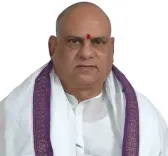
Dr. Jitendra Singh Highlights J&K Lavender's Global Reach
Synopsis
Union Minister Dr. Jitendra Singh spotlighted the international reach of lavender from Doda and Bhadarwah in Jammu and Kashmir, an outcome of the CSIR Aroma Mission that introduced certified cultivation and essential-oil distillation to shift Himalayan farmers toward high-value aromatic crops.
Key Takeaways
Jitendra Singh shared coverage on 29 May 2026 highlighting lavender from Doda and Bhadarwah reaching foreign markets.
The CSIR Aroma Mission , approved in 2016 and launched in 2017 , identified Jammu and Kashmir as a primary focus state for aromatic-crop promotion.
CSIR-IIIM Jammu introduced lavender planting material and distillation units in Doda and Bhadarwah between 2018 and 2020 .
On-farm distillation enables farmers to sell essential oil rather than raw flowers, improving per-acre income.
Lavender cultivation is part of a broader post- 2019 push for technology-led agricultural diversification across the Union Territory.
Updated production data and new buyer agreements from forthcoming trade events are the next measurable milestones to watch.
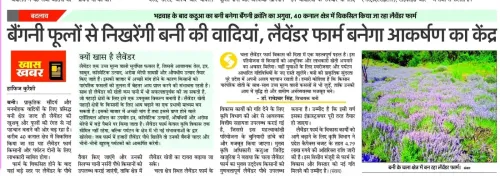
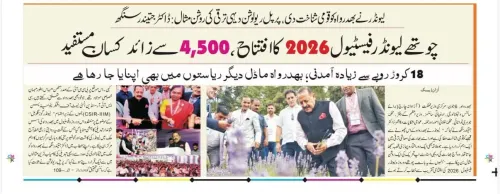
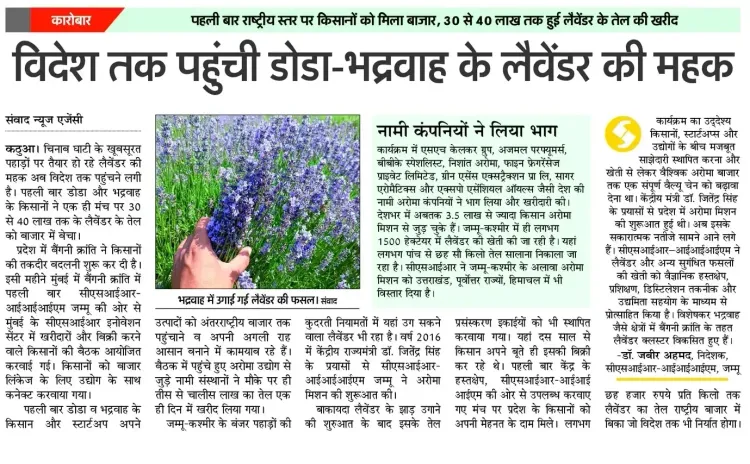
Union Science and Technology Minister Dr. Jitendra Singh on Friday, 29 May 2026 drew attention to the growing international footprint of lavender cultivation from Doda and Bhadarwah in Jammu and Kashmir, sharing a report headlined 'Videsh tak pahunchi Doda-Bhadarwah ke lavender ki mahak' ('The fragrance of Doda-Bhadarwah lavender has reached abroad').
Context
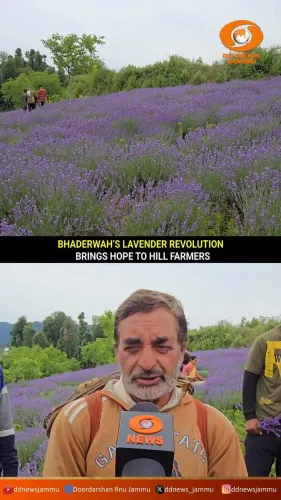
The post amplifies coverage of lavender farmers in Doda district whose produce has reportedly found buyers beyond Indian borders. Doda and the adjoining Bhadarwah valley have emerged as the most visible success stories of aromatic-crop promotion in the Himalayan belt, with lavender fields now a recognisable feature of the landscape during the summer harvest season.
The minister's decision to highlight this story fits a pattern of using social media to spotlight ground-level outcomes of centrally sponsored scientific missions, particularly those tied to Jammu and Kashmir's post-reorganisation economic integration.
Policy Backdrop
The cultivation push traces directly to the CSIR Aroma Mission, a national programme approved in 2016 and rolled out from 2017 with Jammu and Kashmir as a primary focus state. The mission is administered by the Council of Scientific and Industrial Research and targets high-value aromatic and medicinal plants as alternatives to low-yield subsistence crops.
Between 2018 and 2020, scientists from CSIR-IIIM Jammu introduced certified lavender planting material and small-scale distillation units in Doda and Bhadarwah blocks, enabling farmers to produce essential oil rather than selling raw flowers at depressed prices. This value-addition step is considered central to making export linkages commercially viable.
Central scientific agencies have pursued a broader strategy of shifting Himalayan districts away from subsistence agriculture toward high-value aromatic and medicinal plants. Lavender in Jammu and Kashmir has become a flagship example of this technology-led agricultural diversification drive, particularly since 2019 when the Union Territory's administration placed renewed emphasis on economic self-sufficiency.
Stakeholders and Impact
The primary beneficiaries are smallholder farmers in Doda and Bhadarwah who have transitioned to lavender as a cash crop. Access to distillation infrastructure means growers can sell processed essential oil rather than bulk plant material, substantially improving per-acre returns.
Aromatic-crop exporters and fragrance-industry buyers form the downstream stakeholder group. Export linkages, if sustained, would embed Jammu and Kashmir lavender into global supply chains for perfumery, cosmetics, and pharmaceutical applications — markets where consistent quality and traceability command premium pricing.
What's Next
The CSIR Aroma Mission is expected to release updated area and production data that would quantify the scale of cultivation expansion across the Union Territory. Trade events and state-level review meetings in the coming months could yield formal buyer agreements that consolidate the export momentum flagged in the minister's post.
Sustained international demand would strengthen the case for additional processing infrastructure and cold-chain investment in Doda and Bhadarwah, potentially drawing private-sector partners into a segment that has so far been driven largely by public scientific institutions.
Point of View
If backed by verifiable trade data, could become a template argument for scaling aromatic-crop clusters into other underserved Himalayan districts.
NationPress
14 Oct 2026
Frequently Asked Questions
What is the CSIR Aroma Mission and how does it help farmers in Jammu and Kashmir?
The CSIR Aroma Mission is a national programme run by the Council of Scientific and Industrial Research to promote high-value aromatic crops. In Jammu and Kashmir it introduced lavender cultivation and essential-oil distillation units, particularly in Doda and Bhadarwah, giving farmers a more profitable alternative to traditional subsistence crops.
Why is Doda and Bhadarwah lavender in the news?
Union Minister Dr. Jitendra Singh highlighted on 29 May 2026 that lavender from Doda and Bhadarwah in Jammu and Kashmir has reached international markets, signalling export-level demand for the essential oil produced there.
When did lavender farming start in Doda and Bhadarwah?
CSIR-IIIM Jammu introduced certified lavender planting material and distillation infrastructure in Doda and Bhadarwah blocks between 2018 and 2020 under the CSIR Aroma Mission.
How does lavender essential oil benefit J&K farmers compared to selling raw flowers?
Farmers with access to distillation units can sell processed lavender essential oil rather than bulk raw flowers, which commands significantly higher prices in perfumery, cosmetics, and pharmaceutical markets.
What are the next steps for J&K lavender exports?
Analysts are watching for updated area and production data from the CSIR Aroma Mission and any formal buyer agreements expected to be announced at upcoming trade events or state-level review meetings.