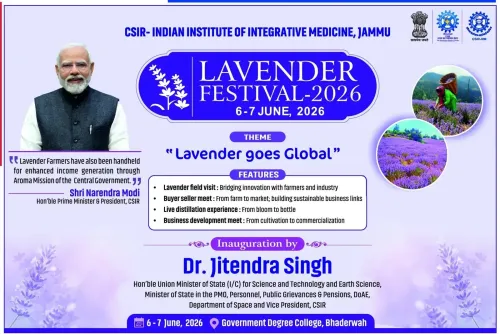
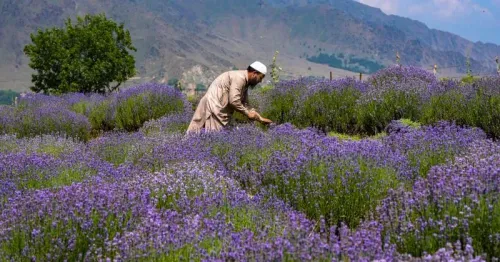
Dr. Jitendra Singh Highlights J&K Purple Revolution
Synopsis
Union Science and Technology Minister Dr. Jitendra Singh has highlighted the Purple Revolution on 29 May 2026, spotlighting CSIR-led lavender cultivation in Jammu and Kashmir. The initiative, rooted in the CSIR Aroma Mission launched in 2016, has transformed hilly districts like Doda and Kishtwar into high-value aromatic crop zones.
Key Takeaways
Union Science and Technology Minister Dr.
Jitendra Singh posted about the Purple Revolution on 29 May 2026 , amplifying the lavender farming initiative in Jammu and Kashmir .
The Purple Revolution is anchored by the CSIR Aroma Mission , launched in 2016 , which promotes aromatic and medicinal crop cultivation across India.
CSIR-IIIM Jammu developed high-yielding lavender varieties and transferred cultivation technology to farmers in districts such as Doda and Kishtwar .
Lavender offers farmers a high-value, wildlife-resistant alternative to subsistence crops, with essential oil commanding strong domestic and export prices.
The initiative aligns with Atmanirbhar Bharat goals and has spawned downstream industries including essential-oil distillation and agri-tourism in the Union Territory.
Further expansion of lavender clusters and possible inclusion under the National Mission on Medicinal and Aromatic Plants are being watched by policy observers.
Union Science and Technology Minister Dr. Jitendra Singh on Friday, 29 May 2026, drew fresh attention to the Purple Revolution — the government-backed initiative transforming lavender cultivation across Jammu and Kashmir — through a post on X that has reignited public interest in the science-led agricultural shift in the Union Territory.
Context
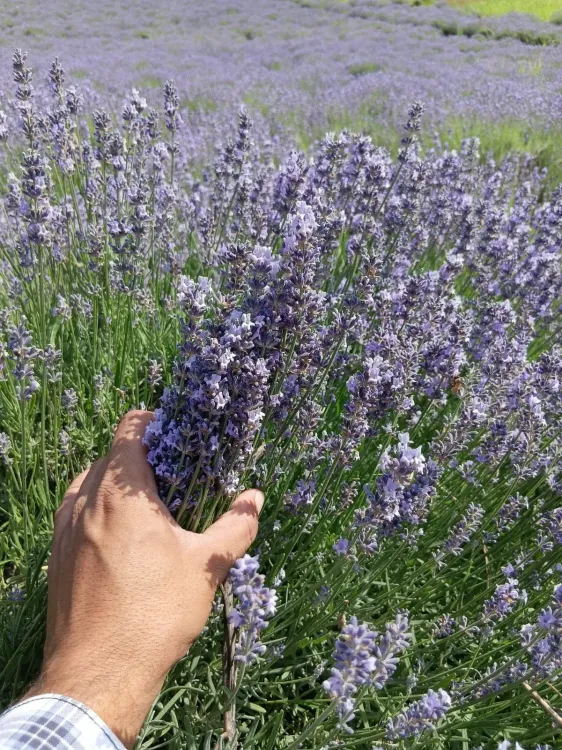
The Purple Revolution is a colloquial name for the large-scale push to introduce lavender farming in the hilly districts of Jammu and Kashmir, particularly in areas such as Doda and Kishtwar. The initiative draws its colour-coded identity from the distinctive violet blooms of the lavender plant, which has emerged as a high-value aromatic crop capable of replacing subsistence agriculture in rain-fed, mountainous terrain. Dr. Singh has been among the most vocal central ministers championing this transformation, repeatedly linking it to the broader promise of science reaching the grassroots.
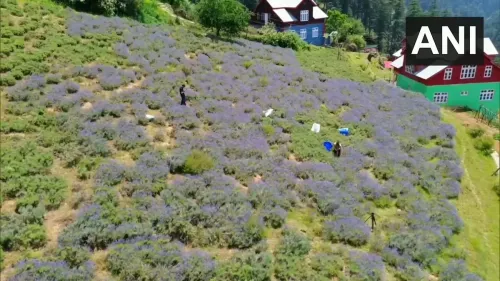
The post, carrying the hashtags #PurpleRevolution and #JammuAndKashmir, was accompanied by an image, reinforcing the visual identity that the campaign has cultivated over several seasons of successful harvests and farmer testimonials.
Policy Backdrop
The scientific engine behind the Purple Revolution is the CSIR Aroma Mission, launched by the Council of Scientific and Industrial Research (CSIR) in 2016 to scale up cultivation of aromatic and medicinal crops for essential oil production and value addition across India. The nodal laboratory driving lavender work in the region is CSIR-IIIM Jammu — the Indian Institute of Integrative Medicine — which developed high-yielding lavender varieties and transferred the cultivation technology directly to farmers under a lab-to-land model.
Following the administrative reorganisation of Jammu and Kashmir in 2019, the Ministry of Science and Technology intensified its engagement with the Union Territory, using CSIR's network to accelerate the roll-out of aromatic crop clusters. The initiative sits at the intersection of Atmanirbhar Bharat, rural livelihood enhancement, and the government's stated goal of doubling farmer income through non-traditional, high-margin crops.
Stakeholders and Impact
The primary beneficiaries of the Purple Revolution are Jammu and Kashmir farmers in hilly and semi-arid belts who previously had limited commercial crop options. Lavender cultivation offers a relatively low-input, high-return alternative: the essential oil extracted from lavender flowers commands strong prices in domestic and export markets, and the crop is naturally resistant to wildlife depredation — a persistent problem in the region's upland farming communities.
Beyond primary growers, the ecosystem supports essential-oil distillation units, agri-entrepreneurs, self-help groups, and downstream fragrance and pharmaceutical industries that source raw material from the region. The Purple Revolution has also generated a tourism and agri-experience economy, with lavender fields attracting visitors during the bloom season, creating supplementary income for local communities.
What's Next
Policy watchers will look for further expansion of lavender clusters into new districts, the commissioning of additional essential-oil processing units, and a possible formal inclusion of lavender under the National Mission on Medicinal and Aromatic Plants. Dr. Singh's continued social-media amplification of the Purple Revolution signals that the Ministry intends to keep the initiative in the national spotlight, likely ahead of the upcoming lavender bloom and harvest season in the Union Territory. The trajectory suggests that Jammu and Kashmir's aromatic agriculture story is far from its final chapter.
Point of View
A region that carries outsized political significance for the BJP-led government. By linking CSIR's lab-to-land work with a visually compelling, hashtag-friendly campaign, the Ministry of Science and Technology has managed to generate public resonance for what is, at its core, an agricultural extension programme. The timing also fits a broader pattern: ahead of each lavender season, central ministers and the CSIR ecosystem amplify success stories to sustain farmer uptake and attract private-sector investment into essential-oil value chains. The Purple Revolution thus serves simultaneously as a development story, a post-2019 J&K narrative, and a soft-power symbol of science-led national integration.
NationPress
12 Oct 2026
Frequently Asked Questions
What is the Purple Revolution in Jammu and Kashmir?
The Purple Revolution refers to the government-backed initiative to promote large-scale lavender cultivation in hilly districts of Jammu and Kashmir, such as Doda and Kishtwar, using technology developed by CSIR-IIIM Jammu under the CSIR Aroma Mission.
What is the CSIR Aroma Mission?
The CSIR Aroma Mission is a national initiative launched by the Council of Scientific and Industrial Research in 2016 to expand cultivation of aromatic and medicinal crops, including lavender, for essential oil production and rural income enhancement across India.
How does lavender farming benefit J&K farmers?
Lavender is a high-value, low-input crop that is naturally resistant to wildlife depredation. Farmers in hilly regions earn premium prices from essential oil extraction, and the crop has also supported agri-tourism and downstream industries in the Union Territory.
What is CSIR-IIIM Jammu's role in the Purple Revolution?
CSIR-IIIM Jammu — the Indian Institute of Integrative Medicine — is the nodal laboratory that developed high-yielding lavender varieties and transferred cultivation technology directly to farmers in Jammu and Kashmir under a lab-to-land model.
What is next for the Purple Revolution in India?
Policy observers are watching for expansion of lavender clusters to new districts, commissioning of additional essential-oil processing units, and possible formal inclusion of lavender under the National Mission on Medicinal and Aromatic Plants.