Dr. Jitendra Singh highlights Kishtwar's Lavender Revolution
Synopsis
Union Minister Dr. Jitendra Singh has spotlighted Kishtwar's 'Lavender Revolution,' where CSIR Aroma Mission-backed cultivation of lavender on the Chenab Hills is transforming smallholder farming in Jammu and Kashmir into a high-value aromatic crop economy.
Key Takeaways
Jitendra Singh on 15 June 2026 pinned a feature on the 'Lavender Revolution' unfolding in Kishtwar , Jammu and Kashmir.
The CSIR Aroma Mission , launched in 2016 , underpins lavender cultivation in Kishtwar by providing planting material, distillation technology, and market linkages.
Kishtwar 's high-altitude terrain in the Chenab valley is climatically suited to lavender, making it a natural candidate for aromatic crop expansion.
Lavender farming offers smallholders significantly higher returns than traditional crops and creates downstream employment in essential oil processing.
The initiative is part of a broader post- 2019 push to extend centrally sponsored scientific schemes uniformly across the Jammu and Kashmir Union Territory.
Further expansion under CSIR-IIIM Jammu and new processing units in the Chenab valley are being watched as potential next steps.
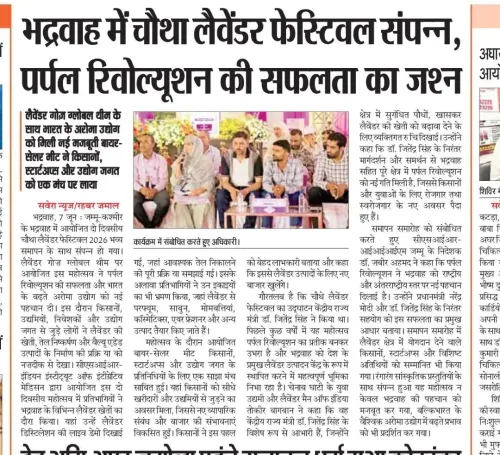
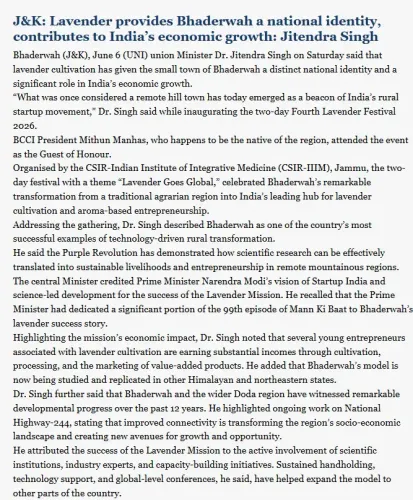
Union Science and Technology Minister Dr. Jitendra Singh on Monday, 15 June 2026 drew attention to the growing lavender cultivation movement in Kishtwar, sharing a feature on what is being called the 'Lavender Revolution' in the Chenab Hills of Jammu and Kashmir.
Context
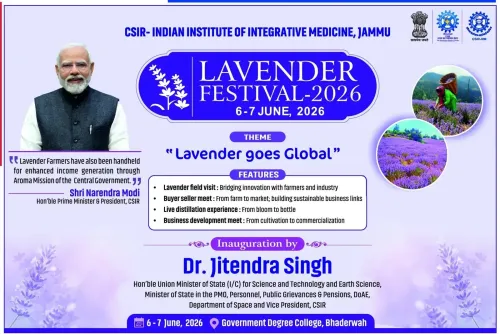
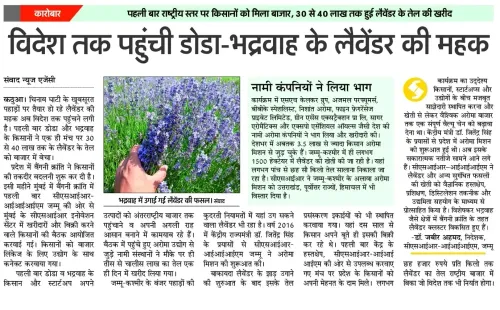
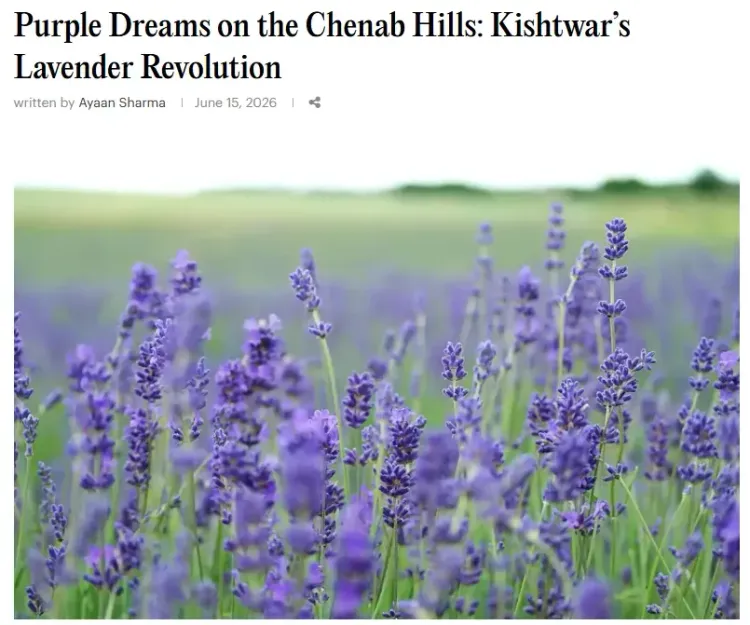
The minister pinned a piece titled 'Purple Dreams on the Chenab Hills: Kishtwar's Lavender Revolution,' highlighting how farmers in the high-altitude Kishtwar district are turning to lavender as a high-value alternative to traditional low-return crops. The Chenab valley's climate and terrain have made it a natural fit for aromatic crop cultivation, and the visual of purple lavender fields across the hills has become a symbol of agrarian change in the region.
Kishtwar, long known for its saffron and other mountain produce, is now drawing attention as a hub for aromatic farming — a shift that carries both economic and ecological significance for local communities.
Policy Backdrop
The lavender push in Kishtwar is rooted in the CSIR Aroma Mission, launched in 2016 by the Council of Scientific and Industrial Research to expand cultivation of lavender, rosemary, and other aromatic plants across India, with a particular focus on Jammu and Kashmir. The mission provides farmers with planting material, distillation technology, and market linkages through institutions such as CSIR-IIIM Jammu.
Post-2019, with Jammu and Kashmir reorganised as a Union Territory, centrally sponsored scientific and agricultural schemes have been extended more uniformly across the region. The lavender initiative sits squarely within this broader push to integrate J&K's rural economy into national agricultural development frameworks.
Dr. Jitendra Singh, who holds independent charge of the Science and Technology and Earth Sciences ministries, has been a consistent advocate for deploying CSIR research to benefit farmers in Jammu and Kashmir — his home region — making his amplification of this story consistent with a long-standing ministerial priority.
Stakeholders and Impact
The primary beneficiaries of the Lavender Revolution are Kishtwar's smallholder farmers, many of whom previously depended on subsistence agriculture on difficult Himalayan terrain. Lavender cultivation offers significantly higher returns per unit of land compared with conventional crops, and the essential oil extracted from lavender commands strong domestic and export demand.
Aromatic crop clusters also create downstream opportunities in processing, distillation, and packaging — generating rural employment beyond the farm. Women farmers in particular have been noted as active participants in lavender cultivation programmes under the CSIR Aroma Mission across Jammu and Kashmir.
What's Next
Attention will now turn to whether the government announces further expansion of lavender clusters under CSIR-IIIM Jammu and whether dedicated essential oil processing units are set up in the Chenab valley in upcoming agricultural or budgetary plans. A scaling of the model from Kishtwar to other high-altitude districts of Jammu and Kashmir could deepen the aromatic farming belt and strengthen the Union Territory's position in India's growing essential oils sector.
As the 'Purple Dreams' narrative gains national visibility through ministerial amplification, the Lavender Revolution in the Chenab Hills may well serve as a template for science-led agricultural transformation in other remote Himalayan districts.
Point of View
A decade-old initiative, is being reframed here as a deliverable of the current dispensation's J&K policy — a pattern seen repeatedly with centrally sponsored schemes in the region. Broader replication of the Kishtwar model could test whether aromatic farming can scale beyond pilot clusters into a durable rural economy across Himalayan districts.
NationPress
13 Sept 2026
Frequently Asked Questions
What is the Lavender Revolution in Kishtwar?
The Lavender Revolution refers to the rapid adoption of lavender cultivation by farmers in Kishtwar district of Jammu and Kashmir, supported by the CSIR Aroma Mission, as a high-value alternative to traditional subsistence crops on Chenab Hills terrain.
What is the CSIR Aroma Mission?
The CSIR Aroma Mission is a national initiative launched in 2016 by the Council of Scientific and Industrial Research to promote cultivation of aromatic and medicinal plants — including lavender — across India, with Jammu and Kashmir as a key focus region.
Why is Kishtwar suitable for lavender farming?
Kishtwar's high-altitude location in the Chenab valley of Jammu and Kashmir provides the cool temperatures and well-drained soils that lavender requires, making it climatically comparable to lavender-growing regions globally.
What did Dr. Jitendra Singh post about Kishtwar lavender?
On 15 June 2026, Union Minister Dr. Jitendra Singh pinned a post on X sharing a feature titled 'Purple Dreams on the Chenab Hills: Kishtwar's Lavender Revolution,' highlighting the aromatic farming transformation in Jammu and Kashmir.
How does lavender farming benefit Kishtwar farmers?
Lavender offers significantly higher income per unit of land compared with conventional crops, and its essential oil has strong domestic and export demand; the crop also creates downstream employment in distillation and processing, benefiting rural communities including women farmers.