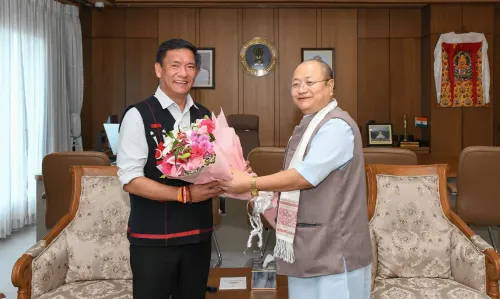
CM Pema Khandu backs ITA think tank for Arunachal Pradesh
Synopsis
Chief Minister Pema Khandu has expressed encouragement over progress toward establishing the Institute for Transforming Arunachal Pradesh, a dedicated state policy think tank. The move reflects a wider national shift toward state-specific strategic planning institutions, with the Northeast's border and connectivity priorities in focus.
Key Takeaways
Chief Minister Pema Khandu publicly backed progress on the Institute for Transforming Arunachal Pradesh (ITA) on 22 May 2026 .
The ITA is envisioned as a dedicated policy think tank for Arunachal Pradesh's long-term development and strategic planning.
NITI Aayog's 2015 establishment spurred states to build their own policy institutions; Arunachal Pradesh had earlier produced a State Vision 2030 document.
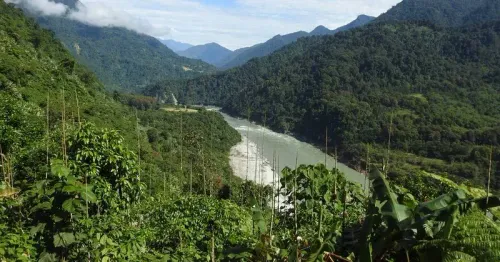
The state borders China , Myanmar , and Bhutan , making strategic, evidence-based planning especially significant.
Key milestones pending include the ITA's formal launch, governing council composition, and first policy outputs.
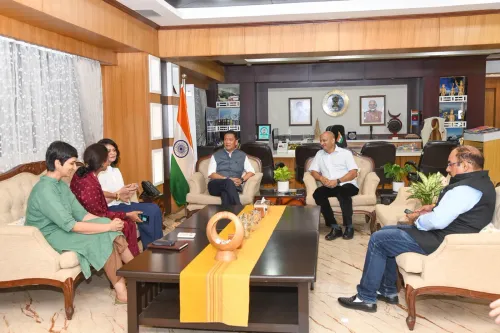
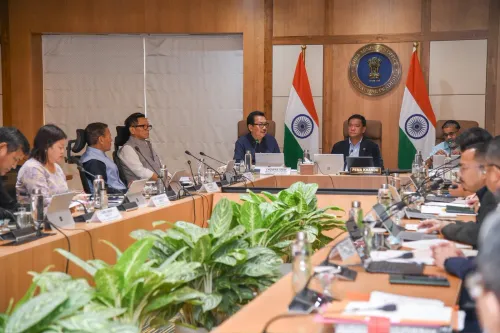
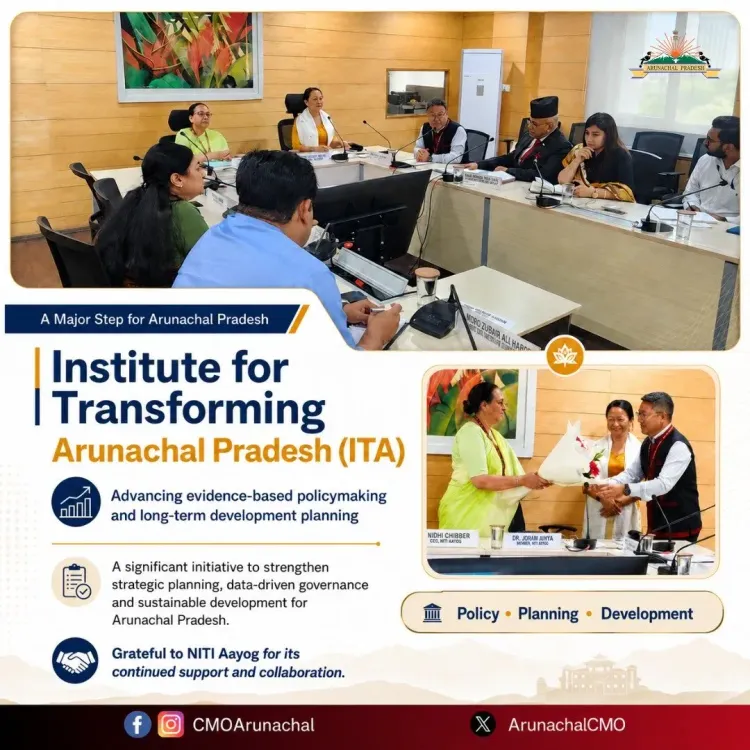
The Chief Minister's Office of Arunachal Pradesh announced on Friday, 22 May 2026 that Chief Minister Pema Khandu has expressed encouragement over progress towards establishing the Institute for Transforming Arunachal Pradesh (ITA), envisioned as a dedicated policy think tank for the state's long-term development and strategic planning.
Context
The ITA is conceived as a state-level institution to drive evidence-based policy formulation for Arunachal Pradesh, a strategically significant northeastern state sharing borders with China, Myanmar, and Bhutan. Chief Minister Khandu's public acknowledgement of the initiative's progress signals the administration's intent to move the proposal from concept toward operational reality. The CMO post described the institute as being 'envisioned as a dedicated policy think tank for the State's long-term development and strategic planning.'
Policy Backdrop
The ITA proposal draws from a broader national shift in governance architecture. When NITI Aayog replaced the Planning Commission in 2015, it actively encouraged states to build their own modern, data-driven policy institutions to complement central planning with region-specific strategies. Arunachal Pradesh had already signalled its intent in this direction through its State Vision 2030 document, produced around 2017, which laid out sectoral goals for the state's medium-to-long-term growth.
Across India, several states have since created or upgraded dedicated think tanks to tailor national schemes to local conditions. In the Northeast, such bodies have tended to prioritise border infrastructure, sustainable resource management, and integration with the Act East Policy framework — all areas of particular relevance to Arunachal Pradesh given its geographic and geopolitical position.
Stakeholders and Impact
The primary beneficiaries of a functional ITA would be state policymakers and development administrators who currently rely on ad hoc planning inputs for one of India's most complex frontier states. A dedicated think tank could systematically analyse data on connectivity gaps, demographic shifts, and resource utilisation to inform budget allocations and scheme design. Civil society organisations and local communities in border areas stand to benefit if the institute's outputs shape more targeted development interventions.
The institute could also serve as an institutional bridge between Arunachal Pradesh's state government and central bodies such as NITI Aayog, helping translate national priorities into locally actionable plans — a function that has historically been under-served in many northeastern states.
What's Next
The key milestones to watch are the formal launch notification for the ITA, the composition of its governing council, and the scope of its initial policy mandate. Observers will look for clarity on the institute's funding structure, its relationship with existing state planning bodies, and whether it will engage external academic or technical partners. The first substantive policy outputs from the ITA will be the clearest indicator of whether the institution can deliver on its founding ambition of transforming Arunachal Pradesh's development trajectory through strategic, evidence-led governance.
Point of View
But the frontier context gives it added geopolitical weight. Whether the ITA can move beyond an expression of intent to produce actionable policy will depend heavily on the calibre of its governing council and the independence it is granted from routine administrative pressures. The announcement also reflects CM Khandu's broader effort to position Arunachal Pradesh as a proactive governance actor, not merely a recipient of centrally-driven schemes.
NationPress
7 Oct 2026
Frequently Asked Questions
What is the Institute for Transforming Arunachal Pradesh (ITA)?
The ITA is a proposed state-level policy think tank for Arunachal Pradesh, designed to support long-term development planning and evidence-based strategic decision-making for the state government.
Why does Arunachal Pradesh need its own policy think tank?
Arunachal Pradesh has unique geographic, demographic and strategic characteristics — including borders with China, Myanmar and Bhutan — that require tailored policy analysis beyond what centralised national bodies can provide.
What is Pema Khandu's role in the ITA?
Chief Minister Pema Khandu, who has led Arunachal Pradesh since 2016, has expressed encouragement over the institute's progress, indicating active support from the state's top executive for its establishment.
How does the ITA relate to NITI Aayog?
NITI Aayog, set up in 2015 as India's central policy think tank, encouraged states to create their own planning institutions. The ITA follows this model, aiming to complement national frameworks with state-specific strategies.
What are the next steps for the Institute for Transforming Arunachal Pradesh?
Key steps include a formal launch notification, announcement of the governing council's composition, and the release of the institute's first policy outputs on state development priorities.