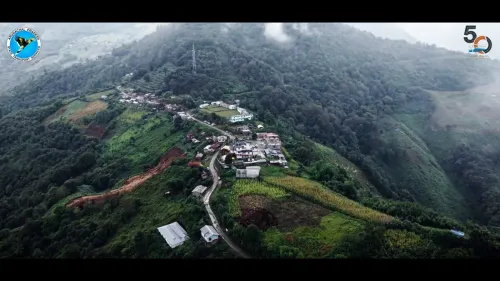
Arunachal CMO Marks 50 Years of APSTS Bus Services
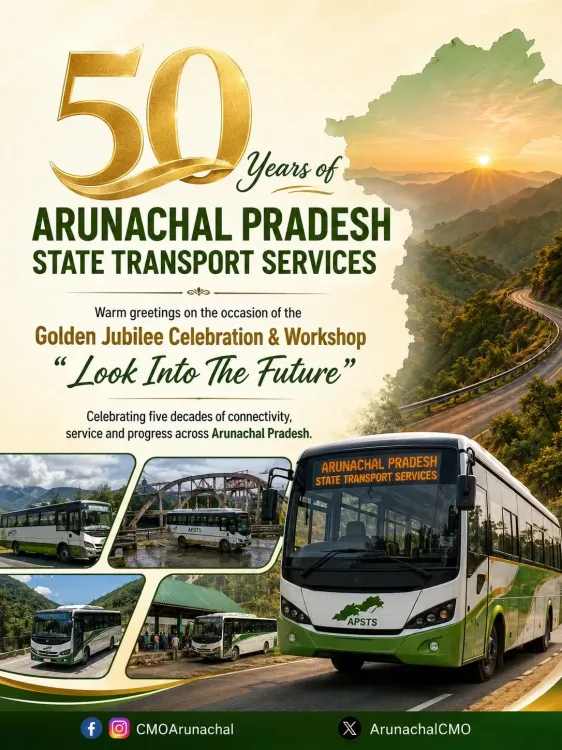
Synopsis
The Chief Minister's Office of Arunachal Pradesh marked the 50th anniversary of APSTS on 25 May 2026, recognising the state-owned bus service's vital role in connecting remote and tribal districts across the mountainous northeastern state.
Key Takeaways
The Chief Minister's Office of Arunachal Pradesh commemorated 50 years of APSTS on 25 May 2026 .
APSTS is the state-owned public bus operator serving remote and tribal areas of Arunachal Pradesh .
The state borders China , Myanmar , and Bhutan , making reliable transport a strategic as well as developmental priority.
Arunachal Pradesh was constituted as a Union Territory in 1972 , around which period state transport services were formally established.
The milestone coincides with accelerated national highway development across Northeast India .
Future focus areas include fleet modernisation and route expansion along new highway corridors.
The Chief Minister's Office of Arunachal Pradesh on Monday, 25 May 2026, extended warm greetings on the commemoration of 50 years of Arunachal Pradesh State Transport Services (APSTS), acknowledging the agency's decades-long role in linking remote and tribal regions of the state.
The official post stated: 'For decades, APSTS has played a vital role in strengthening connectivity and supporting development across the state, especially in remote regions.' The message marks a significant milestone for the state-owned public bus operator that has served as a lifeline for communities across Arunachal Pradesh's mountainous and often inaccessible districts.
Context
Arunachal Pradesh was constituted as a Union Territory in 1972, a move that enabled the formal creation of state-level transport institutions to bridge isolated tribal areas. APSTS emerged from that foundational period as the primary public bus operator tasked with connecting districts that private operators historically found commercially unviable. Spanning terrain that borders China, Myanmar, and Bhutan, the state presents some of the most logistically demanding operating conditions for any transport agency in the country.Policy Backdrop
Successive central and state governments have treated road and bus connectivity across Northeast India as both a development imperative and a strategic priority. The movement of people and goods through border districts carries significance beyond economics, touching on national security and the integration of tribal communities into the broader national mainstream. APSTS has operated within this framework, running routes that no purely commercial operator would sustain. The 50-year milestone arrives at a moment when accelerated national highway and road projects are reshaping the region's infrastructure landscape, potentially opening new corridors for the agency to serve.Stakeholders and Impact
The primary beneficiaries of APSTS operations are the remote and tribal populations of Arunachal Pradesh — communities for whom a reliable bus service can determine access to markets, schools, hospitals, and government offices. In districts where road conditions remain challenging and private transport is sparse, the state transport service functions as an essential public utility rather than a commercial enterprise. The 50th anniversary is therefore as much a recognition of the communities served as it is of the institution itself.What's Next
The commemoration is expected to draw attention to the agency's future trajectory. Observers will watch for announcements on fleet modernisation, route expansions into newly connected highway corridors, and potential integration with central schemes targeting Northeast India's transport infrastructure. As national highway projects continue to open previously inaccessible stretches of Arunachal Pradesh, APSTS will be under pressure to scale its operations to match improved road access and rising passenger demand in border districts.Point of View
Even as private mobility options expand. It fits a broader pattern in which northeastern state governments invoke transport history to build political legitimacy around infrastructure investment. The timing is notable: with national highway projects rapidly changing the region's connectivity map, the government appears to be positioning APSTS as a partner in, rather than a relic of, that transformation. The anniversary framing also quietly underscores the argument for continued public funding of a service that the market alone would not sustain in border districts.
NationPress
19 Sept 2026
Frequently Asked Questions
What is APSTS and what does it do?
APSTS stands for Arunachal Pradesh State Transport Services, the state-owned public bus operator that provides connectivity across remote and tribal districts of Arunachal Pradesh, including areas with little or no private transport.
How old is APSTS in 2026?
APSTS is commemorating 50 years of operations in 2026 , marking five decades of public bus services in Arunachal Pradesh.
Why is transport connectivity important in Arunachal Pradesh?
Arunachal Pradesh shares borders with China, Myanmar, and Bhutan and has mountainous terrain that makes road access difficult. Reliable transport is critical for tribal communities to reach markets, schools, and hospitals, and carries strategic importance for border district integration.
When was Arunachal Pradesh formed as a state?
Arunachal Pradesh was first constituted as a Union Territory in 1972 , which enabled the creation of formal state-level institutions including transport services for its isolated regions.
What are the future plans for APSTS?
While no specific announcements have been confirmed, the 50th anniversary is expected to prompt discussions on fleet modernisation, new route expansions, and integration with national highway corridors being developed across Northeast India.