Arunachal DCM Chowna Mein Chairs Excise Meet With Assam
Synopsis
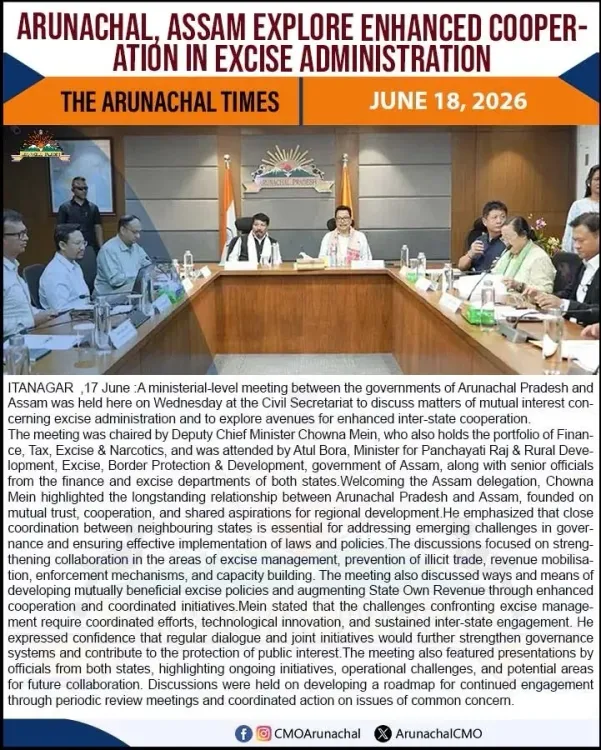
Deputy Chief Minister Chowna Mein chaired a ministerial-level bilateral meeting between Arunachal Pradesh and Assam on 18 June 2026, focusing on excise administration, revenue mobilisation, and inter-state enforcement coordination along their shared border.
Key Takeaways
Deputy CM Chowna Mein chaired the meeting, signalling high-level political commitment from Arunachal Pradesh .
The agenda covered excise administration, revenue mobilisation, enforcement, and inter-state coordination .
The bilateral format operates under state jurisdiction , giving any agreed protocols direct operational force.
Northeastern states have been incrementally deepening such bilateral ties since the North Eastern Council era beginning 1971 .
Stronger coordination is expected to reduce revenue leakages driven by cross-border regulatory arbitrage.
Follow-up enforcement protocols or joint task forces, if constituted, could serve as a regional template for other state pairs.
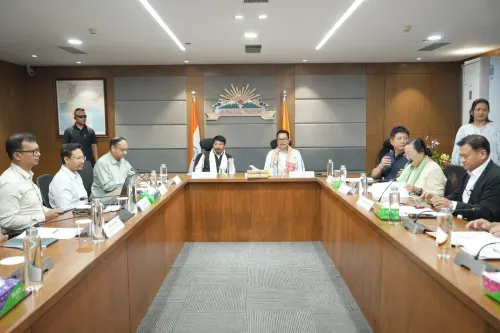
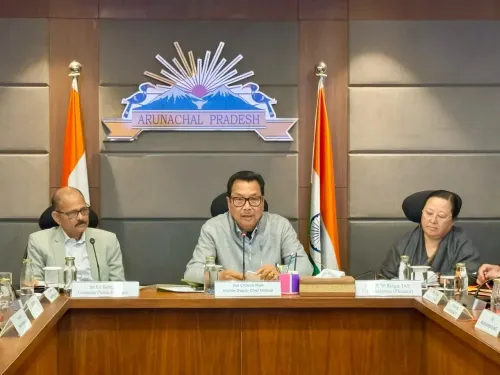
The Chief Minister's Office of Arunachal Pradesh announced on Thursday, 18 June 2026 that Deputy Chief Minister Chowna Mein chaired a ministerial-level meeting with Assam to deepen inter-state cooperation across excise administration, revenue mobilisation, enforcement, and cross-border coordination.
Context
The meeting brought together senior officials from both Arunachal Pradesh and Assam to address shared governance challenges along their common border. Excise administration and revenue leakages have long been pressure points for northeastern states, where porous inter-state boundaries complicate enforcement. The bilateral format signals a deliberate move toward structured, ministerial-level dialogue rather than ad-hoc coordination.
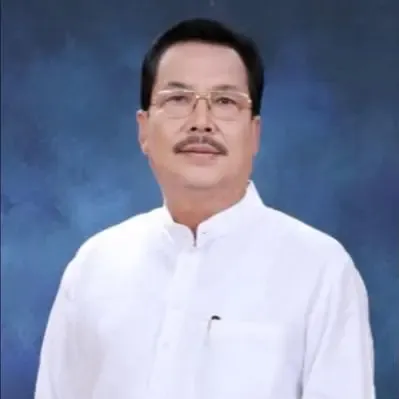
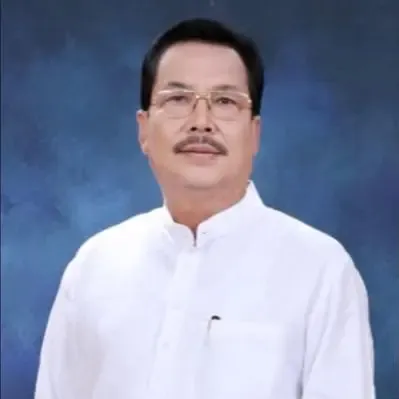
Chowna Mein, who holds the finance and planning portfolio in addition to his role as Deputy Chief Minister, was the natural convener for a meeting that spans both revenue and enforcement mandates. His chairing of the session underscores the political weight that Itanagar is placing on formalising these ties with its western neighbour.
Policy Backdrop
Inter-state administrative cooperation in the Northeast has a long institutional lineage, anchored by the North Eastern Council since its establishment in 1971. However, subjects such as excise remain firmly under state jurisdiction, meaning bilateral agreements between individual states carry more direct operational force than any central framework on these specific issues.
Northeastern states have incrementally expanded such cooperation on revenue, enforcement, and border management over recent years. Similar bilateral meetings between states in the region have previously addressed cross-border smuggling, illicit liquor trade, and resource-related offences — all of which erode state revenues and strain local law-enforcement capacity. The Arunachal Pradesh–Assam meeting fits squarely within this broader pattern of incremental, state-driven integration.
Stakeholders and Impact
The primary stakeholders are the excise and revenue departments of both states, along with enforcement agencies and border-district administrations. Stronger coordination is expected to reduce revenue leakages that arise when regulatory arbitrage — differences in excise duty rates or enforcement intensity — incentivises cross-border movement of goods. Border communities in both states stand to benefit from more consistent and predictable enforcement environments.
For Arunachal Pradesh, which has a relatively small revenue base and depends significantly on central transfers, improving own-tax revenue through tighter excise administration carries direct fiscal significance. Assam, with a larger and more diverse economy, brings greater institutional capacity to such partnerships, making the bilateral format mutually reinforcing.
What's Next
Observers will watch for follow-up announcements on agreed enforcement protocols, joint task forces, or shared data-exchange mechanisms that may emerge from the 18 June meeting. Any formal memoranda of understanding or revised revenue targets referenced in upcoming state budget documents or assembly debates would indicate how far the ministerial-level intent is translated into operational change.
If both states formalise joint enforcement mechanisms, it could serve as a template for other northeastern state pairs grappling with similar cross-border revenue and excise challenges — giving the meeting significance beyond the immediate Arunachal Pradesh–Assam bilateral.
Point of View
Which remains heavily dependent on central transfers, even marginal gains in excise enforcement carry outsized budget significance. The meeting also fits a wider Northeast governance arc: as states mature institutionally, they are increasingly bypassing slower multilateral forums and negotiating direct bilateral arrangements on state-list subjects. If the Arunachal–Assam model produces measurable outcomes, it could accelerate similar pairings across the region, quietly reshaping how northeastern federalism works in practice.
NationPress
17 Sept 2026
Frequently Asked Questions
Why did Arunachal Pradesh and Assam hold a meeting on excise administration?
The two states held a ministerial-level meeting to address shared challenges in excise administration, revenue mobilisation, and cross-border enforcement, where differences in regulatory frameworks can lead to revenue leakages for both states.
Who chaired the Arunachal Pradesh–Assam excise meeting in June 2026?
Deputy Chief Minister Chowna Mein of Arunachal Pradesh chaired the meeting, which took place on 18 June 2026 .
What is the role of Chowna Mein in Arunachal Pradesh?
Chowna Mein is the Deputy Chief Minister of Arunachal Pradesh and also holds the finance and planning portfolio, making him the key minister for revenue-related bilateral discussions.
How does inter-state excise coordination work in northeast India?
Since excise is a state-list subject under the Indian Constitution, northeastern states negotiate bilateral arrangements directly with each other. The North Eastern Council , established in 1971 , provides a broader multilateral forum, but specific enforcement protocols are agreed bilaterally.
What outcomes are expected from the Arunachal–Assam excise meeting?
Observers are watching for agreed enforcement protocols, possible joint task forces, and shared data-exchange mechanisms. Any formal agreements could also appear in state budget documents or assembly debates as revised revenue targets.