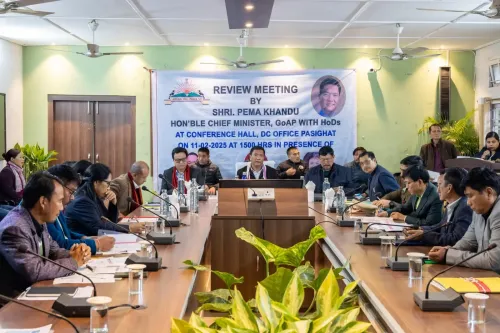
Chief Minister Pema Khandu Declares Arunachal Insurgency-Free, Pledges to Tackle Challenges Head-On
Synopsis
In a bold statement, Arunachal Pradesh's Chief Minister Pema Khandu declared the state free from homegrown insurgency, emphasizing the need for government accountability. He outlined plans to enhance police capabilities and address pressing security challenges, marking a significant step towards internal stability and development.
Key Takeaways
Arunachal Pradesh is free from homegrown insurgency.
The government must take responsibility for security challenges.
Police capabilities to be enhanced through training and technology.
Focus on internal security and public awareness through social media.
The Inner Line Permit system is being digitized to curb illegal immigration.
Itanagar, March 2 (NationPress) Arunachal Pradesh's Chief Minister, Pema Khandu, declared on Monday that the state is free from any indigenous insurgency. He underscored that any existing security or administrative obstacles must be proactively addressed by the government with a sense of accountability and determination.
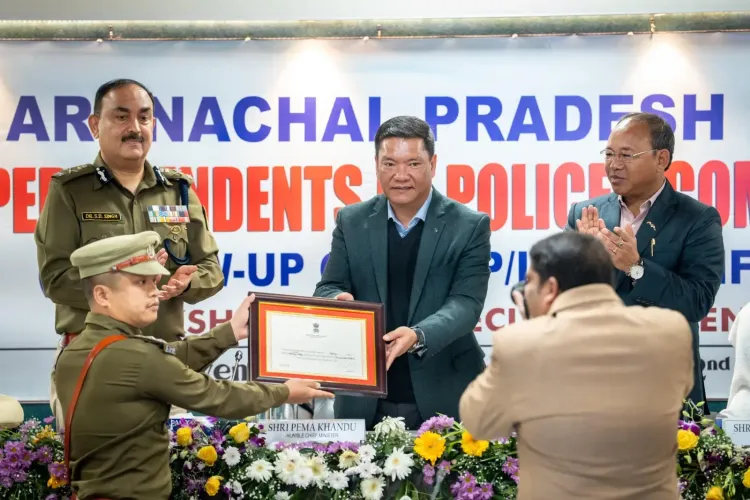
During the opening session of the state-level conference for Superintendents of Police and Commandants at the DK Convention Centre, Khandu stated: “We cannot rely solely on the Government of India for all our needs. This is our state, and we are responsible for resolving our issues.”
Khandu praised the Arunachal Pradesh Police for successfully thwarting attempts to revive insurgency under the guise of the United Tani Army (UTA). He urged for the enhancement of the Special Task Force, advocating for improved training, increased manpower, and better coordination with central armed forces, including the Assam Rifles.
He pointed out that Arunachal Pradesh, being the largest state in the Northeast, shares international borders with Bhutan and Myanmar, as well as a border with Tibet.
The Chief Minister emphasized the importance of accurate official nomenclature in communications and highlighted the need for vigilance along the Myanmar border, particularly in the districts of Tirap, Changlang, and Longding, where issues such as extortion and drug trafficking fueled by cross-border insurgent activities persist.
Khandu stressed the necessity for robust internal security, technology-driven policing, and a focus on conviction-oriented criminal justice. He remarked, “For more than a decade, Prime Minister Narendra Modi has provided decisive leadership to our country. We are advancing in various sectors. However, development and law enforcement must progress in tandem; without law and order, development cannot proceed.”
He advocated for bolstering cyber capabilities and digital forensics, recognizing technology as the future of law enforcement. Additionally, he emphasized activating the official social media channels of the Police Department to foster public awareness and transparency.
Proposing the establishment of a dedicated social media team under the Director General of Police, Khandu encouraged district Superintendents of Police to utilize official platforms judiciously. “The community should be informed of the commendable work undertaken by the police. Social media should be reserved for official communications, not personal use,” he asserted.
Recognizing the state's rich tribal diversity, he encouraged officers to grasp the unique social dynamics of each locality. “Inclusive governance necessitates structured dialogues with stakeholders. Arunachal’s diversity is a strength, but we must be sensitive to local nuances,” he remarked.
On the subject of illegal immigration, the Chief Minister updated that the Inner Line Permit (ILP) system, governed by the Bengal Eastern Frontier Regulation of 1873, is undergoing a technological upgrade and will soon be available in a digital format statewide. He stressed the importance of proactively addressing illegal immigration in the near future.
Referring to the newly introduced criminal laws under the guidance of the Prime Minister - Bharatiya Nyaya Sanhita, Bharatiya Nagarik Suraksha Sanhita, and Bharatiya Sakshya Adhiniyam - the Chief Minister described these changes as a significant transformation in India's criminal justice framework.
Khandu congratulated the state police for achieving 100% training coverage and implementing initiatives such as e-Suraksha, e-Summons, ICJS integration, and mobile forensic vans.
However, he highlighted the pressing need to transition from an arrest-centric to a conviction-centric approach in policing.
“Merely making arrests is insufficient. Our conviction rate is reportedly only around 30%. We must collaborate with the Law and Judiciary Departments to comprehend the reasons behind low conviction rates and address the shortcomings,” he urged, calling for collective brainstorming among police, legal, and judicial sectors.
He emphasized the importance of securing the “golden hour” for evidence preservation and enhancing the State Forensic Science Laboratory, including increasing manpower.
Stressing the significance of internal security in the quest for a developed Arunachal, the Chief Minister called for greater emphasis on modern criminal justice systems, AI-driven policing, cyber security, narcotics control, and the safety of women and children.
Khandu commended the Roing Police Station for being awarded the Best Police Station Award 2025, recognizing their adherence to national standards through effective policing, integrity, empathy, discipline, and the adoption of technology.
He lauded the Arunachal Pradesh Police for their accomplishments, which include the structured implementation of new criminal laws, the destruction of approximately 16,000 acres of illegal poppy and cannabis cultivation, the registration of numerous NDPS cases, significant narcotics seizures, and the dismantling of an inter-state vehicle theft syndicate.
“Arunachal has undergone significant transformation in the past decade. The Police Department has also received substantial support from the Government, and we will continue to fortify it further,” he assured. He added that recommendations arising from the conference would be supported by financial allocations in the forthcoming budget.
Welcoming the newly appointed DGP S.D. Singh Jamwal, whom he described as an experienced and dynamic officer with substantial experience from central deputation, the Chief Minister expressed confidence that under his leadership, the Arunachal Pradesh Police would achieve new milestones. He also expressed hope that the DGP would enjoy a stable and prolonged tenure to execute a clear vision for the force.
Reiterating that peace and stability are paramount, Khandu urged all officers to submit compliance reports promptly and to conduct similar orientation meetings at the district level to ensure effective implementation of the conference outcomes at the grassroots level.
Home Minister Mama Natung, Advisor to the Home Department Mutchu Mithi, Chief Secretary Manish Kumar Gupta, and newly appointed Director General of Police (DGP) S.D. Singh Jamwal, along with senior officers from the state police, CAPF, and civil administration officials, were present.
This conference was organized as a follow-up to the 60th All India Conference of DGPs held recently in Raipur, chaired by Prime Minister Narendra Modi.
Point of View
The statement by Arunachal Pradesh Chief Minister Pema Khandu signifies a pivotal moment in the state's governance. His emphasis on local accountability and proactive measures against security challenges reflects a commitment to ensuring stability and progress in an area marked by diversity and potential. This approach prioritizes community engagement and strategic police enhancement, essential for a safer and more developed Arunachal.
NationPress
13 Oct 2026
Frequently Asked Questions
What did Chief Minister Pema Khandu say about insurgency in Arunachal Pradesh?
Pema Khandu asserted that Arunachal Pradesh does not have any homegrown insurgency and emphasized the government's responsibility to address security challenges.
What initiatives did Khandu propose for the police?
He called for strengthening the Special Task Force, enhancing training and manpower, and improving coordination with central armed forces.
How does Arunachal Pradesh's geography affect its security?
Arunachal Pradesh shares international borders with Bhutan and Myanmar, which presents unique security challenges, especially concerning illegal immigration and drug trafficking.
What is the significance of the Inner Line Permit (ILP) system?
The ILP system is crucial for regulating entry into Arunachal Pradesh and is being upgraded to a digital format to better manage illegal immigration.
What changes are being made to the criminal justice system in Arunachal Pradesh?
New criminal laws are being introduced to transform the justice system, focusing on conviction-oriented policing and enhancing the effectiveness of law enforcement.