IMF: Gulf economies to shrink in 2026 as Hormuz closure bites
Synopsis
The IMF's October 2026 World Economic Outlook delivers a stark verdict: the Strait of Hormuz closure is erasing years of Gulf growth in a single year. Kuwait faces a 16.7% contraction, Iraq 16.0%, Qatar 15.6% — and the region as a whole tips negative for the first time in recent memory. The rebound is projected, but hinges entirely on a conflict resolution that is not yet in sight.
Key Takeaways
The IMF projects Middle East and Central Asia GDP at minus 0.3 per cent in 2026 , down from 3.7 per cent growth in 2025.
Kuwait (-16.7%), Iraq (-16.0%), Qatar (-15.6%), and Bahrain (-11.3%) face the steepest contractions due to disrupted energy output and transport.
The Strait of Hormuz carried roughly 20 million barrels of oil per day — about a quarter of global maritime oil trade — before the conflict.
Oil prices 'almost doubled' in early conflict months and remain 20–40 per cent higher than pre-war levels, according to the WEO.
Iran faces a 7.6 per cent contraction and 78.6 per cent inflation in 2026 amid military exchanges and enhanced sanctions.
India is explicitly excluded from medium-term downgrades, with its growth forecast raised to 7.0 per cent .
The International Monetary Fund (IMF) warned on Tuesday, 13 October 2026 that the ongoing war in the Middle East and the closure of the Strait of Hormuz will push the Middle East and Central Asia region into economic contraction this year, with several Gulf oil producers facing double-digit GDP declines. The projections appear in the IMF's October 2026 World Economic Outlook (WEO).
Regional Contraction: The Scale of the Shock
The IMF projected growth for the Middle East and Central Asia at minus 0.3 per cent in 2026, a sharp reversal from 3.7 per cent growth recorded in 2025. The Fund described this as a downward revision of 2.2 percentage points relative to its April projection, attributing the deterioration to 'a longer closure of the Strait of Hormuz, compared with the baseline assumptions in the April WEO.' A rebound to 6.3 per cent is projected for 2027, contingent on the Strait reopening and logistics normalising.
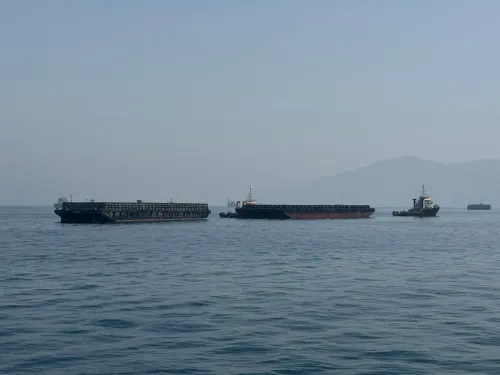
The Strait of Hormuz, according to the WEO, was a transit route through which roughly 20 million barrels of oil — or approximately a quarter of the world's maritime oil trade — flowed daily before the conflict began. Persian Gulf producers have reportedly redirected some supply to alternative ports, while production outside the Gulf rose by 2 million barrels per day.
Hardest-Hit Economies: Kuwait, Iraq, Qatar, Bahrain
The IMF singled out Bahrain, Iraq, Kuwait, and Qatar as 'commodity producers most affected by disruptions to energy output and transport,' projecting double-digit contractions for all four in 2026. According to the WEO's data tables:
Kuwait is projected to contract 16.7 per cent; Iraq by 16.0 per cent; Qatar by 15.6 per cent; and Bahrain by 11.3 per cent. The rebound projections for 2027 are equally dramatic — 19.0 per cent for Iraq, 18.8 per cent for Qatar, 17.1 per cent for Kuwait, and 13.9 per cent for Bahrain — reflecting an expectation of near-complete normalisation once maritime trade resumes.
Saudi Arabia, UAE, Oman: A Mixed Picture
Saudi Arabia, described by the WEO as 'somewhat less affected, as an economy with more diversified export routes,' is projected to contract 3.3 per cent in 2026 — a significant fall from its 4.6 per cent growth in 2025 — before rebounding to 7.9 per cent in 2027. The United Arab Emirates faces a projected contraction of 3.9 per cent this year, with a recovery to 7.7 per cent in 2027.
Oman stands as the notable outlier, with growth projected at 4.1 per cent in 2026, bucking the regional trend. The IMF did not elaborate on Oman's specific structural advantages in the published tables.
Iran's Deepening Crisis
Iran's economy is projected to shrink 7.6 per cent in 2026, with inflation forecast at a staggering 78.6 per cent. The IMF attributed the revision to 'resumed military exchanges, the reimposition of the naval blockade, and enhanced sanctions' — a combination that has compounded the country's already-strained economic position.
Oil Prices and the AI Spillover Gap
The WEO noted that oil prices 'almost doubled in the early months of the conflict' before stabilising at levels still 20 to 40 per cent higher than pre-conflict benchmarks. This sustained price elevation has had mixed consequences — benefiting non-Gulf producers while strangling Gulf exporters whose supply chains run through Hormuz.
The report also flagged a longer-term structural cost: Gulf producers risk missing out on the global artificial intelligence investment wave. The IMF said technology export spillovers would reach some commodity exporters, but 'for Gulf oil exporters this will depend critically on the normalization of maritime trade' — a condition that remains unmet.
India Carved Out as an Exception
India, whose growth forecast the IMF raised to 7.0 per cent, was explicitly identified as an exception. The Fund noted that medium-term downgrades were concentrated among economies 'directly affected by the conflict in the Middle East and energy-importing emerging market and developing economies elsewhere, excluding India.' The carve-out underscores India's relatively resilient macroeconomic positioning even amid a significant regional shock.
The IMF concluded with a warning that 'a prolonged stalemate or further escalation in the Middle East or Ukraine could make commodity prices higher and more volatile for longer' — a signal that the 2027 rebound scenario is far from guaranteed.
Point of View
Iraq, and Qatar are extraordinary by any historical measure — larger than most peacetime recessions and comparable only to wartime or sanctions-driven collapses. What the WEO does not fully resolve is the circularity of the rebound assumption: the 2027 recovery is projected on the premise that the Strait reopens and logistics normalise, but the report simultaneously warns of a 'prolonged stalemate.' If that stalemate holds, the V-shaped recovery becomes a fiction, and the fiscal reserves that Gulf sovereigns have built over decades begin to erode in earnest. India's carve-out is significant but should not breed complacency — sustained 20–40 per cent oil price premiums affect Indian import bills and inflation even when GDP growth holds, and the downstream effects on global supply chains are still working through the system.
NationPress
13 Oct 2026
Frequently Asked Questions
What did the IMF say about Gulf economies in its October 2026 World Economic Outlook?
The IMF projected the Middle East and Central Asia region to contract 0.3 per cent in 2026, reversing 3.7 per cent growth in 2025, as the Strait of Hormuz closure disrupts energy output and trade. Kuwait, Iraq, Qatar, and Bahrain are each expected to see double-digit GDP declines this year.
Which Gulf economies are worst affected by the Hormuz closure?
Kuwait (-16.7%), Iraq (-16.0%), Qatar (-15.6%), and Bahrain (-11.3%) face the steepest contractions in 2026, according to the IMF's WEO tables. These are commodity producers whose energy exports and logistics are most directly disrupted by the Strait closure.
Why is the Strait of Hormuz so critical to the global oil market?
The Strait of Hormuz was the transit route for roughly 20 million barrels of oil per day before the conflict — approximately a quarter of the world's maritime oil trade. Its closure has forced Gulf producers to reroute supply and has pushed oil prices 20–40 per cent above pre-war levels.
How is India's economy affected by the Middle East conflict and IMF forecasts?
India is explicitly carved out of the IMF's medium-term downgrades, with its growth forecast raised to 7.0 per cent in 2026. The Fund noted that downward revisions were concentrated in economies directly affected by the conflict or energy-importing nations, excluding India.
When does the IMF expect Gulf economies to recover?
The IMF projects a sharp rebound in 2027 — Iraq at 19.0%, Qatar at 18.8%, Kuwait at 17.1%, and Bahrain at 13.9% — contingent on the Strait of Hormuz reopening and production, exports, and logistics normalising. The Fund cautioned that a prolonged stalemate could delay or derail that recovery.