Pakistan faces up to $68 bn economic shock if Middle East war escalates
Synopsis
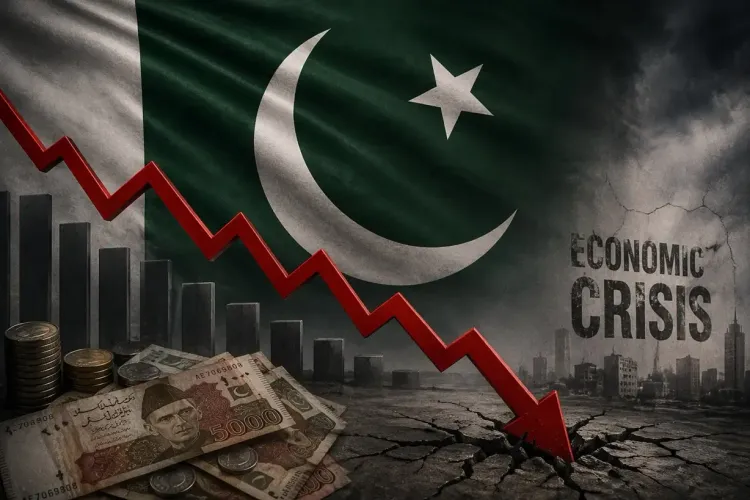
A Pakistani think tank has put hard numbers on a scenario most analysts have only gestured at: a prolonged Strait of Hormuz closure could cost Pakistan up to $68 billion — nearly 17% of its GDP — and push inflation above 18%. With only $15 billion in reserves, the country's IMF lifeline may not be enough to absorb the shock.
Key Takeaways
PRIME warned Pakistan could face an economic shock of up to $68 billion in a worst-case Middle East escalation scenario.
Three scenarios range from $10 billion (2.5% of GDP) in a quick resolution to $50–68 billion (17% of GDP) if the Strait of Hormuz stays shut and oil hits $150 per barrel .
Pakistan's foreign exchange reserves stand at approximately $15 billion , limiting its ability to finance a widening current account deficit.
Inflation could spike to between 15% and 18% in the severe scenario, driven by currency depreciation and rising food and energy costs.
The report warns the financing gap could become unsustainable even with an active IMF programme in place.
Pakistan could face an economic shock of up to $68 billion if the conflict in the Middle East persists and the Strait of Hormuz remains closed for an extended period, according to a presentation by the Policy Research Institute of Market Economy (PRIME) to Pakistan's National Assembly Standing Committee on Finance. The findings, cited by Business Recorder, outline three escalation scenarios ranging from a quick resolution to a prolonged crisis that could wipe out nearly 17 per cent of the country's GDP.
Three Scenarios and Their Economic Cost
In the most benign scenario, where hostilities ease quickly and the Strait of Hormuz reopens soon, the estimated economic cost to Pakistan is approximately $10 billion, equivalent to 2.5 per cent of GDP. The second scenario assumes the conflict continues for another three months, pushing the economic burden to between $24 billion and $32 billion, or nearly 8 per cent of GDP.
In the worst-case scenario — involving a prolonged closure of the strategic waterway and crude oil prices surging to $150 per barrel — the total cost could climb to between $50 billion and $68 billion, nearly 17 per cent of GDP. This is the scenario PRIME warns could push Pakistan into a full-blown financial crisis.
External Sector Under Severe Pressure
PRIME's analysis focuses primarily on Pakistan's external sector, flagging a triple threat: rising import costs, declining exports, and lower remittance inflows. Together, these pressures could sharply weaken the country's balance of payments position and rapidly drain its foreign exchange reserves.
Pakistan's current foreign exchange reserves stand at approximately $15 billion — a figure the report describes as insufficient to finance a widening current account deficit under the severe scenario. According to the report, the financing gap in that case could become unsustainable, even with an active IMF programme in place.
Inflation Could Spike to 18 Per Cent
Inflationary pressures are also projected to intensify significantly. Even under the mild scenario, the report estimates inflation could reach around 10 per cent. A prolonged crisis, driven largely by currency depreciation and rising food and energy prices, could push inflation to between 15 per cent and 18 per cent, the report warns.
This comes amid Pakistan's already fragile macroeconomic recovery, which has relied heavily on IMF-backed fiscal consolidation. A sustained external shock of this magnitude would test the limits of that programme and potentially force a renegotiation of its terms.
Strategic Significance of the Strait of Hormuz
The Strait of Hormuz, which connects the Persian Gulf to the Gulf of Oman, is one of the world's most critical energy chokepoints. Approximately 20 per cent of global oil supply passes through it. For energy-import-dependent economies like Pakistan, any prolonged disruption translates directly into fuel shortages, higher import bills, and currency stress. Notably, Pakistan's energy import dependence makes it among the most exposed South Asian economies to a Hormuz closure.
What Happens Next
The PRIME presentation was made to Pakistan's parliamentary finance committee, signalling that policymakers are actively stress-testing the country's economic resilience. Whether the government acts on these projections — by building reserve buffers, negotiating emergency credit lines, or accelerating energy diversification — remains to be seen. With the Middle East conflict showing no clear signs of de-escalation, the window to prepare may be narrowing.
Point of View
It is essentially a rounding error. What the report does not address is the political economy of preparation: Pakistan's track record on building reserve buffers ahead of crises is poor, and an IMF programme under pressure tends to shrink fiscal space precisely when it is most needed. The real question is not whether Pakistan can survive a mild scenario — it probably can — but whether it has the institutional capacity to act on these projections before the worst case arrives.
NationPress
22 Sept 2026
Frequently Asked Questions
What is the PRIME report on Pakistan's economic risk from the Middle East war?
It is a presentation by the Policy Research Institute of Market Economy (PRIME) to Pakistan's National Assembly Standing Committee on Finance, assessing three economic scenarios if the Middle East conflict escalates and the Strait of Hormuz is disrupted. The worst-case estimate puts Pakistan's economic loss at up to $68 billion, or nearly 17% of GDP.
What are the three economic scenarios outlined in the PRIME report?
The first scenario assumes a quick resolution, costing Pakistan around $10 billion (2.5% of GDP). The second assumes three more months of conflict, raising the cost to $24–32 billion (8% of GDP). The worst case involves a prolonged Hormuz closure and oil at $150 per barrel, pushing costs to $50–68 billion (17% of GDP).
Why is the Strait of Hormuz critical for Pakistan's economy?
The Strait of Hormuz is a key global energy chokepoint through which roughly 20% of the world's oil supply passes. Pakistan is heavily dependent on energy imports, so any prolonged closure drives up import costs, weakens the rupee, and pressures foreign exchange reserves.
How much are Pakistan's foreign exchange reserves, and why does it matter?
Pakistan's foreign exchange reserves stand at approximately $15 billion, which the PRIME report describes as insufficient to absorb a severe external shock. In the worst-case scenario, the financing gap could become unsustainable even with an active IMF programme.
How high could inflation rise in Pakistan under the worst-case scenario?
The PRIME report estimates inflation could reach around 10% even in the mild scenario. In a prolonged crisis, inflation could climb to between 15% and 18%, driven by currency depreciation and surging food and energy prices.