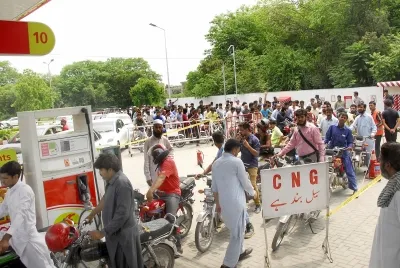
US-Iran conflict delivers structural blow to Pakistan's economy amid oil crisis
Synopsis
Pakistan's weekly oil bill has nearly tripled to $800 million as the US-Iran conflict shuts the Strait of Hormuz — pushing its annualised petroleum burden close to its entire export earnings of $29.8 billion. With no strategic reserve and no alternative supply route, analysts warn this is not a price shock but a structural rupture for one of South Asia's most fragile economies.
Key Takeaways
Pakistan's weekly petroleum import bill has surged 167% — from $300 million to $800 million — due to the US-Iran conflict and Strait of Hormuz closure.
The annualised additional oil burden is approximately $26 billion , nearly matching Pakistan's entire FY2025 merchandise export earnings of $29.8 billion .
Between 85–90% of Pakistan's petroleum is imported, with no strategic petroleum reserve or alternative supply route.
The IMF estimates Pakistan's CPI elasticity to oil at 0.4–0.6% per 10% price rise — among the highest in South Asia.
Prime Minister Shehbaz Sharif publicly confirmed the scale of the petroleum bill increase in April 2026 .
Analysts describe the crisis as a structural blow exposing vulnerabilities that predate the current conflict by decades.
The conflict between the United States and Iran has triggered a severe energy price shock across Pakistan's already fragile economy, compounding rising inflation, dwindling foreign exchange reserves, and a fast-depreciating currency, according to an analysis published in India Narrative. Analysts describe Pakistan as the "primary casualty" in the subcontinent of the US-Iran war.
The Oil Bill Shock
Pakistan's weekly petroleum import bill has surged 167 percent — from $300 million to $800 million — as benchmark Brent crude surpassed $112 per barrel. The closure of the Strait of Hormuz has driven freight costs and insurance premiums to historic highs, amplifying the crisis beyond the crude price itself.
In April 2026, Prime Minister Shehbaz Sharif publicly confirmed the scale of the petroleum bill increase. On an annualised basis, this translates to an additional burden of approximately $26 billion — a figure that nearly matches Pakistan's entire FY2025 merchandise export earnings of $29.8 billion. In effect, Pakistan is generating an import liability equal to its entire export sector in a single commodity category, during a period of acute reserve stress.
A Structural Vulnerability, Not a Transient Shock
The India Narrative analysis argues this is not merely a temporary disruption but a structural blow to one of South Asia's most fragile economies. Between 85 and 90 percent of Pakistan's petroleum requirements are met through imports, predominantly from Gulf states whose export logistics depend entirely on unimpeded Hormuz transit. The country has no comparable alternative supply option and no functioning strategic petroleum reserve.
This structural dependence creates what economists term a high pass-through environment: international oil price increases transmit rapidly and comprehensively into domestic fuel prices, transport costs, electricity tariffs, and consumer prices. The International Monetary Fund (IMF) estimates Pakistan's CPI elasticity to oil at 0.4–0.6 percent per 10 percent price increase — among the highest in South Asia.
Cascading Macroeconomic Impact
According to the analysis, the energy shock transmits across Pakistan's macroeconomy, leading to "accelerating inflation, current account deterioration, foreign exchange reserve depletion, currency depreciation, and a growing logistics crisis at Karachi port." The article notes that these vulnerabilities predate the current crisis by decades, making recovery significantly harder.
"Pakistan's incremental annual oil burden now approaches its total export earnings. This is not a price adjustment — it is a stress event of structural proportions, exposing vulnerabilities that predate the current crisis by decades," the India Narrative article states.
What Comes Next
With no strategic petroleum reserve and no viable alternative import route, Pakistan's fiscal and monetary authorities face limited tools to absorb the shock. Any prolonged closure of the Strait of Hormuz, or further escalation in US-Iran hostilities, risks pushing Pakistan's already stressed balance of payments into a deeper crisis. How Islamabad navigates its IMF programme commitments amid this external shock will be closely watched in the weeks ahead.
Point of View
As before, seek emergency bridge financing and defer the structural reckoning once more.
NationPress
24 Sept 2026
Frequently Asked Questions
How has the US-Iran conflict affected Pakistan's economy?
The US-Iran conflict has triggered a severe energy price shock in Pakistan, pushing its weekly petroleum import bill up 167% from $300 million to $800 million. The Strait of Hormuz closure has driven Brent crude above $112 per barrel and sent freight and insurance costs to historic highs, compounding Pakistan's existing economic vulnerabilities.
Why is Pakistan particularly vulnerable to oil price shocks?
Pakistan imports between 85 and 90 percent of its petroleum requirements, primarily from Gulf states whose exports depend on Hormuz transit. It has no functioning strategic petroleum reserve and no comparable alternative supply route, making it one of the most oil-import-dependent economies in South Asia.
What did Prime Minister Shehbaz Sharif say about the oil import bill?
In April 2026, Prime Minister Shehbaz Sharif publicly confirmed that Pakistan's weekly petroleum import bill had risen from $300 million to $800 million — a 167 percent increase. On an annualised basis, this represents an additional burden of approximately $26 billion.
How does Pakistan's oil burden compare to its export earnings?
Pakistan's annualised additional oil burden of approximately $26 billion nearly matches its entire FY2025 merchandise export earnings of $29.8 billion. This means the country is effectively generating an import liability equal to its entire export sector in a single commodity category.
What does the IMF say about Pakistan's sensitivity to oil prices?
The IMF estimates Pakistan's CPI elasticity to oil at 0.4–0.6 percent per 10 percent oil price increase — among the highest in South Asia. This means oil price rises transmit rapidly into domestic inflation, transport costs, electricity tariffs, and consumer prices.