Assam ranks 3rd in govt health spending, NHA 2023-24 shows
Synopsis
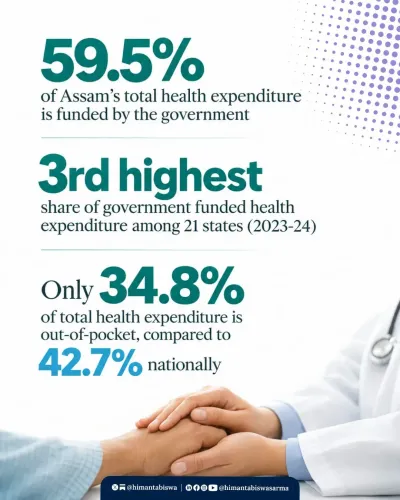
The National Health Accounts 2023–24 ranks Assam third among 21 states for government health expenditure at 59.5%, while the state's out-of-pocket burden on households sits at 34.8% — well below the national average of 42.7%, signalling meaningful progress in public healthcare financing.
Key Takeaways
Assam's government health expenditure accounts for 59.5% of total health spending, the 3rd highest among 21 states in NHA 2023–24.
Household out-of-pocket expenditure in Assam stands at 34.8% , nearly 8 percentage points below the national average of 42.7% .
The data comes from the National Health Accounts 2023–24 , the Government of India's official state-level health financing report.
Assam's performance aligns with National Health Policy 2017 goals to raise government health spending to 2.5% of GDP .
The Ayushman Bharat PM-JAY scheme (2018) has been a key structural driver in reducing direct household medical payments across states including Assam.
Analysts will watch Assam's upcoming state health budget and the next NHA cycle to gauge whether this trajectory is sustained.
Assam has quietly built one of India's strongest public healthcare financing records — and official national data is now making it impossible to ignore. The Chief Minister's Office of Assam announced on Friday, 20 November 2026 that the state's government health expenditure accounts for 59.5% of total health expenditure, ranking it third among 21 states surveyed in the National Health Accounts (NHA) 2023–24, the Government of India's authoritative annual compilation of state-level health financing data.
Assam's out-of-pocket burden: 34.8% vs a national average of 42.7%
The number that hits hardest for ordinary Assam households is not the government's share — it is what families no longer have to pay themselves. The state's out-of-pocket expenditure (OOPE) stands at just 34.8% of total health spending, against a national average of 42.7% — a gap of nearly 8 percentage points that translates directly into less financial devastation when illness strikes. In a country where a single hospitalisation can push a family below the poverty line, that gap is not a statistic. It is a safety net.
The NHA report measures both government and household contributions to health spending across states, making it the definitive yardstick for how much of the medical burden a state's public system actually absorbs. Assam's position near the top of that ranking reflects sustained budget prioritisation of public hospitals, primary health centres, and state-funded insurance coverage.
Where Assam sits in India's health financing arc
The backdrop matters here. The National Health Policy 2017 set an ambitious target of raising government health spending to 2.5% of GDP by 2025 — a goal the country as a whole has struggled to meet. The Ayushman Bharat Pradhan Mantri Jan Arogya Yojana, launched in 2018, extended secondary and tertiary care coverage to low-income families and has been a key driver of reducing direct household payments across participating states, including Assam.
The COVID-19 pandemic exposed just how dangerously thin India's public health infrastructure was, accelerating political pressure on states to raise their own health allocations. Assam's NHA 2023–24 numbers suggest the state has been moving in that direction with measurable effect — though the next budget cycle and the subsequent NHA release will be the real test of whether this trajectory holds.
What the ranking means — and what to watch next
Third place among 21 states is a concrete achievement, not a ceremonial one. It means Assam's public health system is absorbing a larger share of its citizens' medical costs than the vast majority of Indian states. The CMO's post, tagged #CMOAssamBulletin, pointed readers to the full NHA story — signalling that the state intends to keep this data in public view as a governance benchmark.
The metrics to watch next: Assam's state budget health allocation for 2027–28 and whether the upcoming NHA report sustains or improves the government expenditure share. If it does, Assam's healthcare financing model may well become a reference point for other northeastern states still carrying far heavier out-of-pocket burdens on their citizens.
Numbers in a government report rarely move people. This one should — because behind every percentage point drop in out-of-pocket spending is a family in Assam that did not have to sell a buffalo or borrow from a moneylender to pay a hospital bill.
Point of View
Rather than through crisis. The 59.5% government expenditure share places Assam firmly in the top tier of states executing the National Health Policy 2017 vision, and the 34.8% out-of-pocket figure suggests that fiscal commitment is actually reaching households rather than stalling in administrative channels. For the ruling dispensation in Dispur, the data offers durable political capital — public healthcare outcomes are harder to dispute than infrastructure promises. The question the next budget must answer is whether Assam's allocations can grow fast enough to defend this rank as other states, energised by post-pandemic reform mandates, accelerate their own public health spending.
NationPress
20 Nov 2026
Frequently Asked Questions
What is Assam's rank in government health expenditure among Indian states?
Assam ranks 3rd among 21 states in government health expenditure as a share of total health spending, according to the National Health Accounts 2023–24 report.
What percentage of health expenditure in Assam comes from the government?
Government health expenditure in Assam accounts for 59.5% of total health expenditure, as reported in the National Health Accounts 2023–24.
How much do Assam households pay out of pocket for healthcare?
Assam households bear an out-of-pocket health expenditure of just 34.8% , compared to the national average of 42.7% , according to NHA 2023–24 data.
What is the National Health Accounts report?
The National Health Accounts is an official Government of India report that tracks and compares state-level data on health expenditure sources and distribution across public, private, and household channels.
How does Ayushman Bharat affect out-of-pocket health costs in Assam?
The Ayushman Bharat PM-JAY scheme, launched in 2018, provides secondary and tertiary care coverage for low-income families and is one of the key structural drivers reducing direct household medical payments in states like Assam.