CM Himanta's Govt Marks Cancer Awareness Day With Care Push
Synopsis
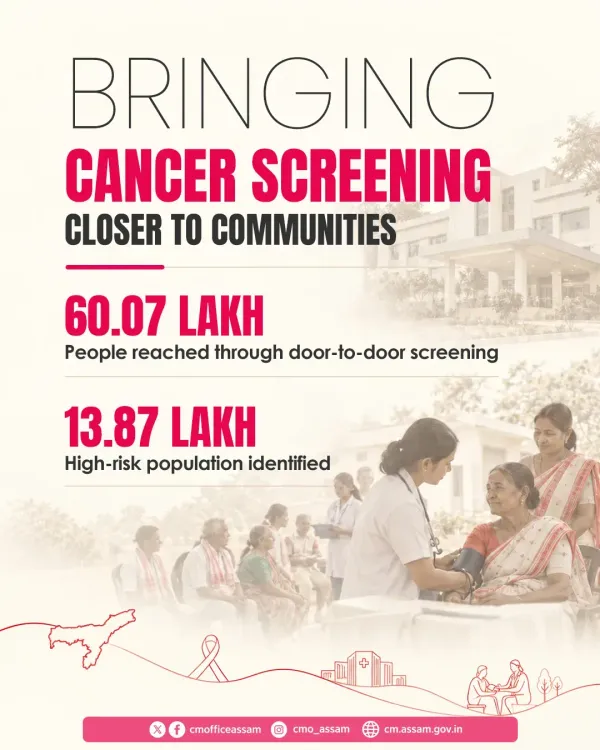
On National Cancer Awareness Day, the Assam Chief Minister's Office highlighted CM Himanta Biswa Sarma's efforts to decentralise cancer care, expand oncology infrastructure, and promote early detection across a state with one of India's highest cancer burdens.
Key Takeaways
The Chief Minister's Office of Assam marked National Cancer Awareness Day on 7 November 2026 by reviewing cancer care progress under CM Himanta Biswa Sarma .
The Assam Cancer Care Foundation , a partnership with Tata Trusts formed in 2017 , anchors the state's district-level cancer facility network.
The government has expanded the Dr.
Borooah Cancer Institute in Guwahati and added oncology units in multiple districts since 2021 .
Northeast India records above-average age-adjusted cancer rates, making decentralised care a public health priority.
Assam's approach aligns with India's National Programme for Prevention and Control of Cancer , targeting early detection and reduced out-of-pocket costs.
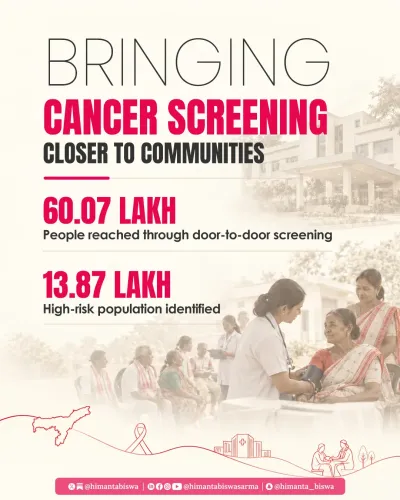
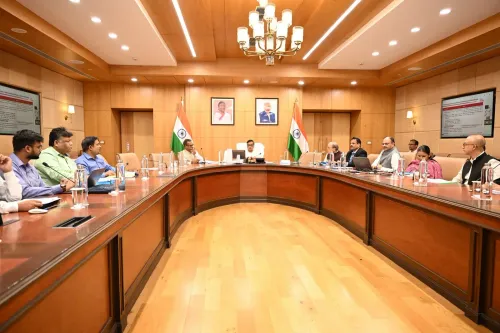
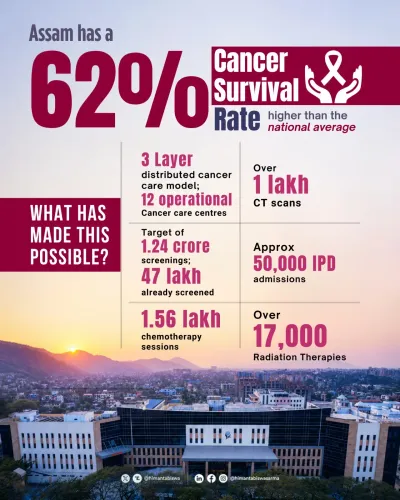
Assam has one of the highest cancer burdens in the country — and on National Cancer Awareness Day, 7 November 2026, the Chief Minister's Office of Assam paused to take stock of how far the state has come in fighting it. The official account highlighted a range of steps taken under Chief Minister Dr. Himanta Biswa Sarma to expand infrastructure, promote early detection, and make oncology services more accessible to ordinary Assamese families.
A Northeast State With an Outsized Cancer Challenge
The numbers behind this effort matter. Northeast India has historically recorded age-adjusted cancer rates above the national average, driven by regional risk factors and, for decades, a severe shortage of specialist facilities outside a few urban centres. For most patients, a cancer diagnosis once meant an expensive, exhausting journey to Guwahati or beyond — or no treatment at all.
That geography of despair is precisely what state-level cancer care investments are designed to close. Assam's push since 2021, when Dr. Himanta Biswa Sarma took charge as Chief Minister, has focused on two parallel tracks: upgrading anchor institutions and pushing oncology services outward into districts.
From Guwahati to the Districts: Decentralising Oncology
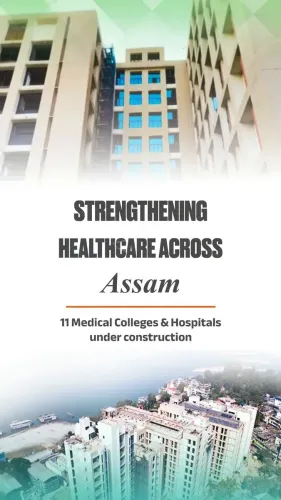
The foundation for this decentralisation was laid even before the current government. The Assam Cancer Care Foundation, a landmark partnership with Tata Trusts established in 2017, set the template: district-level cancer care facilities that would spare patients the burden of travelling to a single tertiary centre. Post-2021, the government built on that base by expanding the flagship Dr. B. Borooah Cancer Institute in Guwahati and commissioning new oncology units in several districts across the state.
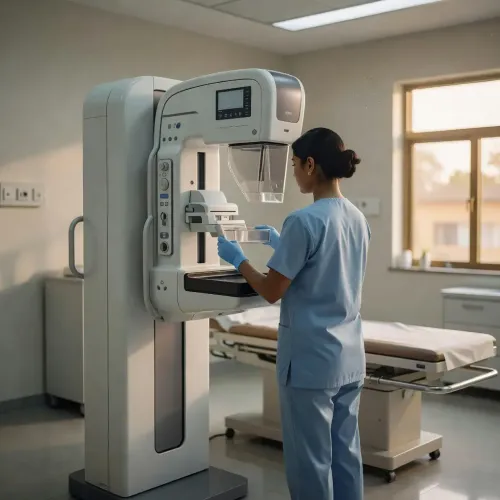
The logic is straightforward — and urgent. Early detection works only if the detection infrastructure exists close to where people live. A mammogram or an endoscopy that requires a two-day journey will simply not happen.
Awareness as the First Line of Defence
National Cancer Awareness Day is observed every year on 7 November — a date chosen to mark the birth anniversary of physicist Marie Curie, whose radiation research underlies modern oncology. India's national observance focuses on prevention, screening, and early detection, themes that map directly onto the state government's stated priorities.
Assam's efforts sit within a larger national architecture: the National Programme for Prevention and Control of Cancer aims to integrate screening into primary health care, reducing the reliance on costly late-stage treatment and cutting out-of-pocket expenditure that pushes families into poverty. The state's expanding district-level network is designed to plug directly into that framework.
What Comes Next for Assam's Cancer Care Network
The real test of these investments will be measured in patient footfall at newly commissioned facilities and in state health budget allocations for oncology in the coming fiscal year. Infrastructure commissioned on paper means little unless it is staffed, supplied, and reaching patients who need it most. On a day built for awareness, the government's signal is clear: the goal is not just bigger hospitals, but earlier diagnoses and shorter distances between a patient and a cure.
Point of View
Health infrastructure in a region historically underserved by specialist care doubles as both a welfare delivery story and a political asset. The broader significance lies in whether district-level oncology centres translate into measurably earlier diagnoses and reduced mortality — a data gap that will define the programme's real legacy far beyond any awareness-day post.
NationPress
7 Nov 2026
Frequently Asked Questions
What is National Cancer Awareness Day and when is it observed?
National Cancer Awareness Day is observed every year on 7 November in India to promote cancer prevention, early screening, and detection. The date marks the birth anniversary of scientist Marie Curie, whose research underpins radiation-based cancer treatment.
What is the Assam Cancer Care Foundation?
The Assam Cancer Care Foundation is a public-private partnership between the Assam government and Tata Trusts , established in 2017 , to build and operate district-level cancer care facilities across the state and reduce patients' dependence on a single tertiary hospital.
What cancer hospital is in Guwahati, Assam?
The Dr. B. Borooah Cancer Institute in Guwahati is Assam's principal tertiary cancer care centre. The government has expanded it since 2021 as part of a broader effort to upgrade oncology services across the state.
Why does Northeast India have high cancer rates?
Northeast India records above-average age-adjusted cancer incidence compared to the national average, attributed to a combination of regional dietary and environmental risk factors and historically limited access to early screening and specialist treatment.
What is CM Himanta Biswa Sarma doing for cancer care in Assam?
Since taking office in 2021 , CM Himanta Biswa Sarma has overseen the expansion of the Dr. B. Borooah Cancer Institute, the addition of district-level oncology units, and continued support for the Assam Cancer Care Foundation to bring early detection and treatment closer to patients.