CM Himanta Flags 62% Cancer Survival Rate in Assam
Synopsis
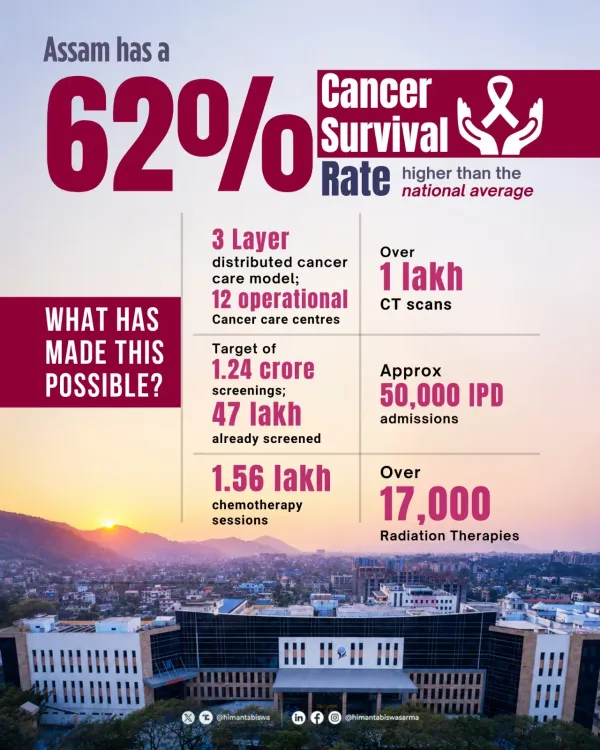
Assam Chief Minister Himanta Biswa Sarma announced that the state's 3-tier cancer care programme has delivered a 62% cancer survival rate, above the national average. The state is targeting screening of 1.2 crore people for early detection and timely treatment.
Key Takeaways
Assam CM Himanta Biswa Sarma announced a 62% cancer survival rate under the state's 3-tier cancer care programme, claiming it exceeds the national average.
The 3-tier model covers screening at primary level, diagnosis at district level, and advanced treatment at tertiary centres.
The state has set a target to screen 1.2 crore people to enable early detection and timely treatment.
Assam is among northeastern states with elevated age-adjusted cancer incidence, making targeted intervention a key health priority.
The programme aligns with the national NPCDCS framework launched in 2010 under the National Health Mission.
Completion of the screening target and independent validation of survival data will be critical next steps.
Assam Chief Minister Himanta Biswa Sarma announced on Monday, 13 July 2026 that the state's three-tier cancer care programme has pushed the cancer survival rate to 62 per cent, which he said is well above the national average. The Chief Minister also said the state is on a mission to screen 1.2 crore people to enable early detection and timely treatment.
Context
In his post, CM Sarma stated: 'Our 3-tier cancer care programme is delivering excellent results. Due to timely testing, diagnosis and treatment, our survival rate stands at 62%, much above the national average. We are on a mission to screen 1.2cr people to detect early and administer timely treatment.'
Assam has historically reported elevated cancer incidence in several districts, particularly for certain cancer sites, making it one of the northeastern states where targeted intervention has been considered a public health priority. The announcement positions the state's structured programme as a measurable success against this backdrop.
Policy Backdrop
The 3-tier cancer care programme is structured to provide screening at the primary health level, diagnosis at the district level, and advanced treatment at tertiary centres — a model designed to intercept cancer at its earliest, most treatable stages. This architecture mirrors the broader framework of the National Programme for Prevention and Control of Cancer, Diabetes, Cardiovascular Diseases and Stroke (NPCDCS), launched in 2010 under the National Health Mission, which sought to shift India's health system from late-stage treatment toward population-level screening.
Several Indian states have adopted tiered cancer-care models under this national framework. The Northeast region has seen particularly focused state-level programmes that supplement central non-communicable disease efforts, given the region's age-adjusted cancer incidence patterns.
Stakeholders and Impact
The primary beneficiaries of the programme are Assam's cancer patients and the broader resident population who stand to gain from early screening. A survival rate of 62 per cent — if sustained and independently validated — would represent a meaningful outcome in a state where access to tertiary oncology care has historically been constrained by geography and infrastructure.
The target of screening 1.2 crore individuals is significant in scale, covering a substantial share of Assam's population of roughly 3.5 crore. Successful completion would require coordinated deployment of screening infrastructure across both urban centres and remote rural areas, including the state's tea-garden communities and riverine districts.
What's Next
Attention will now turn to the pace of completion of the 1.2 crore screening target and whether the state will announce fresh budget allocations or formal agreements with tertiary cancer centres to strengthen referral pathways. Independent audit of the 62 per cent survival figure will also be key to establishing the programme's credibility as a replicable model for other northeastern and high-incidence states. The programme's outcomes could inform the next revision of India's national NCD strategy and may prompt other BJP-governed states to adopt similar tiered frameworks under CM Sarma's convener role in the North-East Democratic Alliance (NEDA).
Point of View
If independently verified, would mark a significant departure from the late-diagnosis patterns that have long characterised cancer outcomes in the Northeast. The 1.2 crore screening target also signals an ambition to move public health delivery from reactive to preventive — a shift that aligns with the Centre's NCD control priorities under the National Health Mission. For Sarma, who has consistently used welfare metrics to consolidate political capital in Assam, health outcomes data of this kind serve a dual purpose: administrative credibility and electoral signalling ahead of future state cycles.
NationPress
12 Oct 2026
Frequently Asked Questions
What is Assam's 3-tier cancer care programme?
It is an Assam government initiative that provides cancer screening at the primary health level, diagnosis at the district level, and advanced treatment at tertiary centres, aimed at catching cancer early and improving survival outcomes.
What is Assam's cancer survival rate according to CM Himanta Biswa Sarma?
CM Himanta Biswa Sarma stated on 13 July 2026 that Assam's cancer survival rate stands at 62%, which he said is much above the national average.
How many people is Assam planning to screen for cancer?
The Assam government has set a target to screen 1.2 crore (12 million) people as part of its early cancer detection mission.
Why does Assam have a special focus on cancer care?
Several districts in Assam and the broader Northeast region report higher age-adjusted cancer incidence rates for certain cancer sites, making early detection and tiered care a key public health priority for the state.
How does Assam's cancer programme relate to the national health framework?
The programme's tiered structure aligns with the National Programme for Prevention and Control of Cancer, Diabetes, Cardiovascular Diseases and Stroke (NPCDCS), launched in 2010 under the National Health Mission to promote early detection of non-communicable diseases.