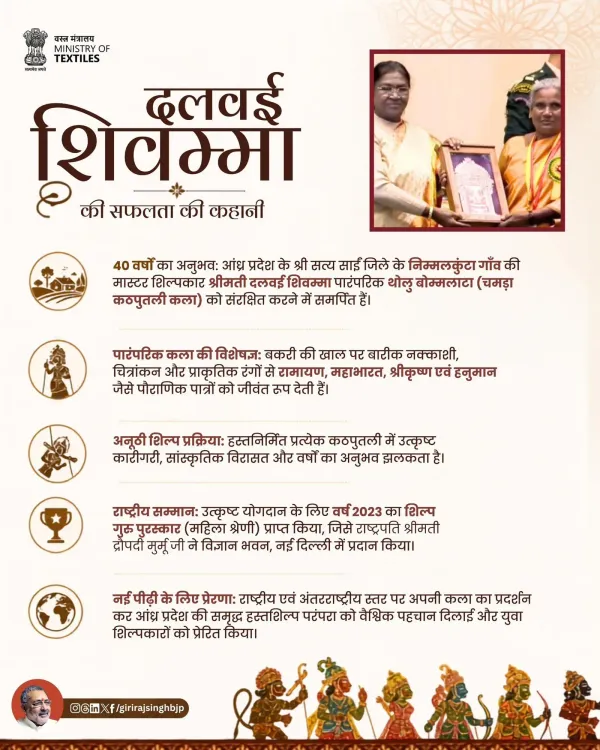
Giriraj Singh spotlights Andhra's leather puppet artist Dalwai Shivamma
Synopsis
Union Textiles Minister Giriraj Singh has highlighted the work of Andhra Pradesh artisan Dalwai Shivamma, who preserves the classical leather shadow puppetry tradition Tholu Bommalata, calling dedicated craftspeople the true identity of India's rich handicraft heritage under the Vocal for Local banner.
Key Takeaways
Union Textiles Minister Giriraj Singh posted on 13 July 2026 recognising artisan Dalwai Shivamma from Andhra Pradesh .
Dalwai Shivamma has spent decades preserving Tholu Bommalata , a classical leather shadow puppet theatre form native to Andhra Pradesh and parts of Telangana.
The minister called dedicated artisans 'the true identity of India's rich handicraft tradition.' The post is tagged under the #VocalForLocal campaign, a national initiative promoted since 2020 as part of the Atmanirbhar Bharat package.
The Ministry of Textiles has made spotlighting individual craftspeople a sustained social-media outreach strategy to promote regional art forms nationally.
Follow-up support through artisan welfare schemes or craft exhibitions could be the next step for practitioners like Shivamma.
Union Textiles Minister Giriraj Singh on Monday, 13 July 2026 used his official X account to spotlight Dalwai Shivamma, an artisan from Andhra Pradesh who has spent decades preserving the classical leather shadow puppetry tradition known as Tholu Bommalata. The minister praised her dedication to keeping the ancient art form alive and described craftspeople like her as the true identity of India's rich handicraft heritage.
Context
In his post, Minister Singh wrote that Dalwai Shivamma has been nurturing the traditional leather puppetry art form — Tholu Bommalata (leather puppet theatre) — for many years. He noted that her craft does not merely keep India's cultural heritage alive, but also connects the new generation with its own traditions. He described such dedicated artisans as 'the true identity of India's rich handicraft tradition.'
Tholu Bommalata is a classical performing art native to Andhra Pradesh and parts of Telangana. Practitioners create large, translucent leather figures — traditionally depicting characters from the Ramayana and Mahabharata — and animate them behind a backlit screen to narrate mythological stories. The art form is considered part of India's intangible cultural heritage.
Policy Backdrop
The minister's post carries the hashtags #VocalForLocal, #SupportArtisans, #Handicrafts, and #IndiaCrafts, explicitly linking the tribute to the Vocal for Local campaign that was promoted nationally from 2020 as a pillar of the Atmanirbhar Bharat package. The campaign encourages domestic consumption and the revival of traditional industries, with the Ministry of Textiles playing a central role in channelling support toward artisan communities.
Ministerial social-media posts recognising individual craftspeople have become a sustained feature of the Ministry of Textiles' outreach strategy, designed to spotlight regional art forms and give them a national platform. The emphasis on leather puppetry aligns with broader government efforts to document and promote India's diverse intangible cultural heritage across states.
Stakeholders and Impact
For traditional artisan communities in Andhra Pradesh — and across India — ministerial visibility of this kind can translate into increased public interest and market demand for their work. Dalwai Shivamma's recognition by a Union Minister places the spotlight on a craft that has historically struggled for mainstream patronage and economic sustainability.
The post also signals the government's intent to position individual craftspeople as cultural ambassadors, reinforcing the message that preserving intangible heritage is a national priority, not merely a regional concern. Younger audiences, who are the target of the inter-generational transmission message in the post, represent both a potential audience for live performances and a future pool of practitioners.
What's Next
Attention will now turn to whether the Ministry of Textiles follows up with concrete support measures — such as inclusion of Tholu Bommalata practitioners in national or state-level craft exhibitions, artisan welfare scheme enrolments, or Geographical Indication-linked promotion initiatives. The ministry's broader artisan outreach calendar and any upcoming handicraft fairs or cultural festivals could provide a natural next platform for artists like Dalwai Shivamma to reach wider audiences and buyers.
Point of View
High-visibility form of cultural diplomacy that reinforces the Vocal for Local brand. The post does double duty: it celebrates intangible cultural heritage while keeping the Atmanirbhar Bharat messaging alive in public discourse. The choice of a leather-craft tradition from Andhra Pradesh also reflects an implicit effort to demonstrate that the BJP-led Centre's cultural outreach extends beyond its traditional strongholds in the Hindi heartland. Whether these symbolic gestures translate into measurable economic uplift for artisan communities will be the metric by which the ministry's broader handicraft agenda is ultimately judged.
NationPress
12 Oct 2026
Frequently Asked Questions
What is Tholu Bommalata?
Tholu Bommalata is a classical leather shadow puppet theatre tradition native to Andhra Pradesh and parts of Telangana, in which large translucent leather figures are animated behind a backlit screen to narrate mythological stories.
Who is Dalwai Shivamma?
Dalwai Shivamma is an artisan from Andhra Pradesh who has spent decades preserving the Tholu Bommalata leather shadow puppetry tradition, earning recognition from Union Textiles Minister Giriraj Singh.
Why did Giriraj Singh post about Dalwai Shivamma?
Minister Giriraj Singh highlighted Shivamma's work to celebrate India's handicraft heritage and connect it to the Vocal for Local campaign, which encourages domestic consumption and support for traditional artisans.
What is the Vocal for Local campaign?
Vocal for Local is a national campaign promoted from 2020 as part of the Atmanirbhar Bharat package, encouraging Indians to buy and promote domestically made products and traditional crafts.
What support can artisans like Dalwai Shivamma receive from the government?
Artisans can potentially benefit from Ministry of Textiles welfare schemes, participation in national craft exhibitions, and promotional initiatives linked to intangible cultural heritage, though no specific new announcement was made in this post.