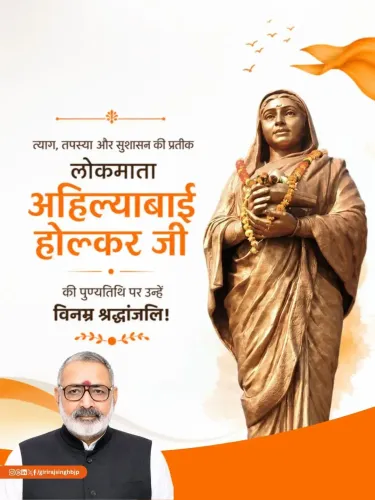
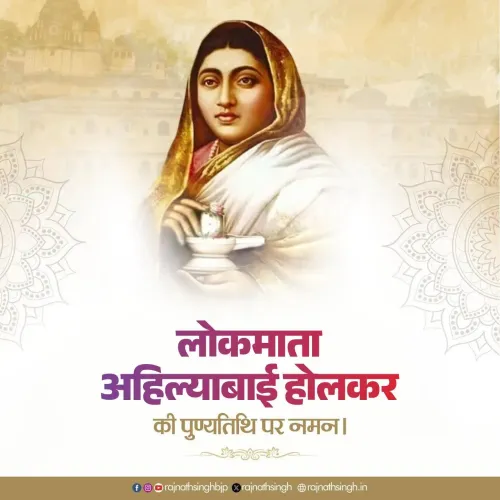
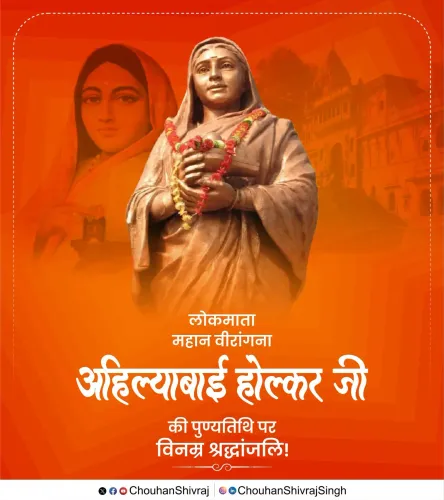
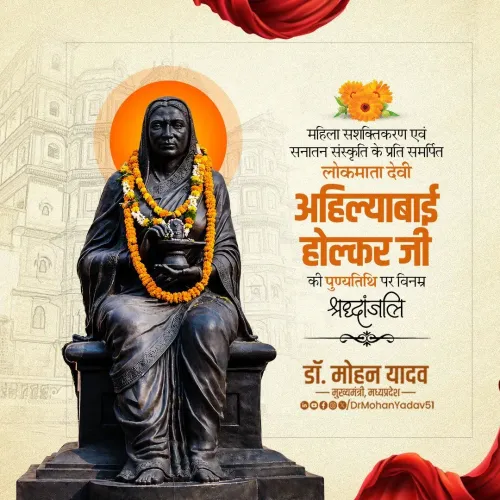
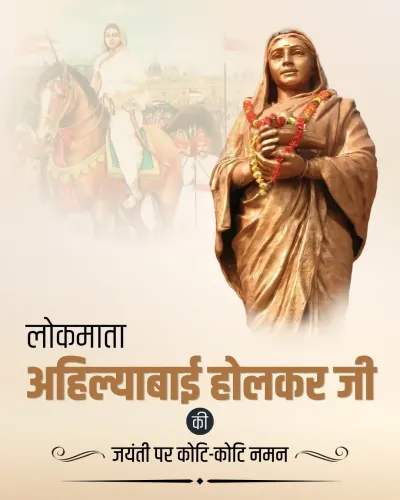
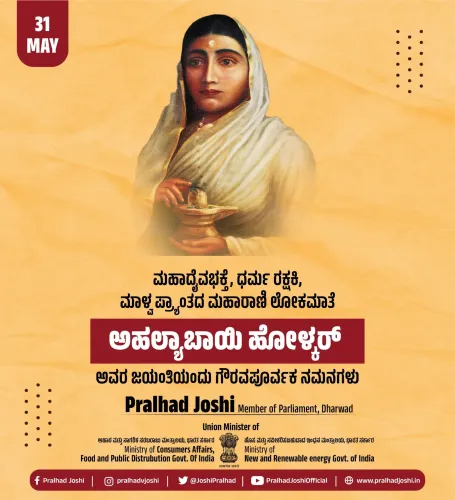
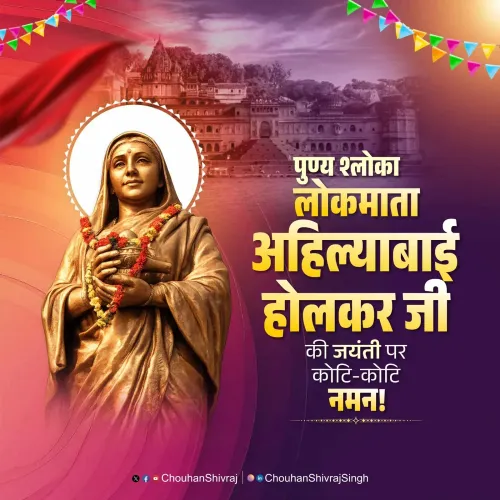
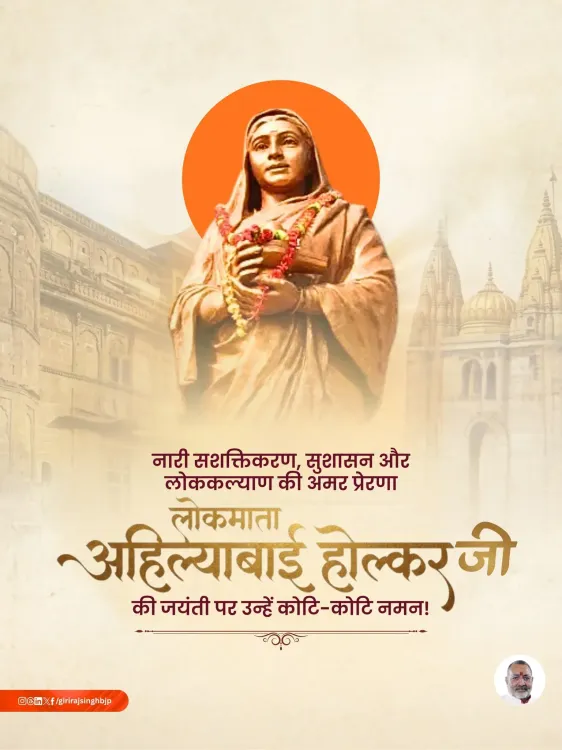
Giriraj Singh pays tribute to Ahilyabai Holkar on her Jayanti
Synopsis
Union Textiles Minister Giriraj Singh marked the Jayanti of 18th-century Malwa ruler Ahilyabai Holkar on 31 May 2026, saluting her as 'Lokmata' and praising her restoration of sacred sites and model of just, people-centred governance.
Key Takeaways
Union Textiles Minister Giriraj Singh posted a tribute on 31 May 2026 marking the Jayanti of Ahilyabai Holkar .
He referred to her by the honorific 'Lokmata' and praised her record on justice, dharma, and public welfare.
Singh highlighted her role in restoring pilgrimage sites and temples, crediting her with reviving Sanatan Sanskriti .
The tribute invoked the themes of nari shakti (women's power) and sushasan (good governance) via dedicated hashtags.
The post aligns with a broader BJP pattern of commemorating pre-colonial Hindu rulers to reinforce cultural and governance messaging.
Ahilyabai Holkar's legacy is directly connected to sites covered under the Swadesh Darshan scheme launched in 2014-15 .
Union Textiles Minister Giriraj Singh on Sunday, 31 May 2026 paid tribute to 18th-century Malwa ruler Ahilyabai Holkar on her birth anniversary, honouring her as a symbol of just governance, public service, and the revival of India's cultural heritage.
Context
In his post, the Minister described Ahilyabai Holkar as 'मातृस्वरूपा पुण्यश्लोका' ('a mother-like, virtuous soul') who presented an unparalleled example of just administration, dharma, and public welfare. He noted that by restoring numerous sacred pilgrimage sites and temples across the country, she gave a new consciousness to Sanatan Sanskriti (Sanatan culture). Concluding with the salutation 'कोटिशः नमन' ('a crore-fold salutations'), Singh referred to her by the honorific 'Lokmata' — meaning 'Mother of the People'.
Ahilyabai Holkar ruled the Malwa kingdom in the latter half of the 18th century and is remembered for her administrative acumen, her system of accessible justice, and her patronage of temple construction and restoration at sites including Kashi, Gaya, Somnath, Ayodhya, and Dwarka. Her legacy has endured as a reference point for women's leadership and good governance in Indian public life.
Policy Backdrop
The tribute connects to a sustained official emphasis on religious tourism and heritage conservation. The Swadesh Darshan scheme, launched in 2014-15, was designed to develop thematic pilgrimage and heritage circuits — several of which include sites historically restored under Ahilyabai Holkar's patronage. The invocation of her legacy as a model of sushasan ('good governance') and nari shakti ('women's power') reflects a broader pattern in official messaging that draws on pre-colonial Hindu rulers to illustrate civilisational continuity.
Senior BJP ministers and leaders have regularly used birth anniversaries of such historical figures to reinforce themes of cultural pride, temple revival, and women's empowerment — all of which have been prominent planks of government communication since 2014.
Stakeholders and Significance
For heritage conservationists and advocates of women's leadership in public life, Ahilyabai Holkar occupies a rare position: a pre-modern ruler whose record on both counts is historically documented. Her Jayanti is observed by cultural organisations, state governments — particularly in Madhya Pradesh and Maharashtra — and central government figures alike.
The hashtags used by Singh — #AhilyabaiHolkar, #अहिल्याबाई_होल्कर_जयंती, #नारी_शक्ति, and #सुशासन — signal the twin messaging of women's empowerment and good governance, themes the ruling dispensation has consistently foregrounded in its cultural outreach.
What's Next
Observers of heritage and pilgrimage policy will watch for any follow-up announcements around temple circuits or cultural infrastructure linked to sites associated with Ahilyabai Holkar's legacy. Her Jayanti has in past years served as an occasion for state-level commemorations and scheme-related announcements in Madhya Pradesh and Maharashtra, and similar activity cannot be ruled out in the weeks ahead.
Point of View
Women's empowerment messaging, and heritage policy. By invoking the twin hashtags of 'nari shakti' and 'sushasan', the Minister maps an 18th-century ruler's legacy onto the BJP government's own self-presentation as a champion of both. The reference to temple restoration and Sanatan Sanskriti is not incidental — it reinforces a civilisational continuity argument that has been central to the party's cultural outreach since 2014. Whether such tributes translate into concrete policy action around pilgrimage infrastructure will be the real test of how seriously the legacy is being operationalised.
NationPress
19 Sept 2026
Frequently Asked Questions
Who was Ahilyabai Holkar?
Ahilyabai Holkar was an 18th-century ruler of the Malwa kingdom, celebrated for her just administration, accessible system of justice, and extensive restoration of temples and pilgrimage sites across India, including at Kashi, Somnath, Ayodhya, and Dwarka.
Why is Ahilyabai Holkar Jayanti observed?
Ahilyabai Holkar Jayanti marks the birth anniversary of the Malwa queen and is observed to honour her contributions to governance, women's leadership, and the preservation of India's cultural and religious heritage.
What did Giriraj Singh say about Ahilyabai Holkar?
Giriraj Singh called her 'Lokmata' and praised her as an unparalleled example of just governance, dharma, and public welfare, adding that her restoration of sacred sites gave a new consciousness to Sanatan Sanskriti.
What is the Swadesh Darshan scheme and how does it relate to Ahilyabai Holkar?
The Swadesh Darshan scheme, launched in 2014-15, develops thematic pilgrimage and heritage circuits across India; several sites in those circuits were historically restored under Ahilyabai Holkar's patronage, linking her legacy to current heritage tourism policy.
Why do BJP leaders frequently tribute pre-colonial Hindu rulers?
BJP leaders regularly mark the birth anniversaries of pre-colonial Hindu rulers to highlight models of good governance and cultural pride, reinforcing the party's emphasis on India's civilisational heritage and themes such as nari shakti and sushasan.