Giriraj Singh Pledges Centre's Full Support to Make AP Top Textile Hub
Synopsis
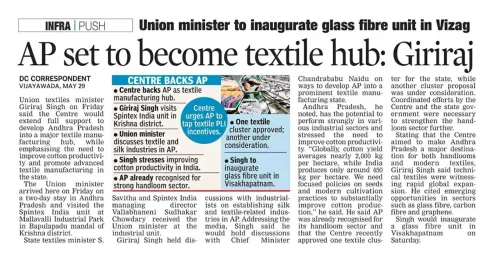
Union Textiles Minister Giriraj Singh on 30 May 2026 pledged full central government support to make Andhra Pradesh a premier national textile hub, citing the state's immense handloom and textiles potential and aligning the push with the Atmanirbhar Bharat framework.
Key Takeaways
Union Textiles Minister Giriraj Singh declared the Centre will support Andhra Pradesh at every step to become a top national textile hub.
The Minister posted in Telugu, signalling direct outreach to the state's regional audience and weaver communities.
The statement is framed within the Atmanirbhar Bharat programme and references new-age fibre and sustainable fashion as priority areas.
The PLI scheme for man-made fibre apparel (notified 2022 ) and the PM MITRA textile parks scheme (approved 2021 ) are the two principal central instruments available to the state.
Handloom weavers and textile MSMEs in Andhra Pradesh are the primary stakeholder groups expected to benefit from enhanced central engagement.
Formal follow-through — MoUs, park allocations, or PLI target revisions — will be the key indicators to watch in the coming months.
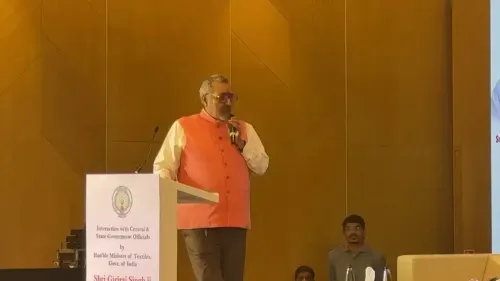
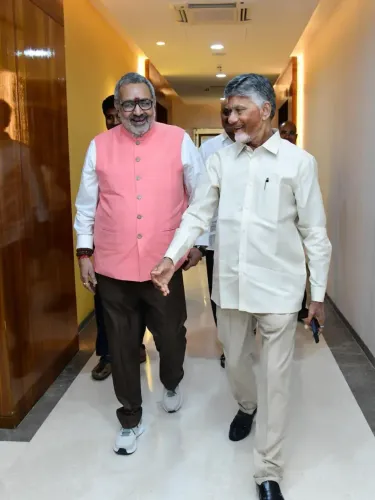
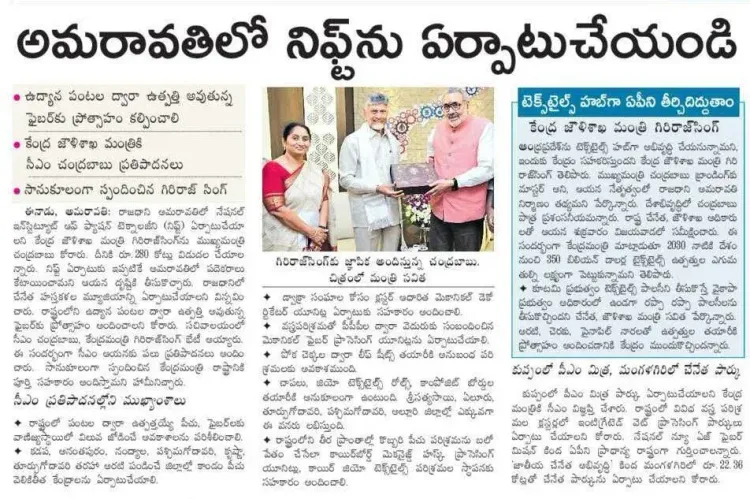
Union Textiles Minister Giriraj Singh on Saturday, 30 May 2026 pledged the central government's full support at every step to realise the Andhra Pradesh Chief Minister's vision of establishing the state as a leading national textile hub, citing immense untapped potential in the textiles and handloom sectors.
Posting in Telugu on X, the Minister stated: 'వస్త్రాలు మరియు చేనేత రంగాల్లో ఆంధ్రప్రదేశ్కు అపారమైన అవకాశాలు ఉన్నాయి' ('Andhra Pradesh has immense opportunities in the textiles and handloom sectors'). He added that bringing about 'comprehensive transformation across the entire sector' is the Ministry's goal and that its 'determined efforts will continue unabated.'
Context
Andhra Pradesh carries a long tradition of handloom weaving, with clusters producing iconic fabrics including Pochampally ikat, Venkatagiri cotton, and Dharmavaram silk. The state has been seeking to leverage this heritage base to attract modern textile manufacturing investment and position itself as a diversified textile destination at the national level. The Minister's statement signals an active federal partnership in that pursuit.
The post was tagged with #AtmanirbharBharat, #NewAgeFibre, and #SustainableFashion, indicating that the Centre's support is framed within the national self-reliance programme and a forward-looking push into technical and sustainable textiles — sectors where global demand is rising sharply.
Policy Backdrop
The central government has put in place two major instruments that could directly benefit Andhra Pradesh. The Production Linked Incentive (PLI) scheme for man-made fibre apparel and fabrics, notified in 2022, offers financial incentives to manufacturers who scale output and exports in designated product lines. Separately, the PM MITRA (Mega Integrated Textile Region and Apparel) parks scheme, approved in 2021, aims to create plug-and-play integrated infrastructure — spinning, weaving, processing, dyeing, and garmenting — under one roof across multiple states.
Both schemes are designed to decentralise textile manufacturing beyond its traditional concentration in Gujarat, Maharashtra, and Tamil Nadu, and states such as Andhra Pradesh have been identified as potential beneficiaries. The Atmanirbhar Bharat framework underpins this strategy by tying domestic value-chain development to export competitiveness and import substitution in both conventional and technical textiles.
Stakeholders and Impact
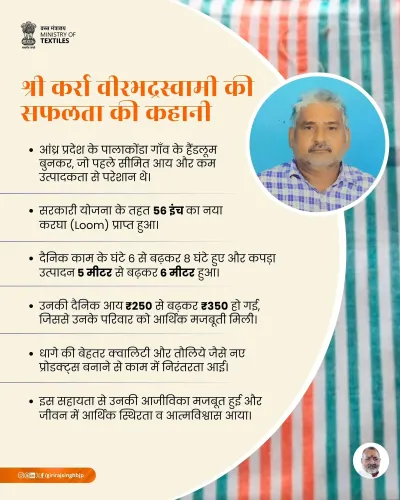
Handloom weavers and textile MSMEs stand to gain most directly from enhanced central support. Andhra Pradesh has a significant weaver population whose livelihoods depend on access to credit, design upgradation, and market linkages — areas where Ministry of Textiles programmes have historically intervened. A step-up in support could translate into more weavers enrolled under welfare schemes and more MSME units qualifying for PLI benefits.
On the industrial side, an elevated status as a national textile hub would require investment in logistics, processing infrastructure, and skilled labour. The hashtag #NewAgeFibre in the Minister's post points to an ambition beyond traditional weaving — encompassing man-made fibres, technical textiles, and sustainable fashion supply chains that carry higher value addition and employment potential.
What's Next
Observers will watch for formal follow-through in the form of MoU signings between the Ministry of Textiles and the Andhra Pradesh government, announcements regarding PM MITRA park allocations, or enhanced PLI targets for the state in the Ministry's next annual review. The Minister's public commitment in the regional language is itself a signal of political intent ahead of any administrative action.
If the Centre's backing translates into concrete project approvals, Andhra Pradesh could emerge as a significant new node in India's textile export map — a development that would also serve the broader national target of growing the country's share in global apparel and technical textile markets over the coming decade.
Point of View
Designed to signal solidarity with the Andhra Pradesh government's industrial ambitions in a sector that is both economically vital and politically resonant for the state's large weaver population. The emphasis on 'comprehensive transformation' and hashtags such as #NewAgeFibre and #SustainableFashion suggests the Ministry is consciously repositioning its Andhra engagement beyond legacy handloom welfare toward higher-value manufacturing and exports. This fits a broader pattern in which the Ministry of Textiles has used state-specific partnerships to decentralise production and meet national export targets under the Atmanirbhar Bharat framework. The real test will come when political intent is matched by project approvals — particularly on PM MITRA park allocations and PLI uptake — that can be measured and held accountable.
NationPress
15 Oct 2026
Frequently Asked Questions
What did Giriraj Singh say about Andhra Pradesh textiles?
Union Textiles Minister Giriraj Singh stated that Andhra Pradesh has immense opportunities in the textiles and handloom sectors and pledged that the central government will support the state at every step to become a leading national textile hub.
What is the PM MITRA textile park scheme?
PM MITRA (Mega Integrated Textile Region and Apparel) is a central government scheme approved in 2021 to build integrated textile infrastructure — covering spinning, weaving, processing, and garmenting — across multiple states, with Andhra Pradesh among potential beneficiary locations.
How does the PLI scheme benefit Andhra Pradesh textiles?
The Production Linked Incentive scheme for man-made fibre apparel and fabrics, notified in 2022 , offers financial incentives to manufacturers who scale output and exports, and Andhra Pradesh-based units investing in eligible product lines can qualify for these benefits.
What is Atmanirbhar Bharat's role in textile development?
Atmanirbhar Bharat is the national self-reliance programme that provides the overarching policy framework for boosting domestic textile manufacturing, reducing import dependence, and increasing India's share of global apparel and technical textile exports.
Which Andhra Pradesh handloom products are internationally known?
Andhra Pradesh is home to several iconic handloom traditions including Pochampally ikat, Venkatagiri cotton, and Dharmavaram silk, which form the heritage base the state seeks to build upon as it pursues a broader textile manufacturing identity.