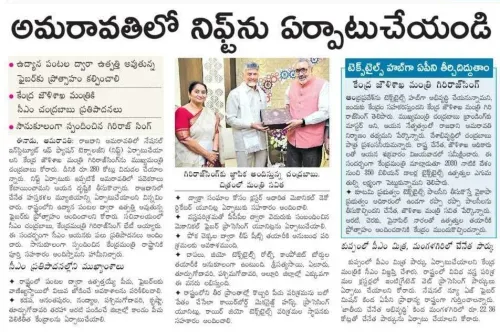
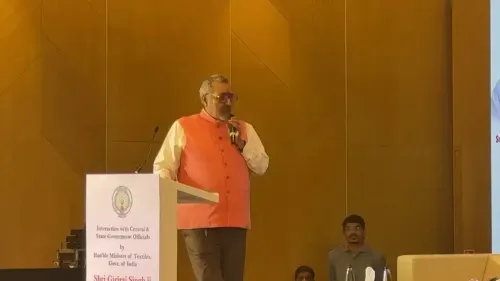
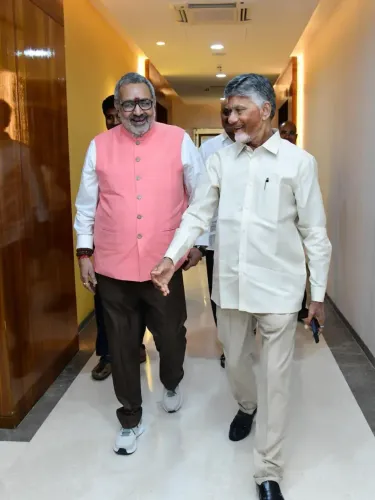
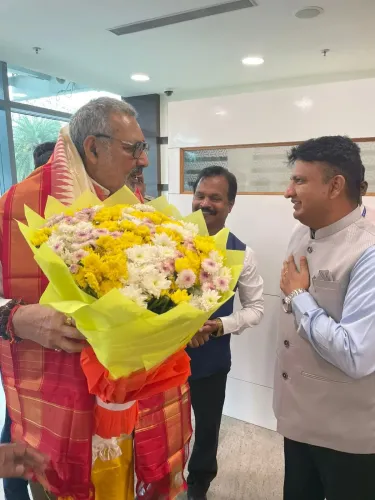
Giriraj Singh eyes Andhra Pradesh as major textile hub
Synopsis
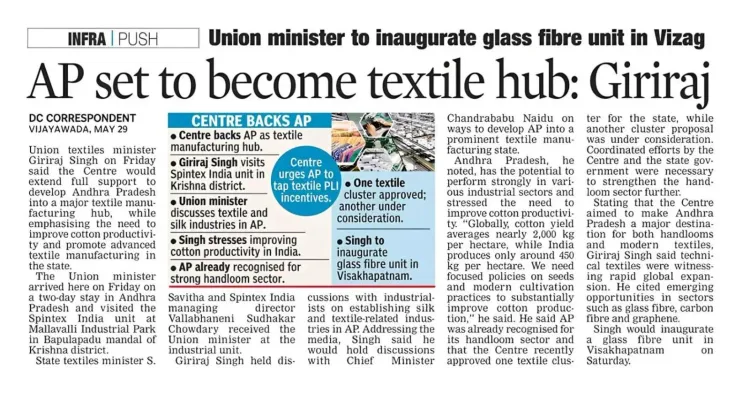
Union Textiles Minister Giriraj Singh on 30 May 2026 highlighted Andhra Pradesh's potential as a national textile and handloom hub, expressing confidence that coordinated Centre-state efforts would drive manufacturing, employment, and innovation in the state under the Viksit Bharat framework.
Key Takeaways
Giriraj Singh on 30 May 2026 identified Andhra Pradesh as a priority state for national textile hub development.
The Minister cited the state's 'forward-looking policies' and 'industry-friendly environment' alongside Central government support as key enablers.
The push is framed within the Viksit Bharat framework, linking regional industrial growth to the national development vision.
The Scheme for Integrated Textile Parks (2005) and ATUFS (2016) are the principal Central policy instruments supporting this strategy.
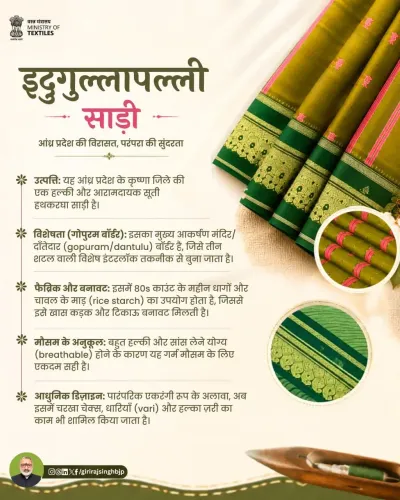
Handloom weavers and textile MSMEs in Andhra Pradesh are the primary intended beneficiaries of Centre-state coordination.
Concrete follow-through — new textile parks, PLI-linked units, or joint monitoring mechanisms — remains to be announced.
Union Textiles Minister Giriraj Singh on Saturday, 30 May 2026, underscored the vast potential of Andhra Pradesh's textiles and handloom sector, expressing confidence that coordinated efforts between the Centre and the state government would transform the southern state into a leading national hub for textile manufacturing, employment generation, and innovation.
Context
Posting on X, the Minister wrote in Hindi: 'Andhra Pradesh mein vastra evam hathkargha kshetra ki apaar sambhavnaayein hain' — 'Andhra Pradesh holds immense potential in the textiles and handloom sector.' He cited the state's 'forward-looking policies, industry-friendly environment, and Central government support' as the pillars driving rapid progress toward making it the country's foremost textile hub.
Singh added that he was confident coordinated efforts between the Centre and the state would see Andhra Pradesh emerge as a 'powerful centre of textile manufacturing, employment creation, and innovation' — framing the push explicitly within the #ViksitBharat (Developed India) vision.
Policy Backdrop
The Ministry of Textiles has long pursued a strategy of building integrated regional clusters to reduce dependence on traditional manufacturing centres such as Tiruppur in Tamil Nadu and Surat in Gujarat. The Scheme for Integrated Textile Parks, launched in 2005, and the Amended Technology Upgradation Fund Scheme (ATUFS), introduced in 2016, form the backbone of this decentralisation effort, offering infrastructure support and capital subsidies to modernise textile units and handlooms across states.
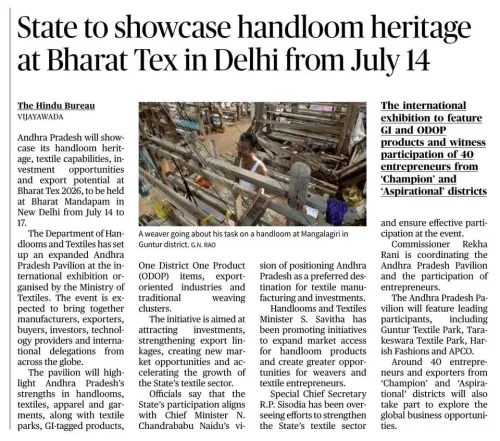
Andhra Pradesh already hosts established handloom clusters and has been identified among several states being positioned for integrated textile park investments and value-chain upgrades under the broader national framework. Central schemes are increasingly implemented through state-level policy alignment, with joint monitoring mechanisms forming a key feature of this approach.
Stakeholders and Impact
Handloom weavers and textile MSMEs in Andhra Pradesh stand to be the most direct beneficiaries of any accelerated Centre-state investment. The state has a significant weaver community whose livelihoods are closely tied to policy support for raw material access, technology upgradation, and market linkages.
Broader employment generation in the labour-intensive textiles sector is a stated national priority, particularly for semi-skilled workers in states like Andhra Pradesh. Any new textile park or production-linked initiative in the state would have downstream effects on logistics, retail, and export infrastructure in the region.
What's Next
Attention will now focus on whether the Minister's statement is followed by concrete announcements — such as the rollout of new integrated textile parks, production-linked incentive units, or formal joint Centre-state monitoring frameworks specifically for Andhra Pradesh. Upcoming Union Budget allocations and state-level textile policy updates will be closely watched by industry stakeholders and weaver cooperatives alike.
The post signals that the Ministry of Textiles is actively aligning with state-level ambitions in Andhra Pradesh, setting the stage for potential policy announcements in the months ahead.
Point of View
A pattern the Ministry of Textiles has deployed to build political and investor momentum ahead of formal policy announcements. By explicitly invoking the Viksit Bharat framework, the Minister ties a state-level industrial push to a national electoral and developmental narrative, reinforcing the BJP's governance record in a state where the party has allied interests. The emphasis on 'coordinated efforts' also suggests that the Centre is seeking active state-level policy reciprocity — not simply top-down fund transfers. Whether this translates into measurable investment or remains aspirational rhetoric will depend on the specifics announced in subsequent budget cycles and textile policy reviews.
NationPress
13 Oct 2026
Frequently Asked Questions
Why is Giriraj Singh focusing on Andhra Pradesh for textiles?
Union Textiles Minister Giriraj Singh has highlighted Andhra Pradesh's established handloom clusters, industry-friendly state policies, and alignment with Central schemes as reasons to position it as a major national textile hub, as part of a broader strategy to develop regional manufacturing centres beyond traditional hubs like Tiruppur and Surat.
What Central schemes support textile development in Andhra Pradesh?
The Scheme for Integrated Textile Parks, launched in 2005, and the Amended Technology Upgradation Fund Scheme (ATUFS), introduced in 2016, are the principal Central instruments offering infrastructure support and capital subsidies for textile and handloom modernisation in states including Andhra Pradesh.
What is the Viksit Bharat framework in the context of textiles?
Viksit Bharat, or 'Developed India', is the Union government's overarching development vision under which sectoral policies — including textiles — are framed. Central textile schemes are increasingly implemented through state-level policy alignment under this framework to boost employment and exports.
Who benefits most from Andhra Pradesh becoming a textile hub?
Handloom weavers and textile MSMEs in Andhra Pradesh are the most direct beneficiaries, gaining from improved infrastructure, technology upgradation support, market linkages, and employment opportunities generated by integrated textile park investments.
What should we watch for next in Andhra Pradesh textiles policy?
Key developments to watch include announcements of new integrated textile parks or production-linked incentive units in Andhra Pradesh, formal Centre-state joint monitoring mechanisms, and relevant allocations in upcoming Union Budget sessions.