Assam Budget 2026: State to Replace Open Canals with Piped Irrigation
Synopsis
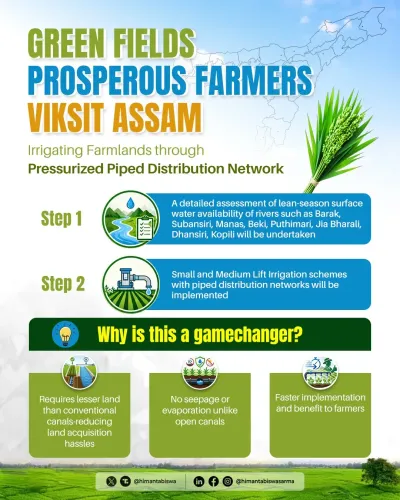
The Chief Minister's Office of Assam announced in the Assam Budget 2026 that the state will replace conventional open irrigation canals with a Pressurized Piped Distribution Network to reduce water loss, cut costs and improve irrigation efficiency for farmers across the northeastern state.
Key Takeaways
The Assam Budget 2026 proposes transitioning from open irrigation channels to a Pressurized Piped Distribution Network .
The shift is designed to reduce water loss, lower irrigation costs and deliver faster water access to farmers.
Traditional open canal systems are estimated to lose 30 to 40 percent of water through seepage in Indian conditions.
The proposal aligns with the Pradhan Mantri Krishi Sinchayee Yojana , the central government's irrigation efficiency scheme launched in 2015 .
Agriculture — including rice, tea and horticulture — is a significant contributor to Assam's economy and stands to benefit directly.
Specific budget allocations, pilot districts and rollout timelines are yet to be officially detailed.
The Chief Minister's Office of Assam announced on 10 July 2026 that the Assam Budget 2026 proposes a major overhaul of the state's irrigation infrastructure, with the government committing to transition from conventional open channels to a Pressurized Piped Distribution Network for agricultural irrigation.
Context
The announcement, shared as part of a series of budget highlights under the hashtag #AssamBudget2026, identifies irrigation modernisation as a central pillar of agricultural reform. The government stated the shift aims to 'reduce water loss, lower costs and deliver faster, more efficient irrigation for farmers.' Assam, a northeastern state where agriculture — including rice, tea and horticulture — forms a significant share of the economy, has long relied on open canal networks that are susceptible to seepage and evaporation losses.
Policy Backdrop
The move aligns with a well-established national trend. Several Indian states have been migrating from open canal systems to pressurised piped networks, a shift driven by studies estimating seepage losses of 30 to 40 percent in traditional irrigation infrastructure. The Pradhan Mantri Krishi Sinchayee Yojana (PMKSY), launched by the Government of India in 2015, has been the primary central framework promoting efficient irrigation, micro-irrigation adoption and improved water-use efficiency across states, including Assam. The state's budget proposal continues the pattern of northeastern states integrating central irrigation objectives into their own fiscal plans.
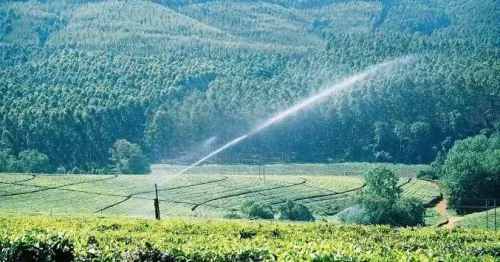
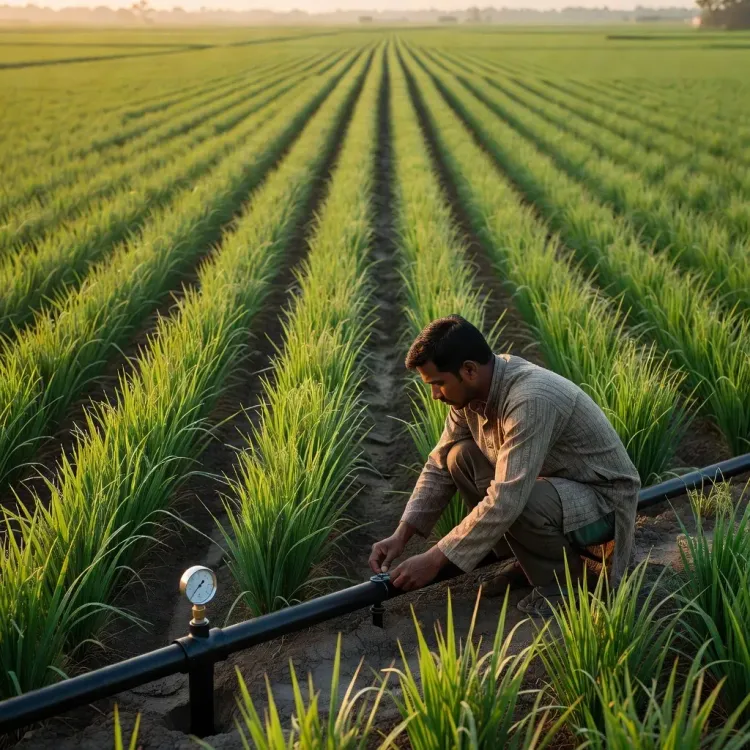
Pressurised piped systems deliver water directly to farm plots under controlled pressure, enabling drip and sprinkler connections, reducing dependence on gravity-fed channels, and cutting the labour and maintenance costs associated with earthen or concrete open canals. For a flood-prone and water-stressed region like Assam, the model also supports climate-resilient agricultural planning.
Stakeholders and Impact
The primary beneficiaries of the proposed transition are Assam's farming communities, who currently bear the burden of inefficient water delivery, uneven field coverage and high irrigation costs under the open-channel system. Faster and more reliable water access is expected to improve crop yields, reduce input costs and support multiple cropping cycles where water availability had previously been a constraint.
The agricultural sector at large — spanning smallholder rice cultivators, tea garden operations and horticulture growers — stands to gain from more predictable irrigation scheduling. The shift also has downstream implications for water resource management across the state, potentially reducing pressure on natural water bodies during dry seasons.
What's Next
Budget allocation figures, pilot districts and a detailed implementation timeline for the 2026-27 fiscal year are expected to be outlined as the full budget document is tabled and debated. Coordination with central ministries responsible for PMKSY and related irrigation funding will be closely watched, as will the state's capacity to execute a large-scale infrastructure rollout across Assam's geographically diverse terrain. If implemented at scale, the Pressurized Piped Distribution Network could redefine how irrigation is delivered across one of India's most agriculturally dependent northeastern states.
Point of View
The move signals a maturation in how Assam plans its farm-sector spending. The political calculus is clear: rural Assam remains electorally decisive, and visible infrastructure upgrades in irrigation carry tangible on-ground impact. Whether the proposal translates into executed infrastructure or remains a budget line will depend on implementation bandwidth and central co-funding arrangements in the 2026-27 fiscal year.
NationPress
8 Oct 2026
Frequently Asked Questions
What is the Assam Budget 2026 irrigation announcement?
The Assam Budget 2026 proposes replacing conventional open irrigation canals with a Pressurized Piped Distribution Network to reduce water loss, cut costs and improve water delivery speed for farmers across the state.
What is a Pressurized Piped Distribution Network for irrigation?
A Pressurized Piped Distribution Network delivers water to farm plots through enclosed pipes under controlled pressure, enabling drip and sprinkler connections while eliminating the seepage and evaporation losses common in open canal systems.
How much water is lost in traditional open canal irrigation in India?
Studies estimate that traditional open canal irrigation systems in India lose between 30 and 40 percent of water through seepage and evaporation before it reaches farm fields.
How does Assam's irrigation plan relate to PMKSY?
The proposal aligns with the Pradhan Mantri Krishi Sinchayee Yojana, the central government scheme launched in 2015 to promote efficient irrigation and reduce water losses, which Assam has been part of since the scheme's inception.
Who benefits from piped irrigation in Assam?
Assam's farmers — including smallholder rice cultivators, tea garden operators and horticulture growers — are the primary beneficiaries, as piped irrigation promises more reliable water access, lower costs and potentially higher crop yields.