CM Himanta sets August dates for Orunodoi, Nijut Moina re-launch
Synopsis
Chief Minister Himanta Biswa Sarma has set August re-launch dates for Orunodoi, Nijut Moina and NFSA food distribution in Assam, and announced a new district-level grievance unit called Orunodoi Sarothi to strengthen last-mile welfare delivery.
Key Takeaways
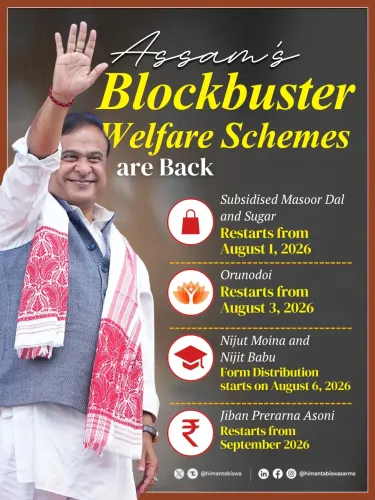
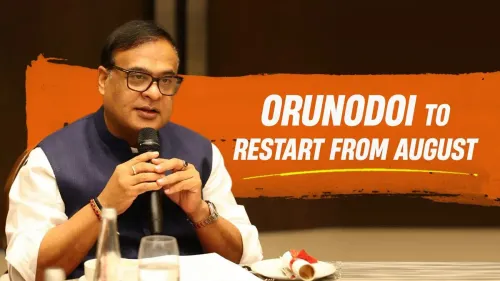
Orunodoi will be re-launched on 1 August 2026 , Nijut Moina on 6 August , and NFSA food grain distribution from 10 August .
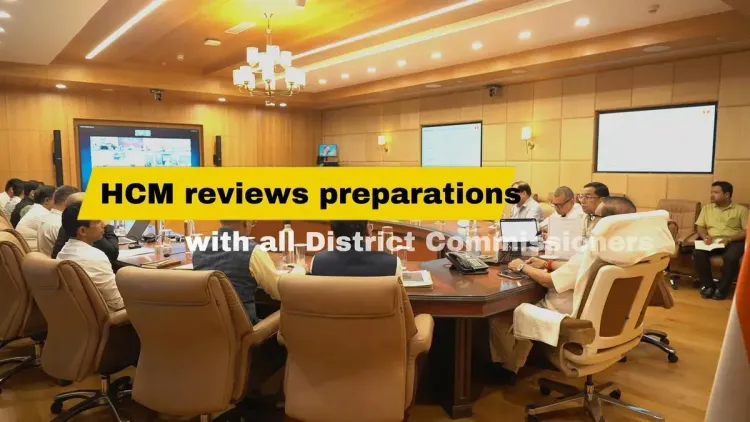
CM Himanta Biswa Sarma chaired a review with all District Commissioners on 29 July 2026 to finalise delivery plans.
A new mechanism, Orunodoi Sarothi , will be introduced in every district for grievance redressal and accountable benefit delivery.
Orunodoi , first launched around 2020 , provides monthly financial assistance to women from economically weaker sections across Assam.
DCs have been directed to ensure 'seamless, transparent and efficient' delivery to every eligible beneficiary.
Three welfare lifelines for lakhs of Assam households are getting a firm calendar — and a new accountability layer to back them up. The Chief Minister's Office of Assam announced on Wednesday, 29 July 2026 that Chief Minister Dr. Himanta Biswa Sarma chaired a state-wide review with all District Commissioners, locking in re-launch dates for the state's most consequential welfare programmes.
Three programmes, three August deadlines
The schedule is precise: the flagship women's assistance scheme Orunodoi re-launches on 1 August, the Nijut Moina initiative follows on 6 August, and distribution of subsidised food grains under the National Food Security Act (NFSA) begins from 10 August. Staggering the dates across ten days is a deliberate administrative choice — it gives district machinery breathing room to process each rollout without overlap.
What Orunodoi means for Assam's women
Orunodoi — the Assamese word for 'sunrise' — was first launched around 2020 as a monthly direct-benefit transfer targeted at women from economically weaker sections. It has since grown into one of the state's most politically and socially visible programmes, reaching lakhs of beneficiaries across the Brahmaputra valley and the hills. The re-launch signals a reset: fresh enrolment, updated beneficiary lists, and renewed delivery infrastructure.
The NFSA, a 2013 central law, mandates subsidised food grains for priority households. Its Assam rollout has run through state-managed public distribution channels, but periodic reviews — like the one CM Sarma convened today — are standard practice to plug leakages and update beneficiary rolls.
Orunodoi Sarothi: the grievance layer Assam's districts will now carry
The sharpest new announcement is Orunodoi Sarothi — a dedicated grievance redressal mechanism to be introduced in every district. The name itself ('Sarothi' means charioteer or guide) signals intent: not just a complaint box, but an active navigator for citizens stuck in bureaucratic gaps. CM Sarma directed all DCs to ensure delivery is 'seamless, transparent and efficient' — language that puts district-level accountability squarely on record.
The move reflects a pattern visible across several state governments: welfare schemes are only as strong as the last-mile mechanism that catches those who fall through. A dedicated district-level redressal unit is a structural fix, not a cosmetic one.
What to watch as August unfolds
The real test arrives in the weeks after the launches — how quickly Orunodoi Sarothi units become operational, whether beneficiary coverage expands beyond previous rolls, and how NFSA distribution data compares to earlier cycles. Assam's district administration has its calendar. Now it has to deliver against it.
Point of View
Whose governance brand rests heavily on direct-benefit delivery and visible administrative action, the staggered calendar also manages optics — each launch gets its own moment. The broader pattern mirrors a national trend of states layering grievance infrastructure onto existing welfare schemes to improve both coverage and political credit attribution.
NationPress
13 Sept 2026
Frequently Asked Questions
When is Orunodoi being re-launched in Assam in 2026?
Orunodoi will be re-launched on 1 August 2026 , as announced by Chief Minister Himanta Biswa Sarma after a review meeting with all District Commissioners on 29 July 2026.
What is Orunodoi Sarothi in Assam?
Orunodoi Sarothi is a new grievance redressal mechanism announced by CM Himanta Biswa Sarma, to be introduced in every district of Assam to make welfare delivery more responsive, accountable and citizen-centric.
What is the Nijut Moina scheme in Assam?
Nijut Moina is an Assam state welfare initiative scheduled for re-launch on 6 August 2026 . Specific details on its origins could not be independently verified from available records.
When will NFSA food distribution begin in Assam in August 2026?
Distribution of essential food items under the National Food Security Act (NFSA) is set to begin from 10 August 2026 in Assam, as directed by CM Himanta Biswa Sarma.
What is the Orunodoi scheme in Assam?
Orunodoi is Assam's flagship women-centric welfare scheme, first launched around 2020 , that provides monthly direct financial assistance to women from economically weaker sections across the state.