Assam CM Office: Flood Relief on War Footing
Synopsis
The Chief Minister's Office of Assam declared on 21 July 2026 that flood relief and rescue operations are proceeding on a war footing, with all agencies in close coordination. The announcement, backed by four images, comes amid the state's annual monsoon flood cycle driven by the Brahmaputra River.
Key Takeaways
The Chief Minister's Office of Assam confirmed on 21 July 2026 that flood relief and rescue operations are ongoing 'on a war footing.' All agencies are stated to be working in close coordination to assist flood-affected residents.
Assam faces recurrent annual flooding from the Brahmaputra River and its tributaries, affecting lakhs of people each monsoon season.
India's disaster-response framework under the National Disaster Management Act, 2005 enables deployment of the NDRF alongside state forces during such events.
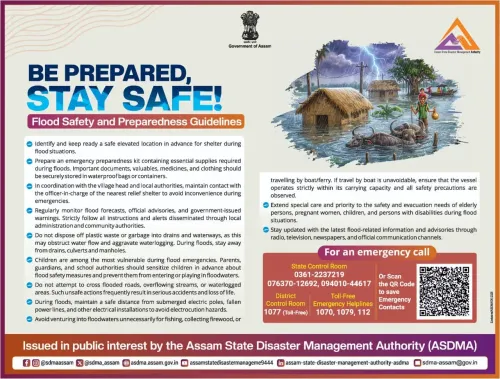
The Assam State Disaster Management Authority (ASDMA) issues daily flood bulletins tracking district-wise inundation and displaced persons.
Long-term structural measures including Brahmaputra embankment and dredging projects have been pursued since the 1950s but annual flooding continues to challenge the state.
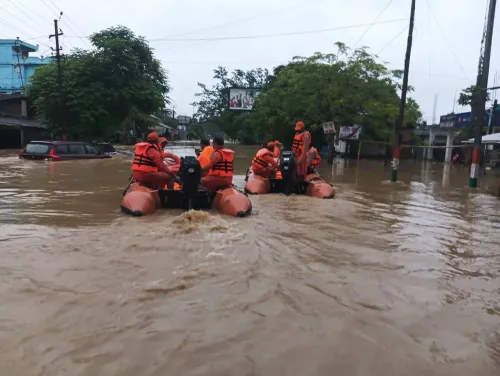
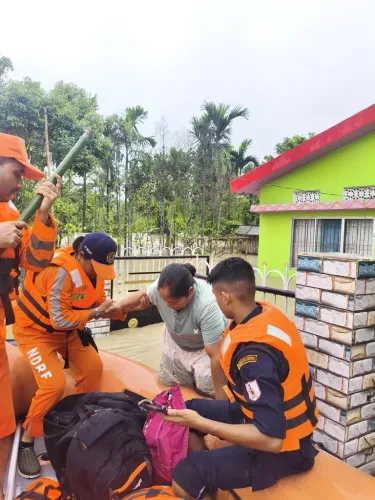
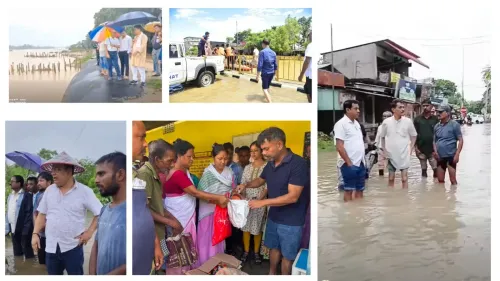
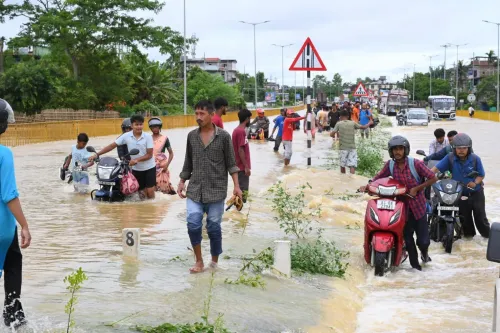
The Chief Minister's Office of Assam announced on Tuesday, 21 July 2026 that flood relief and rescue operations across the state are continuing 'on a war footing,' with all agencies working in close coordination to assist those in need.
Context
Assam endures recurrent, large-scale riverine flooding every monsoon season, driven primarily by the swelling of the Brahmaputra River and its tributaries across the state's plains. The annual cycle routinely displaces lakhs of residents, inundates agricultural land, and strains local administration. The CMO's statement signals that the current flood situation has reached a severity requiring an all-hands, round-the-clock response posture.
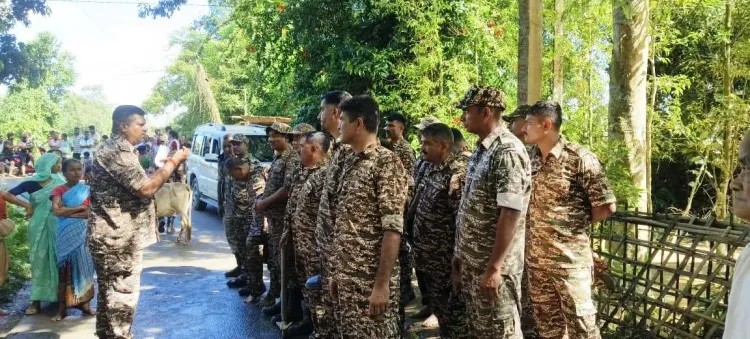
The phrase 'war footing' in official communication is a standard indicator that the state executive has elevated its operational tempo, mobilising multiple agencies simultaneously rather than sequentially. The post was accompanied by four images, underscoring the on-ground scale of the relief effort.
Policy Backdrop
India's coordinated disaster-response architecture is anchored in the National Disaster Management Act of 2005, which established clear roles for central and state agencies during events such as floods. Under this framework, the National Disaster Response Force (NDRF) — the central government's specialist rescue body — can be deployed alongside state counterparts to augment local capacity.
Assam has historically relied on a combination of the NDRF, the State Disaster Response Force (SDRF), district administration, and the Indian Army during peak flood events. Longer-term structural responses have included successive Brahmaputra embankment-strengthening and dredging programmes dating back to the 1950s, though annual flooding continues to test these defences each monsoon.
Stakeholders and Impact
The most immediate stakeholders are flood-affected residents across rural and semi-urban communities in Assam — people who depend on rescue boats, relief camps, food distribution, and medical assistance during inundation. Farmers face crop loss, while those in low-lying areas risk displacement for weeks at a stretch.
For coordinating agencies — state government departments, the NDRF, SDRF, district collectors, and civil-society volunteers — the 'close coordination' cited by the CMO is operationally critical. Gaps between agencies have historically led to delays in reaching the most vulnerable, making inter-agency communication a key metric of response quality. The Assam State Disaster Management Authority (ASDMA) typically issues daily flood bulletins tracking district-wise inundation, displaced persons, and relief-camp occupancy.
What's Next
Attention will now focus on ASDMA's daily flood bulletins for granular data on the number of districts affected, persons displaced, and relief camps operational. Any formal request from the state government to New Delhi for additional central assistance — whether additional NDRF battalions, financial relief under the National Disaster Response Fund, or Army deployment — would mark a significant escalation.
As the monsoon season progresses through August, embankment integrity and early-warning system effectiveness will be closely watched. The pace at which affected families can return home and resume livelihoods will ultimately define the relief operation's success.
Point of View
Part public reassurance — that the state executive is treating the current flood cycle as a crisis requiring maximum mobilisation rather than routine management. For the ruling dispensation in Dispur, visible, coordinated relief is politically essential in a state where monsoon flooding is a perennial grievance and a recurring electoral flashpoint. The emphasis on 'close coordination' also implicitly addresses a long-standing criticism of Indian disaster response: that inter-agency silos slow the reach of relief to the most vulnerable. How quickly the state transitions from rescue to rehabilitation — and whether embankment failures are formally audited — will reveal whether this response breaks from historical pattern or repeats it.
NationPress
21 Jul 2026
Frequently Asked Questions
What is the current flood situation in Assam in July 2026?
The Chief Minister's Office of Assam stated on 21 July 2026 that flood relief and rescue operations are continuing on a war footing, with all agencies in close coordination to assist those affected. Specific district-level data is tracked through daily ASDMA flood bulletins.
Which agencies are involved in Assam flood relief operations?
Assam's flood response typically involves the National Disaster Response Force (NDRF), the State Disaster Response Force (SDRF), district administration, and state government departments working in coordination under the National Disaster Management Act, 2005.
Why does Assam flood every year?
Assam experiences recurrent annual flooding primarily due to the monsoon-season swelling of the Brahmaputra River and its tributaries, which inundate the state's low-lying plains. The state has pursued embankment and dredging projects since the 1950s, but flooding remains a persistent challenge.
What does 'war footing' mean in the context of disaster relief?
'War footing' in official government communication means that all available resources and agencies have been mobilised simultaneously for round-the-clock operations, indicating that the situation has been classified as a high-severity emergency requiring maximum response.
How can flood-affected people in Assam get relief?
Flood-affected residents in Assam can approach district administration-run relief camps for shelter, food, and medical assistance. The Assam State Disaster Management Authority (ASDMA) publishes daily bulletins with information on camp locations and affected districts.