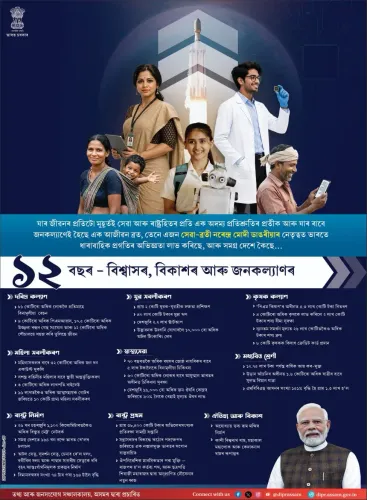
CM Assam Office Marks 12 Years of Modi-Led Welfare Governance

Synopsis
The Chief Minister's Office of Assam marked 12 years of Prime Minister Narendra Modi's governance on June 9, 2026, sharing a video tribute under #12YearsOfGaribKalyan. The post frames the period as a shift from narrow welfare subsidies to integrated well-being, anchored by flagship schemes including Jan Dhan, Swachh Bharat, PM-KISAN, and the Garib Kalyan Anna Yojana.
Key Takeaways
The Chief Minister's Office of Assam posted a video tribute on June 9, 2026 , marking 12 years of PM Narendra Modi 's governance.
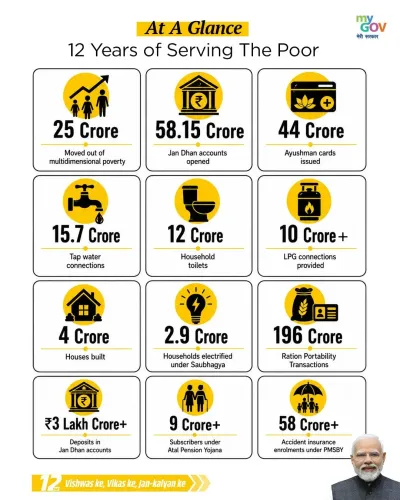
The campaign hashtag #12YearsOfGaribKalyan frames the period as a shift 'from welfare to well-being.' Key schemes in the 12-year arc include PM Jan Dhan Yojana (2014), Swachh Bharat Mission (2014), PM-KISAN (2018), and PM Garib Kalyan Anna Yojana (2020–2024).
Direct benefit transfers (DBT) and digital infrastructure are central to the governance narrative being amplified.
Assam's BJP-led government has consistently aligned with central welfare messaging since coming to power in 2016 .
Observers are watching for fresh central announcements tied to the next Union Budget cycle.
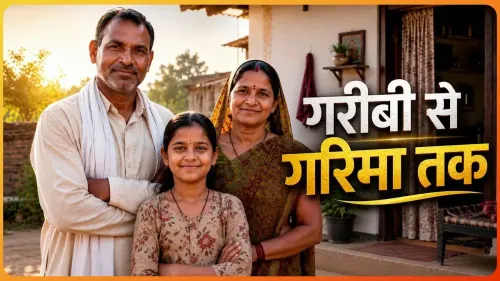
The Chief Minister's Office of Assam on Tuesday, June 9, 2026, shared a video tribute marking 12 years of governance under Prime Minister Narendra Modi, framing the period as a shift 'from welfare to well-being' under the hashtag #12YearsOfGaribKalyan.
Context
The post, published at 9:30 AM IST, accompanies a video and captures the BJP-led Assam government's alignment with the central narrative around 12 years of the Modi administration — which began in May 2014. The phrase 'Garib Kalyan' (welfare of the poor) has served as the umbrella framing for the central government's social spending architecture since that period.
The Chief Minister's Office described the era as one of 'transformative governance,' a phrase echoing the broader communication strategy that has positioned welfare delivery as a structural upgrade rather than a temporary relief measure.
Policy Backdrop
The 12-year arc referenced in the post spans a sequence of flagship schemes. Pradhan Mantri Jan Dhan Yojana, launched in August 2014, aimed to bring unbanked households into the formal financial system. The Swachh Bharat Mission, rolled out in October 2014, linked sanitation access to broader well-being goals.
PM-KISAN, introduced in December 2018, extended direct income support to small and marginal farmers. More recently, the PM Garib Kalyan Anna Yojana — first announced in 2020 and extended in phases through 2024 — provided free grain to priority households, becoming one of the largest food security interventions in the country's history.
Together, these programmes form the policy lineage that the #12YearsOfGaribKalyan campaign draws upon, presenting digital infrastructure and direct benefit transfers (DBT) as the mechanisms that shifted welfare from subsidy-based models to integrated development.
Stakeholders and Impact
The primary beneficiaries of the schemes highlighted in this narrative are low-income households, rural communities, and small and marginal farmers across India. Assam, a northeastern state with significant rural and tribal populations, has been an active implementer of central welfare programmes since the BJP-led government came to power there in 2016.
States governed by the same party as the Centre have routinely amplified such milestone messaging through coordinated social media campaigns, using anniversary moments to reinforce the political and administrative continuity between state and central delivery mechanisms.
What's Next
The 12-year milestone arrives as policymakers and observers watch for state-level utilisation reports on extended food security schemes and any fresh central announcements tied to the upcoming Union Budget cycle. The Garib Kalyan framing is expected to remain central to the ruling party's communication ahead of any major electoral or legislative calendar events.
How the central government chooses to build on this narrative — whether through new scheme extensions, enhanced DBT allocations, or fresh policy launches — will determine whether the 'welfare to well-being' arc moves from messaging into measurable new commitments.
Point of View
Party-wide communication exercise marking a politically significant milestone. By invoking 'Garib Kalyan' — a phrase that doubles as a scheme name and a broader ideological claim — the messaging ties state governance to the Centre's welfare brand. This pattern of synchronised amplification from BJP-ruled states reflects a disciplined media strategy that uses anniversaries to consolidate narrative ownership over welfare delivery. The post signals that the 'welfare to well-being' frame will likely anchor the ruling party's political communication through the next budget and electoral cycle.
NationPress
20 Sept 2026
Frequently Asked Questions
What is #12YearsOfGaribKalyan?
#12YearsOfGaribKalyan is a social media campaign marking 12 years of Prime Minister Narendra Modi's governance since May 2014, highlighting welfare and well-being schemes such as PM Jan Dhan Yojana, PM-KISAN, and PM Garib Kalyan Anna Yojana.
What is PM Garib Kalyan Anna Yojana?
PM Garib Kalyan Anna Yojana is a central government food security scheme that provides free grain to priority households. It was first announced in 2020 and was extended in phases through 2024.
Why is the Assam Chief Minister's Office posting about Modi's 12 years?
Assam is governed by the BJP, the same party that leads the central government. BJP-ruled states routinely amplify central welfare milestones through coordinated social media campaigns to reinforce alignment between state and central governance.
What are the major welfare schemes launched in 12 years of Modi government?
Key schemes include Pradhan Mantri Jan Dhan Yojana for financial inclusion (2014), Swachh Bharat Mission for sanitation (2014), PM-KISAN income support for farmers (2018), and PM Garib Kalyan Anna Yojana for food security (2020).
What does 'from welfare to well-being' mean in the context of Modi governance?
The phrase reflects the central government's framing that its programmes have evolved from narrow subsidy-based relief toward integrated development, using digital infrastructure and direct benefit transfers to deliver services more efficiently to low-income and rural households.