Assam CM Office: Traditional Dongs Revived for 1,452 Households
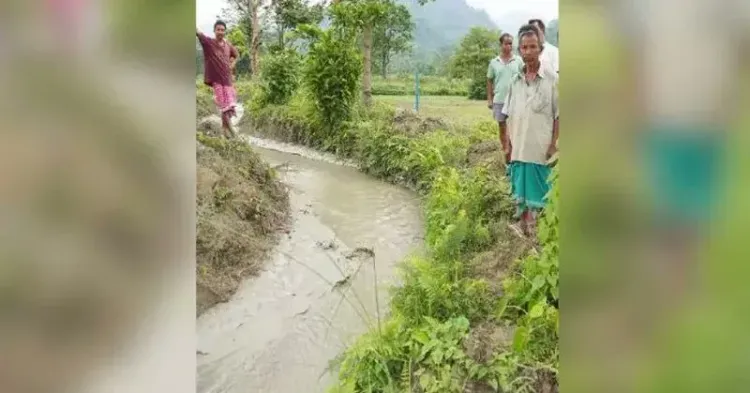
Synopsis
The Chief Minister's Office of Assam announced that the revival of traditional dong irrigation canals — a centuries-old Bodo water-management practice — has benefited 1,452 households across the Bodoland Territorial Region, advancing post-accord rural development commitments in western Assam.
Key Takeaways
1,452 households across the Bodoland Territorial Region have benefited from the revival of traditional dong irrigation canals.
Dongs are community-managed earthen channels historically used by Bodo villages for agriculture and flood control in the Brahmaputra valley .
The initiative aligns with rural infrastructure commitments made under the 2020 Bodo Peace Accord .
The Bodoland Territorial Council (BTC) is the nodal implementing body, working with state water resources and agriculture departments.
The programme supports climate-resilient agriculture by reviving low-cost, indigenous water-management infrastructure in tribal districts.
Further phases of dong restoration in other BTC blocks and formal crop-yield assessments are being watched by policy observers.
The Chief Minister's Office of Assam announced on Wednesday, 17 June 2026 that the revival of traditional dongs — community-managed earthen irrigation canals historically used by Bodo villages — has extended benefits to 1,452 households across the Bodoland Territorial Region in western Assam.
Context
Dongs are centuries-old irrigation channels integral to Bodo agrarian life, channelling water from rivers and streams to paddy fields while also serving as a buffer against seasonal flooding in the Brahmaputra valley. Over decades, neglect and encroachment had rendered many of these canals non-functional, depriving farming families of a reliable water source. The current revival effort restores this indigenous infrastructure, directly linking traditional knowledge to modern rural-development goals.
The Bodoland Territorial Region (BTR) spans four districts in western Assam — Kokrajhar, Chirang, Baksa, and Udalguri — and is administered by the Bodoland Territorial Council (BTC), an autonomous body established under the 2003 Bodo Accord and strengthened by the landmark 2020 Bodo Peace Accord.
Policy Backdrop
The 2020 Bodo Accord — signed between the Government of India, the Government of Assam, and Bodo groups — placed rural infrastructure and livelihood restoration at the centre of post-conflict development in BTC areas. Revival of traditional water-management systems aligns squarely with that mandate, blending indigenous practice with state irrigation programmes.
Assam's broader push for climate-resilient agriculture in the Northeast has increasingly turned to indigenous water-management techniques as cost-effective, ecologically sound alternatives to large-scale concrete irrigation works. Dong restoration fits this template, requiring relatively low capital investment while delivering direct livelihood gains to smallholder farming families.
Stakeholders and Impact
The 1,452 households now covered are primarily Bodo farmers who depend on seasonal paddy cultivation as their principal livelihood. Restored dongs improve water availability during the critical kharif (monsoon) sowing season and reduce vulnerability to erratic rainfall — a growing concern across the Northeast. Women-headed households and marginal farmers, who lack the resources to invest in private irrigation, stand to benefit most.
The BTC has been the nodal implementing body for this initiative, working in coordination with the state's water resources and agriculture departments. Community participation in maintenance — a defining feature of the traditional dong system — is expected to sustain the infrastructure beyond the initial restoration phase.
What's Next
Officials and policy observers will watch for the extension of dong restoration to additional BTC blocks not yet covered under the current phase, as well as any formal assessment of changes in crop yield or groundwater levels in villages where canals have been revived. The programme's success in reaching 1,452 households could serve as a template for similar indigenous water-management revival efforts in other tribal districts of the Northeast. A measurable improvement in agricultural output in the covered areas would strengthen the case for scaling the model statewide.
Point of View
Indigenous solution to a modern rural-welfare target, the administration sidesteps the capital-intensive pitfalls of large irrigation projects while generating visible, enumerable beneficiaries. The specific figure of 1,452 households signals an intent to demonstrate measurable progress in BTR, where development deficits have historically fuelled grievance. If yield data from restored villages bears out the welfare claims, the dong model could become a replicable template for other tribal regions of the Northeast seeking post-accord normalcy.
NationPress
19 Sept 2026
Frequently Asked Questions
What are traditional dongs in Assam?
Traditional dongs are community-managed earthen irrigation canals historically used by Bodo villages in the Brahmaputra valley to channel water to paddy fields and manage seasonal flooding. They are a centuries-old indigenous water-management system central to Bodo agriculture.
How many households have benefited from the dong revival in Bodoland?
According to the Chief Minister's Office of Assam, the revival of traditional dongs has benefited 1,452 households across the Bodoland Territorial Region.
What is the Bodoland Territorial Region?
The Bodoland Territorial Region (BTR) is an autonomous administrative area in western Assam comprising four districts — Kokrajhar, Chirang, Baksa, and Udalguri — governed by the Bodoland Territorial Council under the 2003 and 2020 Bodo Accords.
How does the dong revival relate to the 2020 Bodo Accord?
The 2020 Bodo Peace Accord committed the governments of India and Assam to rural infrastructure and livelihood restoration in BTC areas. The dong revival directly fulfils that mandate by restoring indigenous irrigation infrastructure and improving agricultural livelihoods for Bodo farming families.
What is the significance of reviving indigenous water management in Northeast India?
Reviving indigenous water-management systems like dongs is seen as a climate-resilient, low-cost alternative to large concrete irrigation projects. It preserves traditional ecological knowledge while delivering direct livelihood benefits to smallholder and marginal farmers in tribal districts of the Northeast.