CM Himanta flags Assam estate's first Indian matcha launch
Synopsis
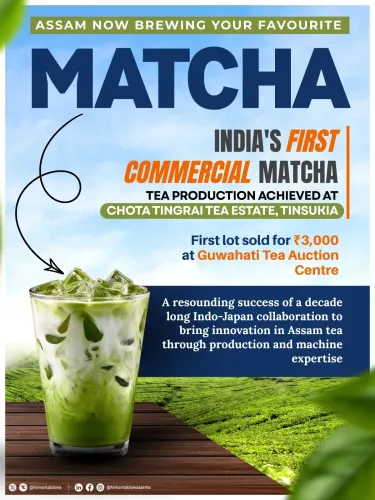
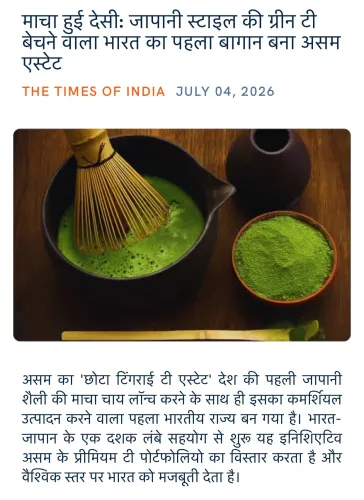
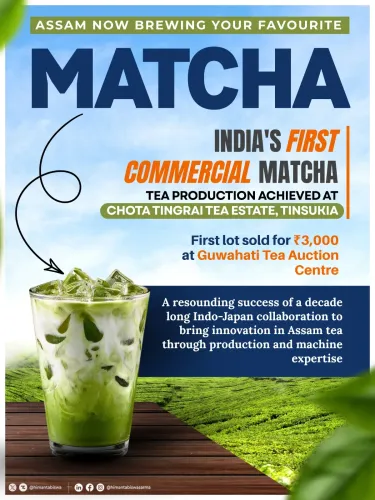
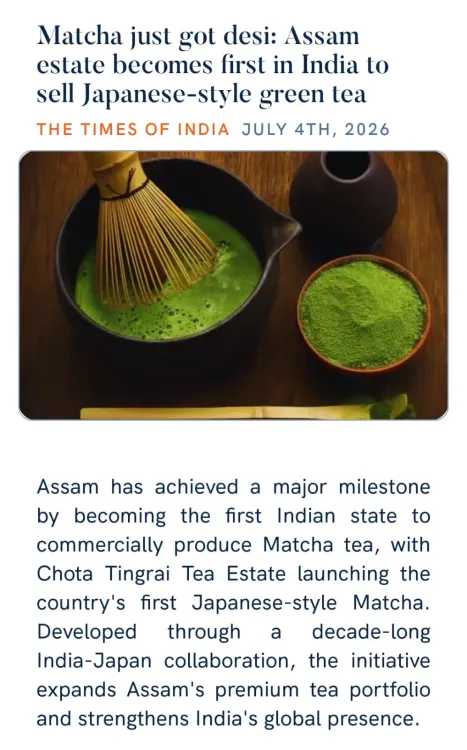
An Assam tea estate has become the first in India to commercially sell Japanese-style matcha green tea, a milestone CM Himanta Biswa Sarma spotlighted on 5 July 2026. The development marks a significant shift in Assam's tea industry from bulk black tea toward high-value specialty products with strong domestic and export demand.
Key Takeaways
An Assam tea estate has become the first in India to commercially sell Japanese-style matcha green tea.
CM Himanta Biswa Sarma highlighted the milestone on 5 July 2026 , signalling state-level endorsement of tea sector diversification.
Assam produces over half of India's total tea output but has historically focused on black orthodox and CTC varieties.
The move aligns with state government policy encouraging tea estates to shift toward specialty, value-added products for better farmer incomes.
The development mirrors similar specialty tea experiments in Darjeeling and the Nilgiris targeting health-focused domestic and export markets.
Whether the Tea Board of India will extend infrastructure support and certification to other Assam gardens remains a key question for scaling the matcha model.
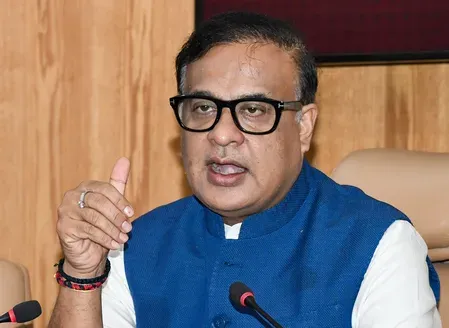
Assam Chief Minister Himanta Biswa Sarma on Sunday, 5 July 2026, highlighted a landmark development in the state's tea industry: an Assam tea estate has become the first in India to commercially sell Japanese-style matcha green tea, marking a significant shift in the country's century-old tea production landscape.
Context
Assam accounts for more than half of India's total tea output, but the industry has historically been dominated by black orthodox and CTC (crush-tear-curl) varieties geared toward bulk domestic consumption and commodity exports. The emergence of a matcha-producing estate signals a deliberate pivot toward specialty, health-focused teas that command significantly higher price points both domestically and in international markets.
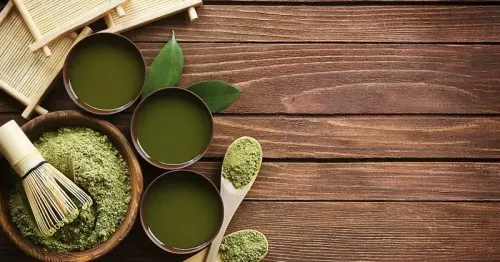
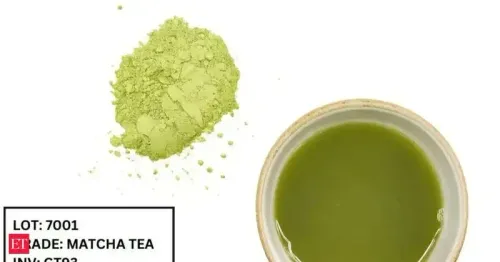
Matcha — a finely ground powder of specially shade-grown and steamed green tea leaves — is a cornerstone of Japanese tea culture and has seen surging global demand driven by health and wellness trends. Producing it requires distinct agronomic practices and processing infrastructure quite different from conventional Assam tea manufacturing.
Policy Backdrop
Since the mid-2010s, the Assam government has actively encouraged tea estates to diversify into value-added and specialty categories to improve farmer incomes and sharpen the state's export competitiveness. This policy direction has gathered momentum under CM Sarma, who has used digital platforms to amplify agricultural milestones and attract investor attention to the sector.
Across the broader Northeast, states have pursued crop diversification and Geographical Indication (GI)-linked branding of tea, coffee, and spices to move beyond low-margin bulk commodity sales. Assam's matcha experiment mirrors similar initiatives in Darjeeling and the Nilgiris, where estates have invested in white teas, oolongs, and other specialty products targeting health-conscious consumers. The Tea Board of India has been a key institutional player in supporting such transitions through research, certification frameworks, and export promotion.
Stakeholders and Impact
The development carries direct implications for Assam's estimated 6 lakh permanent tea garden workers and a larger base of small growers who supply leaf to processing units. A successful matcha value chain could translate into higher per-kilogram realisations for growers and open new export corridors to Japan, Europe, and North America, where matcha commands premium retail prices.
For consumers, a domestically produced matcha offers a potentially more affordable alternative to imported Japanese varieties. Industry observers note that the quality benchmarks for matcha — particularly the shading protocols that boost chlorophyll and L-theanine content — will be closely scrutinised by both domestic buyers and potential export partners.
What's Next
The key question now is whether the Assam government and the Tea Board of India will extend processing infrastructure support and certification pathways to other gardens interested in replicating the matcha model. New green tea standards or export incentive guidelines from the Tea Board could accelerate adoption across the state's roughly 800 large tea estates.
If matcha production scales beyond a single pioneer estate, Assam could position itself as a credible alternative origin in the global specialty green tea market — a branding opportunity that aligns squarely with the state government's broader agricultural diversification agenda.
Point of View
With real implications for grower incomes and export diversification. The critical test, however, lies not in the announcement but in whether institutional support — from the Tea Board and state agencies — follows to build a replicable supply chain rather than a one-estate showcase. If policy infrastructure catches up with the headline, Assam's matcha moment could reshape how India positions its tea sector in premium global markets.
NationPress
4 Oct 2026
Frequently Asked Questions
Which Assam estate is producing matcha green tea in India?
The specific name and location of the estate have not been officially confirmed in verifiable public records. CM Himanta Biswa Sarma identified it broadly as an Assam estate that has become the first in India to commercially sell Japanese-style matcha green tea.
What is matcha and how is it different from regular Assam tea?
Matcha is a finely ground powder made from shade-grown, steamed green tea leaves, central to Japanese tea culture. It differs sharply from Assam's dominant black orthodox and CTC teas, which use fully oxidised leaves and a different processing method.
Why is Assam producing matcha green tea now?
The Assam government has encouraged tea estates to diversify into specialty and value-added teas since the mid-2010s to improve farmer incomes and boost export competitiveness, making matcha production a natural extension of that policy direction.
Is Indian matcha as good as Japanese matcha?
Quality benchmarks for matcha — particularly shading protocols that raise chlorophyll and L-theanine levels — will be closely evaluated by buyers and export partners. Assam's matcha is too new to the market for a definitive quality comparison to be established.
Will matcha production expand to other Assam tea gardens?
That depends on whether the Tea Board of India and the Assam government extend processing infrastructure support and certification frameworks to other estates, a development that industry observers are watching closely.