Assam Launches Brikhya Bandhu: 1 Crore Saplings by Students
Synopsis
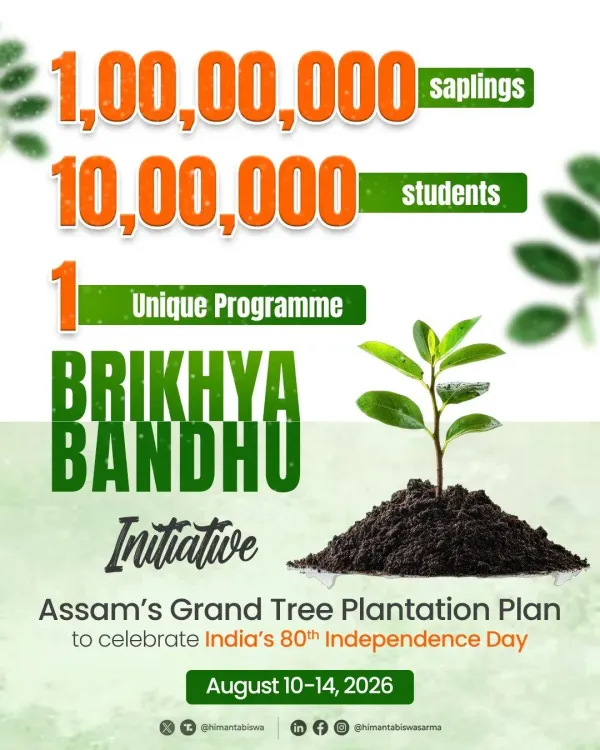
Assam's Chief Minister's Office launched 'Brikhya Bandhu' on 5 July 2026, mobilising 10 lakh students to plant and nurture 1 crore saplings statewide to mark India's 80th Independence Day — framing the drive as a long-term environmental stewardship movement, not a one-day event.
Key Takeaways
The Chief Minister's Office of Assam announced the Brikhya Bandhu initiative on 5 July 2026 .
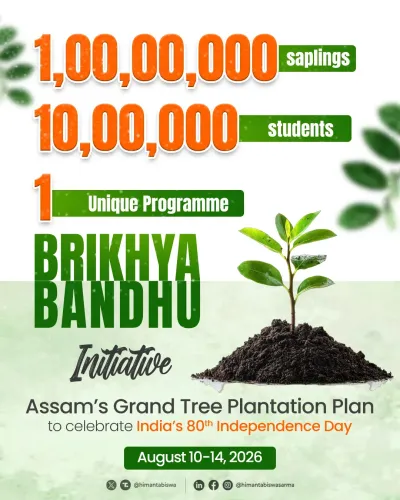
10 lakh students will plant and nurture 1 crore saplings across Assam.
The drive is timed to commemorate India's 80th Independence Day .
The initiative is led under Chief Minister Dr.
Himanta Biswa Sarma , who has governed Assam since May 2021 .
It is framed as a 'people's movement' focused on long-term environmental stewardship, not merely a symbolic plantation event.
The programme aligns with national frameworks including the Green India Mission and India's Bonn Challenge commitments.
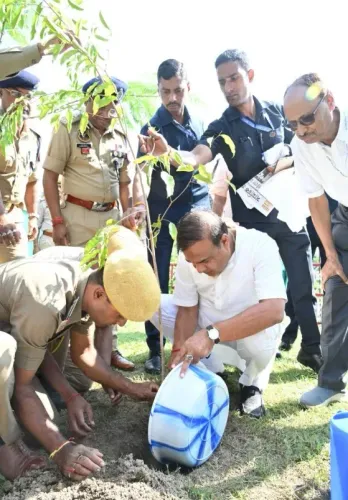
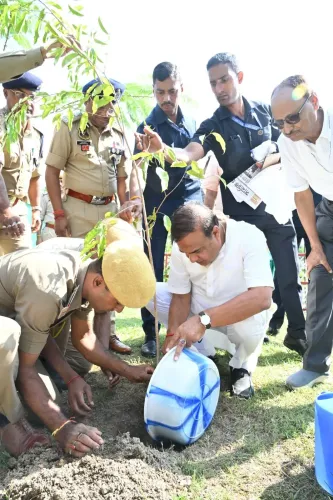
The Chief Minister's Office of Assam announced on 5 July 2026 the launch of 'Brikhya Bandhu', a state-wide environmental initiative under which 10 lakh students will plant and nurture 1 crore saplings across Assam, timed to commemorate India's 80th Independence Day.
Context
The Chief Minister's Office of Assam described the initiative as 'more than a plantation drive', framing it as 'a commitment to environmental stewardship, sustainability and inspiring the next generation to become custodians of a greener Assam.' The programme is positioned as a people's movement, with school students at its centre, linking ecological responsibility directly to civic identity on a landmark national anniversary.
The drive is being carried out under the leadership of Chief Minister Dr. Himanta Biswa Sarma, who has helmed the Assam government since May 2021 and has aligned several state programmes with national development and sustainability targets.
Policy Backdrop
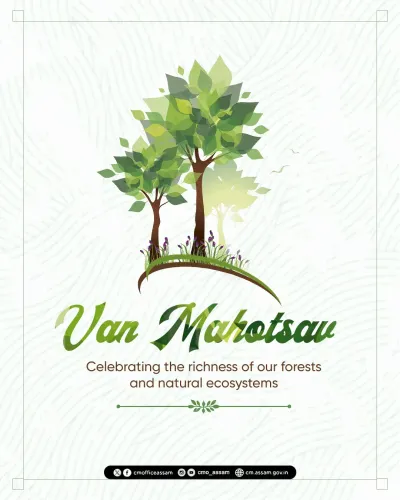
Brikhya Bandhu fits within a long lineage of state-supported afforestation efforts in India. The country's Van Mahotsav festival, launched in 1950, established the tradition of mass public tree-planting as a civic ritual. More recently, the Green India Mission, launched in 2014 under the National Action Plan on Climate Change, set targets for expanding forest and tree cover across states — including Assam, whose biodiversity-rich landscape makes it a critical zone for such interventions.
India has also committed to international frameworks such as the Bonn Challenge, which calls for large-scale landscape restoration. State governments have increasingly used youth-focused plantation drives as a mechanism to meet both national forest-cover targets and international obligations, integrating environmental goals into education and governance simultaneously.
Stakeholders and Impact
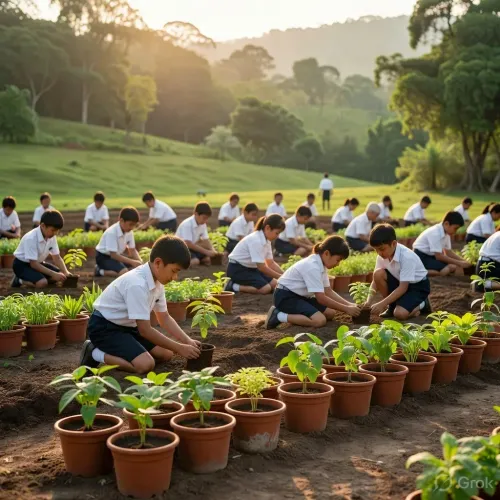
The primary participants are 10 lakh students drawn from schools across Assam, making this one of the state's most expansive youth-environment mobilisations. By assigning students not just the task of planting but also nurturing saplings, the programme attempts to build a sustained relationship between young people and the natural environment rather than a one-day symbolic event.
Rural communities across Assam are also implicated as stakeholders, given that sapling survival and long-term forest health depend on local stewardship beyond the school calendar. The initiative's framing as a 'people's movement' signals an intent to embed environmental responsibility in community culture, not just institutional obligation.
What's Next
Observers will watch whether Brikhya Bandhu generates formal progress reporting on sapling survival rates — a metric that has historically separated symbolic plantation drives from measurable ecological outcomes. Any integration of the programme into the 2026-27 school curriculum or announcement of dedicated monitoring mechanisms in future Assam Assembly sessions would signal deeper institutional commitment.
With India's 80th Independence Day on the horizon, Brikhya Bandhu is likely to serve as a flagship state-level contribution to national commemorative programming, potentially drawing attention to Assam's environmental governance record ahead of broader policy reviews.
Point of View
Not just planting — the Assam government is attempting to shift the conversation from headline numbers to long-term ecological accountability. For Chief Minister Himanta Biswa Sarma, the initiative reinforces a governance brand built on large-scale, visible mobilisation in India's northeast. Whether Brikhya Bandhu moves beyond symbolism will depend on the monitoring architecture the state builds around sapling survival and curriculum integration in the coming academic year.
NationPress
5 Oct 2026
Frequently Asked Questions
What is the Brikhya Bandhu initiative in Assam?
Brikhya Bandhu is an Assam government environmental initiative launched on 5 July 2026, under which 10 lakh students will plant and nurture 1 crore saplings across the state to mark India's 80th Independence Day.
Who launched the Brikhya Bandhu scheme?
The initiative was launched by the Assam Government under the leadership of Chief Minister Dr. Himanta Biswa Sarma, as announced by the Chief Minister's Office of Assam.
How many saplings will be planted under Brikhya Bandhu?
Under the Brikhya Bandhu drive, 1 crore (10 million) saplings will be planted and nurtured by 10 lakh (1 million) students across Assam.
Why was Brikhya Bandhu launched on Independence Day?
The initiative is timed to commemorate India's 80th Independence Day, using the national occasion to link civic pride with environmental responsibility and youth stewardship.
How does Brikhya Bandhu connect to national environmental policy?
The drive aligns with India's Green India Mission and commitments under the Bonn Challenge, both of which call for expanded forest cover and large-scale landscape restoration across states including Assam.