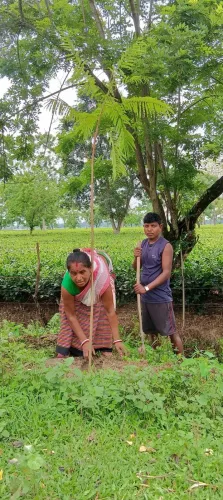
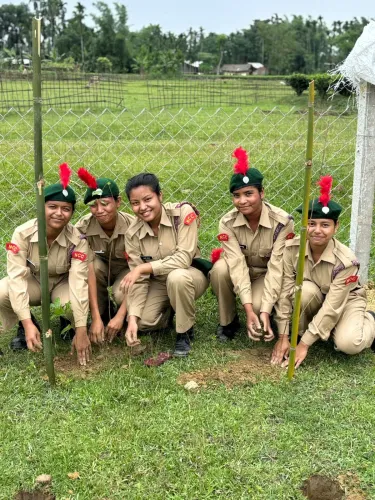
CM Himanta Leads Assam's 1.02 Crore Sapling Drive on World Environment Day
Synopsis
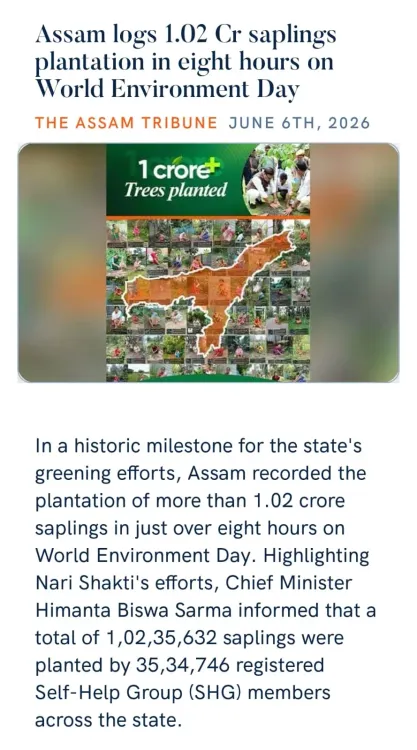
Assam planted 1.02 crore saplings in eight hours on World Environment Day 2026, the Chief Minister's Office announced, citing PM Modi's environmental vision and CM Himanta Biswa Sarma's leadership. The drive forms part of India's broader afforestation targets under the Green India Mission and Paris Agreement commitments.
Key Takeaways
1.02 crore saplings were planted across Assam in a single eight-hour window on World Environment Day .
The drive was led by Chief Minister Dr.
Himanta Biswa Sarma and aligned with PM Narendra Modi's national environmental vision.
India's Green India Mission (notified 2014 ) and updated Nationally Determined Contributions (2022) set the policy framework for such state-level plantation drives.
India targets 33 percent forest and tree cover nationally; northeastern states like Assam are prioritised in central afforestation funding.
Long-term impact depends on post-plantation survival rates and independent verification through the India State of Forest Report .
Assam lies within the Indo-Burma biodiversity hotspot , making afforestation efforts ecologically significant beyond carbon targets.
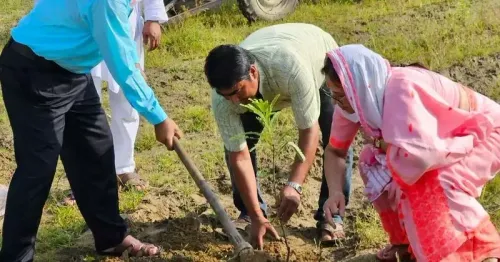
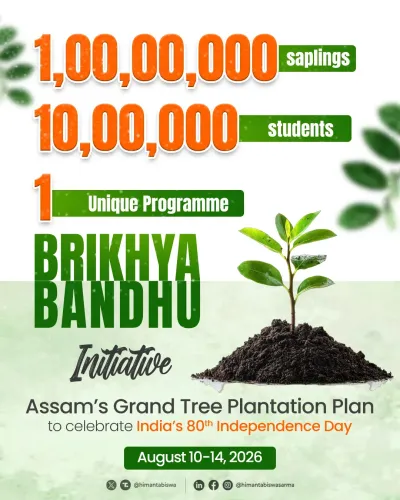
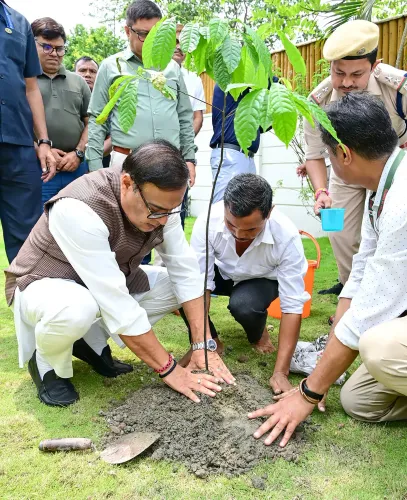
The Chief Minister's Office of Assam announced on Saturday, 6 June 2026 that the state planted 1.02 crore saplings in a single eight-hour window, marking what officials described as a significant milestone on World Environment Day. The drive was carried out under the leadership of Chief Minister Dr. Himanta Biswa Sarma and aligned with the broader environmental vision attributed to Prime Minister Narendra Modi.
Context
World Environment Day, observed every year on 5 June, is the United Nations' principal platform for promoting global environmental awareness and action. Since its inception in 1972, the day has served as a focal point for governments, civil society, and citizens to undertake pledges and measurable actions on ecological protection. Mass plantation drives have become a signature mode of participation for Indian states on this occasion.
Assam's official post stated the effort was 'guided by the vision of Hon'ble Prime Minister Shri Narendra Modi and led by HCM Dr. Himanta Biswa Sarma,' framing the exercise as both a state achievement and a contribution to a national environmental agenda. The 1.02 crore saplings figure, if sustained, would represent a substantial single-day addition to the state's green cover.
Policy Backdrop
India's National Action Plan on Climate Change, launched in 2008, included the Green India Mission — a dedicated programme targeting the enhancement of forest and tree cover across the country. The mission was formally notified in 2014 with an aim to bring an additional 5 million hectares under forest or tree cover and improve the quality of existing forests.
India's updated Nationally Determined Contributions, submitted in 2022 under the Paris Agreement, include a target to create an additional carbon sink of 2.5 to 3 billion tonnes of CO2 equivalent through forest and tree cover by 2030. States across the country, including those in the Northeast, have been encouraged to align plantation drives with these national commitments. Assam has historically received central afforestation funding given the ecological importance of the region's biodiversity corridors and river basins.
Indian states have long used coordinated mass plantation events to work toward the national benchmark of 33 percent forest and tree cover. The India State of Forest Report, published periodically by the Forest Survey of India, tracks net changes in cover and serves as the primary accountability mechanism for such drives.
Stakeholders and Impact
Assam's residents and the state's forest department are the immediate stakeholders in this initiative. A large-scale plantation exercise of this nature typically involves district administrations, forest officials, school and college volunteers, and community groups working in a coordinated, time-bound manner across multiple locations simultaneously.
The ecological significance of plantation drives in Assam extends beyond carbon sequestration. The state is part of the Indo-Burma biodiversity hotspot and is home to critical wildlife habitats including Kaziranga National Park and the Brahmaputra floodplain ecosystem. Sustained afforestation in buffer zones and degraded land can contribute to soil stabilisation, flood mitigation, and habitat connectivity for species including the one-horned rhinoceros.
Experts and policy observers generally note that the long-term impact of such drives depends heavily on post-plantation maintenance, survival audits, and the selection of ecologically appropriate native species rather than monoculture plantings.
What's Next
The key metric to watch will be the survival rate of the 1.02 crore saplings over the following months, particularly through Assam's monsoon season and into the dry winter period. Plantation numbers announced on a single day are typically subject to independent verification through subsequent forest survey data.
The next edition of the India State of Forest Report will be closely watched to assess whether drives of this scale translate into measurable net gains in state forest cover. Any follow-up state budget allocations for plantation maintenance or extensions of central scheme funding to Assam would indicate the government's commitment to converting a one-day milestone into a durable ecological outcome.
Point of View
And Assam's claim of 1.02 crore saplings in eight hours fits squarely into that pattern. For CM Himanta Biswa Sarma, the exercise serves a dual purpose: reinforcing Assam's development narrative and signalling alignment with the Centre's environmental agenda ahead of future federal funding cycles. The credibility of such drives, however, increasingly rests on post-plantation audits — a domain where Indian states have historically been inconsistent. The real test will be whether this milestone appears as net forest cover gain in the next India State of Forest Report, rather than remaining a headline figure.
NationPress
21 Oct 2026
Frequently Asked Questions
How many saplings did Assam plant on World Environment Day 2026?
According to the Chief Minister's Office of Assam, the state planted 1.02 crore saplings in eight hours on World Environment Day, which falls on 5 June each year.
Who led the Assam plantation drive on World Environment Day?
The drive was led by Chief Minister Dr. Himanta Biswa Sarma and was described as being guided by the vision of Prime Minister Narendra Modi .
What is the Green India Mission?
The Green India Mission is a national scheme under India's National Action Plan on Climate Change , formally notified in 2014 , that targets the expansion and improvement of forest and tree cover across the country as part of India's climate commitments.
Why does Assam focus on afforestation?
Assam is part of the Indo-Burma biodiversity hotspot and receives central afforestation funding given its ecological importance. Plantation drives also support India's Paris Agreement target of creating additional forest-based carbon sinks by 2030 .
How is the success of plantation drives measured in India?
The India State of Forest Report , published by the Forest Survey of India, is the primary tool for tracking net changes in forest and tree cover. Experts also assess sapling survival rates and species suitability to determine the actual ecological impact of plantation events.