CM Himanta Leads Assam's 1-Crore Tree Drive on World Environment Day
Synopsis
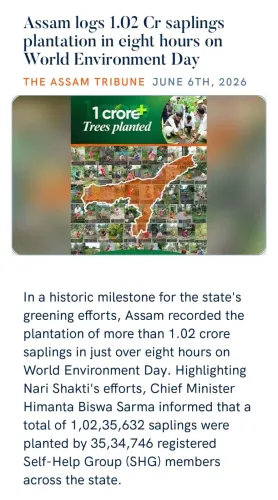
On World Environment Day 2026, Assam Chief Minister Himanta Biswa Sarma announced that over 35 lakh women SHG members are planting 1 crore saplings statewide under the #Assam1CrTrees campaign, mobilising grassroots women's collectives as the centrepiece of the state's greening push.
Key Takeaways
Assam CM Himanta Biswa Sarma launched the #Assam1CrTrees campaign on World Environment Day, 5 June 2026 .
More than 35 lakh women SHG members are participating in the coordinated plantation drive.
The target is to plant 1 crore saplings in a single day across Assam .
Women's Self Help Groups, organised under frameworks like the National Rural Livelihoods Mission , are the primary workforce for the drive.
The campaign fits a national pattern of deploying SHG networks for environmental and natural-resource goals alongside livelihood work.
Long-term impact will depend on sapling survival rates and verified increases in Assam's recorded forest and tree cover.
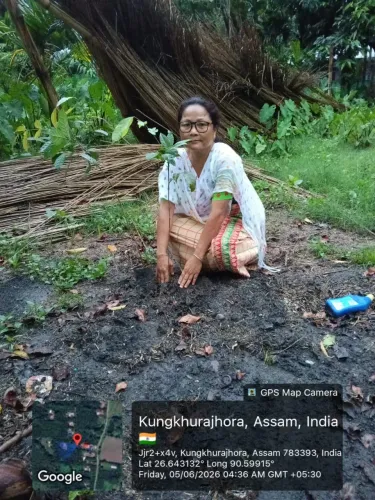
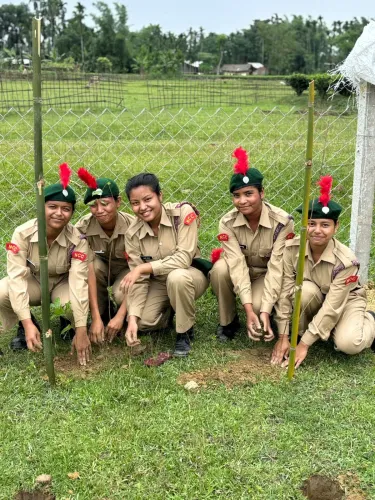
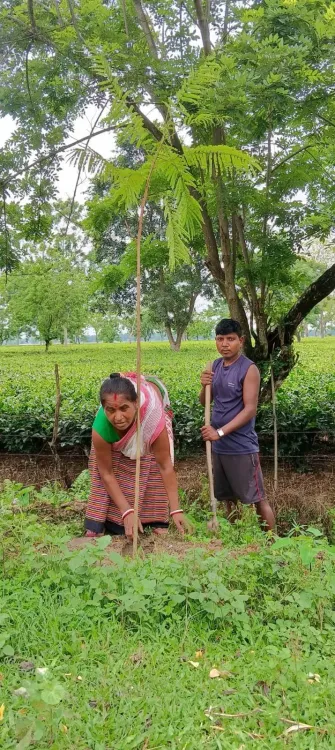
Assam Chief Minister Himanta Biswa Sarma on Friday, 5 June 2026 announced that more than 35 lakh women Self Help Group (SHG) members across Assam are planting 1 crore saplings in a single coordinated drive to mark World Environment Day. The campaign, tagged #Assam1CrTrees, is being led by women's collectives and positions the state's grassroots network as the primary engine of its greening effort.
Context
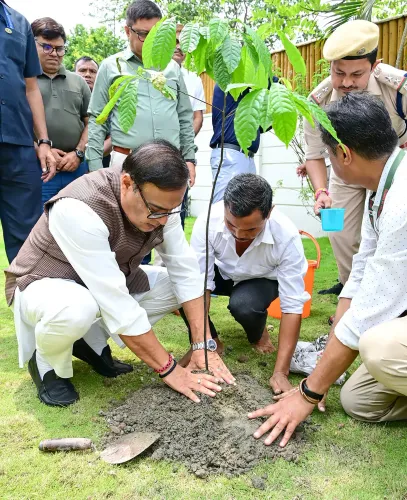
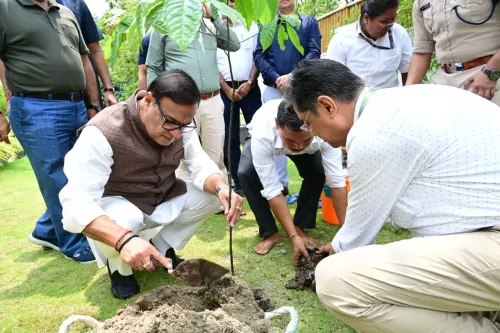
World Environment Day, observed every year on 5 June, was established by the United Nations to promote global environmental awareness and mobilise action. This year, Assam has channelled the occasion into a large-scale plantation exercise, with Chief Minister Sarma sharing photographs of women SHG members at work across the state. His post described the initiative as Assam's 'Nari Shakti' — women's power — leading the greening efforts.
Assam faces persistent environmental pressures, including annual flooding, erosion along the Brahmaputra river system, and biodiversity stress. Expanding tree and forest cover has been identified as a long-term mitigation measure by state planners.
Policy Backdrop
Women's SHGs in India are promoted primarily under the National Rural Livelihoods Mission (NRLM), a central government programme that organises rural women into collectives for economic and social development. Deploying this network for environmental work reflects a broader national pattern of using SHG infrastructure for natural-resource management beyond its original livelihood mandate.
Assam has also participated in national afforestation programmes under the Compensatory Afforestation Fund Management and Planning Authority (CAMPA) since the early 2010s. The current campaign aligns with India's stated climate commitments, which include raising the country's total forest and tree cover as part of its nationally determined contributions.
Stakeholders and Impact
The most direct participants are the 35 lakh-plus women SHG members whose labour underpins the drive. For these women, the exercise represents both an environmental contribution and a visible public role in a state-level initiative. Rural communities across Assam stand to benefit if the saplings survive and mature, improving local micro-climates and reducing soil erosion.
The campaign also carries political salience for the BJP-led Assam government: mobilising women's groups at this scale on a nationally observed day projects administrative reach and environmental commitment simultaneously.
What's Next
The immediate measure of success will be sapling survival rates over the next two to three growing seasons — a metric that past state plantation drives across India have struggled to document rigorously. Independent assessment of how many of the 1 crore saplings survive to become established trees will determine the ecological value of the exercise. Official green-cover data, updated periodically by the Forest Survey of India, will eventually reflect whether campaigns of this scale produce measurable gains in Assam's recorded tree cover.
Point of View
One-crore-sapling drive, Chief Minister Sarma is doing more than marking a UN calendar date — he is demonstrating the administrative bandwidth of the BJP government's grassroots network in Assam. The move fits a deliberate pattern across several BJP-governed states of converting NRLM-linked women's collectives into visible delivery vehicles for flagship environmental and welfare campaigns. The political optics of 'Nari Shakti' leading a green drive are carefully calibrated: they reinforce both the gender-empowerment narrative and the environmental credentials of the state government ahead of what remains a competitive political landscape in the Northeast. Whether the campaign translates into durable ecological gains will hinge on post-plantation monitoring — the persistent weak link in India's mass afforestation record.
NationPress
20 Oct 2026
Frequently Asked Questions
What is the Assam 1 crore tree plantation campaign?
The #Assam1CrTrees campaign is a World Environment Day 2026 initiative in which over 35 lakh women SHG members across Assam plant 1 crore saplings in a single coordinated drive to expand the state's green cover.
Who is organising the tree plantation drive in Assam?
The drive is being led by women's Self Help Group (SHG) members across Assam , coordinated under the state government headed by Chief Minister Himanta Biswa Sarma .
What is the role of SHGs in Assam's environment campaign?
Women's SHGs, organised primarily under the National Rural Livelihoods Mission (NRLM) , are serving as the primary workforce for the plantation drive, with more than 35 lakh members participating statewide.
Why is World Environment Day significant for Assam's tree drive?
World Environment Day , observed on 5 June every year, provided a nationally and globally recognised occasion for Assam to launch a large-scale, visible plantation campaign aligned with India's broader climate and forest-cover commitments.
How will the success of Assam's 1 crore tree plantation be measured?
Success will ultimately be gauged by sapling survival rates over the following growing seasons and by changes in Assam's officially recorded forest and tree cover, as periodically assessed by the Forest Survey of India .