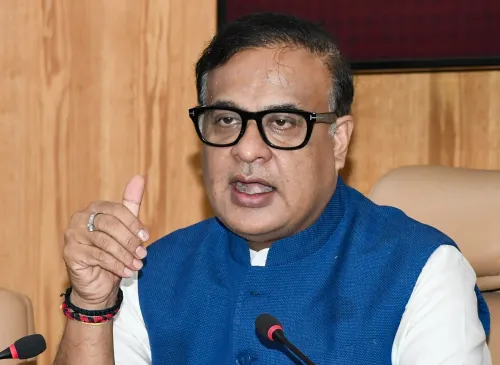
Assam CM Office announces tighter Aadhaar rules to curb infiltration

Synopsis
The Chief Minister's Office of Assam announced on 14 June 2026 that the state has tightened Aadhaar card rules to curb cross-border infiltration. The move by CM Himanta Biswa Sarma's government extends Assam's long-running use of identity infrastructure to address illegal immigration concerns along its Bangladesh border.
Key Takeaways
The Chief Minister's Office of Assam announced tighter Aadhaar card rules on 14 June 2026 to prevent infiltrators from obtaining identity documents.
CM Himanta Biswa Sarma has made immigration control a central policy priority since taking office in 2021 .
The move builds on earlier measures including the NRC , whose final list published in August 2019 excluded approximately 1.9 million applicants.
The Assam Accord of 1985 sets 24 March 1971 as the legal cut-off for detecting foreigners in the state.
The Supreme Court upheld Aadhaar linkage with government services in 2018 , providing the constitutional framework within which the new rules operate.
Legal challenges, if filed, are expected to be heard by the Gauhati High Court or the Supreme Court .
The Chief Minister's Office of Assam announced on Sunday, 14 June 2026 that the state has tightened rules governing Aadhaar card enrolment and issuance, citing the need to curb cross-border infiltration. The move signals a fresh push by the Himanta Biswa Sarma government to use India's national biometric identity infrastructure as a tool for state-level immigration control.
Context
Assam has long been at the centre of India's debate over illegal immigration, particularly from Bangladesh. The state shares a porous border and has historically seen large-scale demographic shifts that successive governments have sought to document and address. The latest Aadhaar rule changes are framed by the government as a necessary administrative step to ensure that identity documents are not misused by those who entered the country illegally.
Chief Minister Himanta Biswa Sarma, who has held office since 2021, has made immigration control a defining policy priority. His administration has pursued multiple parallel tracks — from supporting the National Register of Citizens (NRC) to backing the Citizenship Amendment Act — and the reported Aadhaar tightening extends this established pattern.
Policy Backdrop
The Aadhaar system, managed by the Unique Identification Authority of India (UIDAI) since 2009, is India's foundational biometric identity scheme. While the Supreme Court upheld Aadhaar linkage with government services in 2018, it also struck down certain mandatory uses, establishing a legal framework within which any state-level procedural tightening must operate.
The Assam Accord of 1985 — a tripartite agreement between the Central government, the state government, and the All Assam Students' Union — set 24 March 1971 as the cut-off date for detecting foreigners. The NRC, whose updated list was published in August 2019, excluded approximately 1.9 million applicants from the final register. The new Aadhaar rules appear to build on this existing architecture of documentation and verification.
Stakeholders and Impact
Residents of Assam's border districts are likely to feel the most immediate impact, as stricter verification requirements at enrolment points could affect both genuine residents and those whose documentation is incomplete or disputed. Civil society groups and legal advocates working on citizenship and statelessness issues will be watching the implementation closely.
For the state government, the measure is positioned as a governance imperative. Critics, however, have previously argued that documentation drives in Assam risk rendering vulnerable communities — including long-resident minorities — stateless if procedural safeguards are not robust. Any legal challenges could reach the Gauhati High Court or the Supreme Court.
What's Next
The specifics of the revised enrolment procedures — including what additional verification documents will be required and how existing Aadhaar holders may be affected — are expected to be detailed in follow-up government orders. Legal observers will monitor whether the new rules attract judicial scrutiny, particularly given the Supreme Court's earlier rulings on the limits of mandatory Aadhaar linkage.
The development adds another chapter to Assam's decades-long effort to reconcile identity documentation with the complex realities of its border demography — a challenge that remains unresolved despite successive legislative and administrative interventions.
Point of View
The government is testing the boundaries of UIDAI's mandate and the Supreme Court's 2018 Aadhaar ruling. The measure will likely deepen the fault lines between those who see documentation drives as essential governance and those who warn of statelessness risks for vulnerable communities. How the courts and UIDAI respond will determine whether this becomes a replicable model for other border states.
NationPress
13 Sept 2026
Frequently Asked Questions
Why has Assam tightened Aadhaar card rules?
The Assam government tightened Aadhaar enrolment rules in June 2026 to prevent illegal immigrants, particularly those from Bangladesh, from obtaining India's national biometric identity document and thereby accessing government services and benefits.
What is the NRC and how does it relate to Aadhaar in Assam?
The National Register of Citizens (NRC) is an Assam-specific registry updated and published in August 2019 to identify illegal immigrants; it excluded approximately 1.9 million applicants. The new Aadhaar rules are seen as complementing the NRC by adding another layer of verification at the identity enrolment stage.
Who is the Chief Minister of Assam behind these rules?
Himanta Biswa Sarma has been the Chief Minister of Assam since 2021 and has consistently prioritised measures against illegal immigration, including support for the NRC and the Citizenship Amendment Act.
Can Aadhaar rules be tightened by a state government?
While Aadhaar is a central government scheme administered by UIDAI, state governments can introduce additional verification requirements at enrolment points. Any such measures must remain within the framework set by the Supreme Court's 2018 ruling on Aadhaar.
What legal challenges could the new Assam Aadhaar rules face?
Legal experts expect potential challenges in the Gauhati High Court or the Supreme Court, particularly on grounds that stricter rules could render genuine residents — especially minorities in border districts — unable to obtain identity documents, raising statelessness concerns.