CM Himanta Bans Aadhaar Enrolment for Adults in Assam

Synopsis
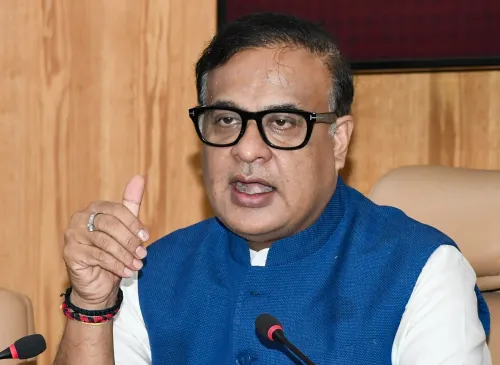
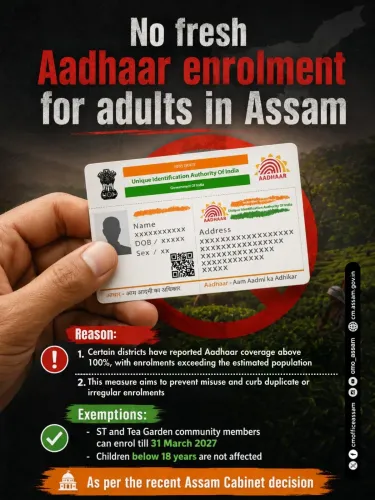
Assam Chief Minister Himanta Biswa Sarma has announced a ban on Aadhaar card issuance to all adults above 18 in Assam, citing national interest and the need to prevent illegal immigrants from obtaining identity documents. Scheduled Tribes and Tea Garden communities receive an exemption until 31 March 2027.
Key Takeaways
Assam has announced a ban on Aadhaar issuance to all adults above 18 years , citing national interest and illegal immigration concerns.
CM Himanta Biswa Sarma stated the goal is to prevent illegal immigrants from using Aadhaar to legitimise their presence in India.
Scheduled Tribe (ST) and Tea Garden communities are exempted and will have until 31 March 2027 to enrol under Aadhaar .
The move builds on the Assam Accord (1985) and the NRC process, which excluded approximately 1.9 million people in its 2019 final list.
Aadhaar is a central government scheme under UIDAI , raising questions about state jurisdiction and the need for formal coordination with the Union government .
Legal and constitutional challenges are anticipated, with enforcement details and central government response yet to be confirmed.
Assam Chief Minister Himanta Biswa Sarma announced on Saturday, 13 June 2026 that the state has decided to ban the issuance of Aadhaar cards to all adults above 18 years of age, citing national interest and the need to prevent illegal immigrants from legitimising their presence through the biometric identity system. The announcement, made via a post on X, carves out a specific exemption for Scheduled Tribe (ST) and Tea Garden communities, who will be granted an extension until 31 March 2027 to complete their Aadhaar enrolment.
Context
Sarma framed the decision in unambiguous terms: 'In national interest, Assam has decided to ban issuance of Aadhar cards to all adults above 18 years so that no illegal can legitimise themselves.' The move is the latest in a series of state-level administrative actions aimed at tightening citizenship and identity verification in Assam, a state that shares a border with Bangladesh and has long been at the centre of debates over illegal immigration.
The exemption for ST communities and Tea Garden workers signals a deliberate policy choice to protect historically marginalised indigenous and tribal groups — populations that have faced documentation challenges for decades — while applying the blanket restriction to the general adult population.
Policy Backdrop
The decision builds directly on the framework established by the Assam Accord of 1985, which set 24 March 1971 as the cut-off date for detecting and deporting foreigners who entered Assam from Bangladesh. The updated National Register of Citizens (NRC), whose final list was published in 2019, excluded approximately 1.9 million people suspected of being illegal immigrants — a process that underscored the state's long-running effort to separate citizens from non-citizens.
Aadhaar, administered by the Unique Identification Authority of India (UIDAI) under the Aadhaar Act of 2016, is a central government scheme. Its enrolment is typically governed by federal rules, making a state-level restriction on issuance a significant jurisdictional step that is likely to invite scrutiny over the division of powers between the state and the Union government.
Stakeholders and Impact
The restriction, if enforced, would affect every adult resident of Assam above 18 years who does not yet hold an Aadhaar card — cutting off access to a document increasingly required for banking, government subsidies, SIM card registration, and a range of welfare schemes. For those excluded from the NRC and living without settled legal status, the ban would effectively close a widely used route to obtaining identity proof.
The Tea Garden community — a large, historically disadvantaged workforce descended from labourers brought to Assam during the colonial era — and Scheduled Tribes are given until 31 March 2027, reflecting the state's acknowledgement that documentation gaps in these communities stem from structural exclusion rather than illegal entry. Civil society groups and legal advocates are expected to scrutinise how the restriction will be implemented and whether it will face challenges before the courts.
What's Next
Formal implementation will hinge on a government notification and coordination with UIDAI, which operates Aadhaar enrolment centres across the country. Constitutional questions around state jurisdiction over a centrally administered scheme are likely to surface, potentially prompting parliamentary questions or judicial review. CM Sarma's announcement sets the political direction; the administrative and legal pathway to enforcement remains to be defined. How the Union government responds — whether by endorsing, modifying, or contesting the state's move — will determine whether this becomes a replicable model for other border states or remains an Assam-specific measure.
Point of View
A move that tests the boundaries of cooperative federalism. By exempting ST and Tea Garden communities, the policy attempts to insulate itself from charges of targeting indigenous or historically marginalised groups, focusing its restriction squarely on those who cannot establish pre-1971 lineage. The decision fits a consistent pattern under the current Assam government of layering administrative measures on top of the NRC framework to sustain pressure on undocumented residents. Whether the Union government formally backs the move or quietly distances itself will be the critical variable in determining whether this sets a national precedent.
NationPress
27 Oct 2026
Frequently Asked Questions
Why has Assam banned Aadhaar cards for adults?
Assam CM Himanta Biswa Sarma announced the ban citing national interest, stating that the restriction is intended to prevent illegal immigrants from using Aadhaar enrolment to legitimise their presence in India.
Who is exempt from the Assam Aadhaar ban?
Scheduled Tribe (ST) communities and Tea Garden communities in Assam are exempt from the ban and have been given an extension until 31 March 2027 to enrol under Aadhaar .
Is a state government allowed to ban Aadhaar enrolment?
Aadhaar is administered by the Unique Identification Authority of India (UIDAI) under a central law — the Aadhaar Act of 2016 — making a state-level restriction a significant jurisdictional step. Legal and constitutional challenges are expected, and formal coordination with the Union government will be required for enforcement.
How does this relate to the Assam NRC?
The ban is consistent with Assam's long-running citizenship verification efforts, including the updated National Register of Citizens (NRC) whose final list published in 2019 excluded approximately 1.9 million people . The Aadhaar restriction is designed to close an identity-documentation route that those excluded from the NRC might otherwise use.
What happens to adults in Assam who do not have Aadhaar yet?
Under the announced policy, adults above 18 years in Assam — other than those from ST and Tea Garden communities — would no longer be able to obtain a new Aadhaar card . Since Aadhaar is required for banking, subsidies, and many government services, those without it could face significant barriers to accessing welfare and legal documentation.