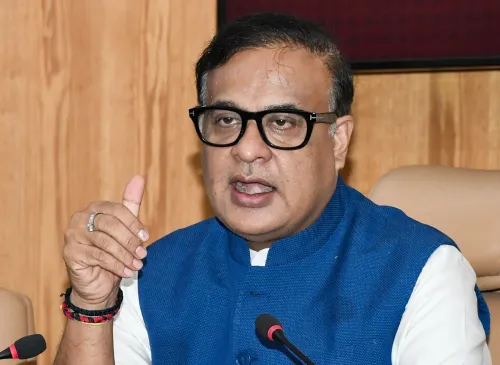
CM Himanta Briefs Press on Aadhaar, VB-G RAM & Deputation Rules

Synopsis
The Assam Cabinet, chaired by Chief Minister Dr. Himanta Biswa Sarma, on 13 June 2026 approved steps to restrict Aadhaar enrolment for adults, close implementation gaps in the VB-G RAM (Gramin) rural scheme, and tighten rules on premature bureaucratic deputations — signalling a broad push on identity verification and administrative discipline.
Key Takeaways
Assam Cabinet met on 13 June 2026 and took decisions on three governance fronts simultaneously.
Himanta Biswa Sarma explained the government's rationale for restricting Aadhaar enrolment for individuals aged 18 years and above .
Steps are being taken to ensure the VB-G RAM (Gramin) rural scheme has no implementation loopholes.
The government is moving to regulate premature deputations to strengthen administrative discipline in the state bureaucracy.
The decisions build on earlier Assam government actions — including the NRC finalised in 2019 and deputation-reform orders of 2021-22 — reflecting a consistent governance pattern.
Formal government notifications formalising these decisions are expected to follow the Cabinet meeting.
The Chief Minister's Office of Assam on Saturday, 13 June 2026 shared a post-Cabinet press briefing in which Chief Minister Dr. Himanta Biswa Sarma addressed three significant governance decisions: restricting Aadhaar enrolment for individuals aged 18 years and above, plugging loopholes in the VB-G RAM (Gramin) rural scheme, and tightening rules on premature deputations across the state bureaucracy.
Context
Dr. Himanta Biswa Sarma, who has led the Bharatiya Janata Party government in Assam since May 2021, addressed reporters after the Assam Cabinet meeting. The briefing covered three distinct but interrelated governance concerns spanning identity verification, rural programme delivery, and administrative discipline. The Chief Minister answered questions directly, signalling that these decisions carry political as well as administrative weight.
The press interaction follows a pattern of post-Cabinet transparency that the Sarma government has maintained, using direct media engagement to explain the rationale behind sensitive policy shifts — particularly those touching on residency and eligibility for state benefits.
Policy Backdrop
The move to restrict Aadhaar enrolment for those aged 18 and above sits within a long-standing concern in Assam about illegal immigration and the misuse of biometric identity documents to access welfare entitlements. The National Register of Citizens (NRC), finalised in 2019, was a landmark attempt to separate citizens from undocumented residents; subsequent identity-verification steps by the state government have broadly followed that logic.
Aadhaar, operated by the Unique Identification Authority of India (UIDAI), was upheld by the Supreme Court in 2018 as constitutionally valid, though the court restricted its mandatory use. State governments have since calibrated how and when Aadhaar is used for welfare delivery, and Assam's latest step appears to be an additional eligibility filter at the enrolment stage itself.
On administrative reform, the Assam government had already issued orders in 2021-22 to curb the misuse of inter-departmental deputations. The Cabinet's fresh push to regulate 'premature deputations' suggests those earlier measures are being further reinforced to strengthen accountability within the state services.
Stakeholders and Impact
The Aadhaar enrolment restriction, if formalised through a government notification, would directly affect adults in Assam who do not yet hold the biometric identity card and seek to enrol for the first time. Critics of such measures have historically argued they risk excluding genuine residents, while proponents say tighter entry-point checks are necessary given the state's unique demographic sensitivities.
Rural households stand to be affected by the VB-G RAM (Gramin) scheme safeguards. The government's stated goal is to ensure implementation is loophole-free, which could mean stricter beneficiary verification or closer monitoring of fund utilisation at the village level. State government employees — particularly those posted on deputation — are the primary group affected by the administrative discipline measures, which aim to curb transfers that bypass standard procedure.
What's Next
The specific provisions of all three decisions are expected to be formalised through official government orders or notifications in the coming days. Formal rules on Aadhaar enrolment age restrictions and the VB-G RAM (Gramin) implementation guidelines, once notified, will be the key documents to watch. Legal scrutiny of the Aadhaar measure is possible, given the Supreme Court's earlier guidance on limiting exclusions linked to biometric identity.
The decisions collectively reflect Assam's continuing effort to tighten the architecture of welfare delivery and administrative governance — a theme that is likely to feature prominently in the state's political narrative ahead of future electoral cycles.
Point of View
Tightening a rural scheme, and curbing premature deputations together signal an administration consciously projecting governance rigour. The Aadhaar move is the most politically charged, sitting squarely within Assam's decade-long identity-verification arc that began with the NRC — and it will attract legal scrutiny given the Supreme Court's 2018 guardrails. The deputation reform, meanwhile, is a classic bureaucratic consolidation play: governments tighten transfer norms when they want to assert control over a civil service that may have grown accustomed to informal arrangements. Taken together, these steps reinforce Sarma's brand of assertive, process-driven governance that has defined his tenure since 2021.
NationPress
13 Sept 2026
Frequently Asked Questions
Why is the Assam government restricting Aadhaar enrolment for people above 18?
The Assam government has cited the need to prevent loopholes in identity verification, particularly given long-standing concerns about illegal immigration and misuse of biometric documents to access welfare benefits. The specific provisions are expected to be detailed in a formal government notification following the 13 June 2026 Cabinet meeting.
What is the VB-G RAM (Gramin) scheme in Assam?
VB-G RAM (Gramin) is a rural scheme being implemented by the Assam government. The Cabinet on 13 June 2026 discussed steps to ensure there are no loopholes in its implementation; the exact provisions of the scheme were not publicly detailed in the post-Cabinet briefing.
What are premature deputations and why is Assam regulating them?
Premature deputations refer to the transfer of government employees to other departments or roles before the standard tenure is completed. Assam is tightening rules on this practice to strengthen administrative discipline and prevent misuse of the deputation system, building on orders the state government first issued in 2021-22.
When did the Assam Cabinet meet to take these decisions?
The Assam Cabinet met on Saturday, 13 June 2026. Chief Minister Dr. Himanta Biswa Sarma briefed the press on the key decisions afterwards, and the Chief Minister's Office shared the briefing on X the same day.
Can Assam legally restrict Aadhaar enrolment for adults?
The Supreme Court in 2018 upheld Aadhaar's constitutional validity but restricted its mandatory use in certain contexts. Any state-level restriction on enrolment would likely face legal scrutiny to ensure it does not violate the court's guidelines or exclude genuine residents from identity documentation.