Athawale hits back at Uddhav Thackeray's 'regime change' remarks, says elections are the way
Synopsis
Union Minister Ramdas Athawale has turned the 'regime change' controversy into a direct constitutional argument — invoking Dr Ambedkar's Constitution to tell Uddhav Thackeray that if he wants to change the government, he must win elections. The exchange lays bare a deepening battle over electoral legitimacy, the ECI's credibility, and the limits of democratic dissent ahead of 2029.
Key Takeaways
Union Minister Ramdas Athawale on 18 October 2026 rebuked Uddhav Thackeray over his 'regime change' remarks, saying only the public — through elections — can change a government.
Athawale directed Thackeray to contest the 2029 elections if he seeks a change of power.
Athawale defended CEC Gyanesh Kumar , saying his appointment is backed by Constitutional power and that the ECI would investigate 'vote chori' allegations.
Uddhav Thackeray had on Saturday declared at an All India Journalists' Conference event that the Opposition was indeed seeking to 'overthrow this power' through democratic means.
The controversy stems from ongoing protests in New Delhi against the ECI over alleged systematic 'vote theft'.
Athawale invoked Dr Babasaheb Ambedkar's Constitution as the framework within which political change must occur.
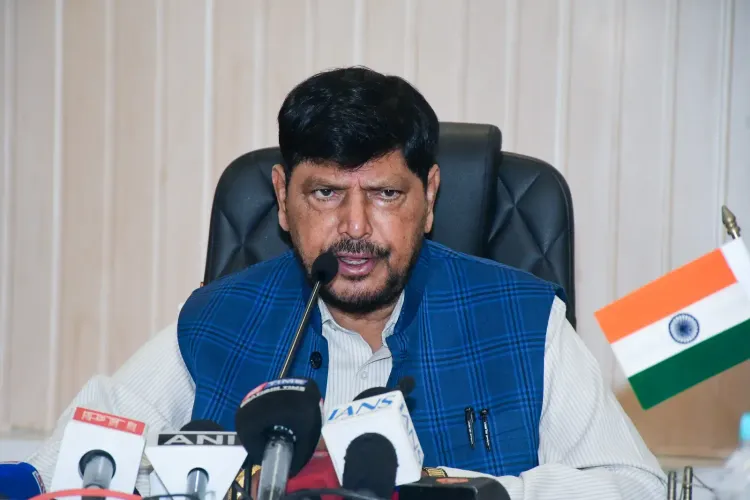
Union Minister Ramdas Athawale on Sunday, 18 October 2026, launched a sharp counterattack on Shiv Sena (UBT) chief Uddhav Thackeray over his 'regime change' remarks, asserting that in a democracy, the power to change a government belongs solely to the people and can only be exercised through elections. The remarks add a fresh edge to a political controversy that has been simmering in New Delhi over alleged 'vote theft' and protests targeting the Election Commission of India (ECI).
Athawale's Rebuttal
'If Uddhav Thackeray wants a change, he can strive for it in the upcoming 2029 elections. It is not in his hands alone; it lies with the public. Millions of people cast their votes and exercise their franchise to elect a government. This is not Bangladesh, Nepal, or Sri Lanka. Our country is governed according to the Constitution drafted by Dr Babasaheb Ambedkar,' Athawale said.
The Union Minister also weighed in on the controversy surrounding Chief Election Commissioner Gyanesh Kumar, whose appointment has come under Opposition scrutiny. 'Gyanesh Kumar is also elected through Constitutional power. If there is an allegation of vote chori, then the Election Commission will investigate it. However, SIR is also an important process to eliminate the names of fake voters, people who have passed away and avoid any duplications,' he added.
Athawale further noted that if any genuine voter had been removed from electoral rolls, 'the issue will surely be looked into,' but maintained that the correct democratic recourse remains contesting elections.
What Thackeray Said
The exchange was triggered by remarks Uddhav Thackeray made on Saturday at an awards ceremony organised by the All India Journalists' Conference in New Delhi. Thackeray launched a forceful defence of the Opposition's position, declaring: 'If opposing the government democratically is branded as a regime change, then yes, we are trying to bring about a regime change, and we stand here precisely to overthrow this power.'
Thackeray also questioned how the Opposition could remain silent when, in his view, the ruling establishment was depriving citizens of their fundamental rights to express opinions through elections and stage peaceful protests. He referenced recent remarks by advocate Prashant Bhushan in Delhi, asking: 'If the ruling party claims that we are attempting to change this system, what is wrong with that?'
Background: The 'Regime Change' Controversy
The phrase 'regime change' entered the political discourse after Opposition leaders and student activists deployed it during ongoing protests in the national Capital against the ECI and Chief Election Commissioner Gyanesh Kumar over what they allege is systematic 'vote theft'. The protests have drawn a strong reaction from the ruling establishment, which critics argue has sought to frame democratic dissent as anti-constitutional activity.
Notably, this is not the first time the Mahayuti alliance and the Maha Vikas Aghadi — the two rival blocs in Maharashtra — have traded blows over electoral integrity. The rift between the two factions of Shiv Sena, following the split that brought Eknath Shinde's group into alignment with the Bharatiya Janata Party (BJP), has kept both sides in a state of sustained political confrontation.
Wider Implications
Athawale's intervention is significant as it brings a prominent Dalit political voice into the debate, invoking Dr Babasaheb Ambedkar's Constitution as the ultimate arbiter of democratic change — a framing that places the onus squarely on electoral participation rather than street-level mobilisation. This comes amid a broader national debate about the independence and credibility of the ECI, which has faced mounting scrutiny from Opposition parties across the country.
With Maharashtra Assembly elections in recent memory and national polls on the horizon, the battle over electoral legitimacy is unlikely to subside. How the ECI responds to the 'vote chori' allegations — and whether the Special Intensive Revision (SIR) process is seen as transparent — will shape the political temperature in the weeks ahead.
Point of View
Athawale is doing double duty — defending the government while signalling that the Dalit political tradition stands against extra-electoral disruption. What is missing from the ruling side's response, however, is any serious engagement with the substance of the 'vote chori' allegations; deflecting to the SIR process is not the same as addressing concerns about electoral roll integrity. Thackeray, for his part, has chosen to own the 'regime change' label rather than retreat from it — a calculated gamble that positions the Opposition as constitutionally brave rather than seditious. With Maharashtra's political wounds still raw and 2029 approaching, both sides are building their electoral narratives now, and legitimacy — not just policy — is the battlefield.
NationPress
18 Oct 2026
Frequently Asked Questions
What did Ramdas Athawale say about Uddhav Thackeray's 'regime change' remarks?
Athawale said that in a democracy, the power to change a government rests with the public and can only be exercised through elections — not by any individual. He directed Thackeray to contest the 2029 elections if he wished to change the government, adding that India is governed by the Constitution drafted by Dr Babasaheb Ambedkar.
What did Uddhav Thackeray say about 'regime change'?
Thackeray, speaking at an All India Journalists' Conference event in New Delhi on Saturday, said that if opposing the government democratically is labelled a 'regime change', then the Opposition is indeed seeking one. He framed the Opposition's stance as a constitutional right to challenge a government that, in his view, is depriving citizens of their fundamental rights.
What is the 'vote chori' controversy and who is it directed at?
The 'vote chori' allegation refers to claims by Opposition leaders and student activists that voters have been unlawfully removed from electoral rolls, directed at the Election Commission of India and CEC Gyanesh Kumar. The controversy has sparked protests in New Delhi and triggered political demands for an independent investigation.
What is the Special Intensive Revision (SIR) process that Athawale mentioned?
The Special Intensive Revision (SIR) is an electoral roll cleansing exercise conducted by the Election Commission of India to remove duplicate entries, deceased voters, and ineligible names. Athawale cited it as an important safeguard, though critics argue its implementation has also removed genuine voters.
How does this controversy connect to the broader Maharashtra political situation?
The dispute is rooted in the ongoing rivalry between the Mahayuti alliance (which includes Athawale's faction) and the Maha Vikas Aghadi, anchored by Thackeray's Shiv Sena (UBT). The 2022 Shiv Sena split — which brought the Eknath Shinde faction into alignment with the BJP — has left both sides in sustained confrontation, with electoral integrity now emerging as a central battleground ahead of 2029.