Ayush Ministry signs MoU with BHASHINI to translate traditional knowledge into 22 Indian languages
Synopsis
India's Ministry of Ayush has partnered with the BHASHINI platform to bring Ayurveda, Unani, Siddha, Yoga, Sowa-Rigpa, and Homoeopathy knowledge into all 22 constitutionally recognised Indian languages using AI. It is one of the most ambitious attempts yet to digitise and democratise traditional medicine — if domain-specific terminology and dataset quality hold up.
Key Takeaways
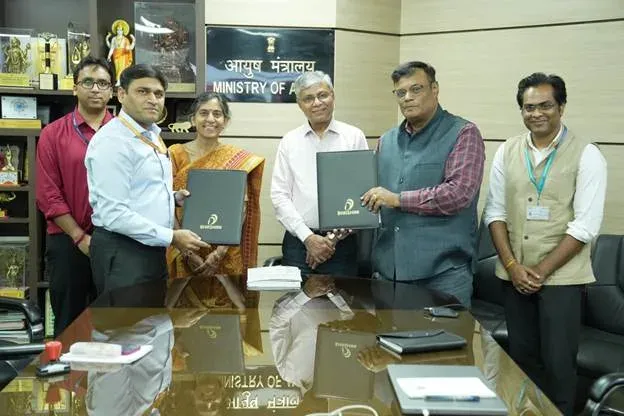
The Ministry of Ayush and Digital India BHASHINI Division (DIBD) signed an MoU on 14 May to enable AI-powered multilingual translation of traditional knowledge systems.
The initiative, titled 'BHASHINI Rajyam – A BHASHINI Sahayogi Program' , targets all 22 scheduled languages under the Eighth Schedule of the Constitution.
Integration will cover Ayush Grid portals, applications, and AI tools across Ayurveda, Unani, Siddha, Yoga, Naturopathy, Sowa-Rigpa, and Homoeopathy.
Domain-specific multilingual terminology systems and contextual AI models for healthcare communication will be developed under the partnership.
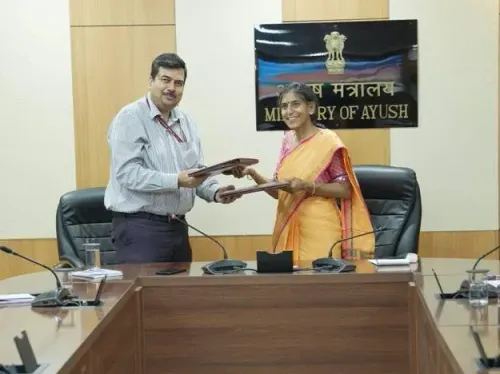
The MoU was signed by Dr.
Subodh Kumar (Ministry of Ayush) and Amitabh Nag , CEO, Digital India BHASHINI Division.
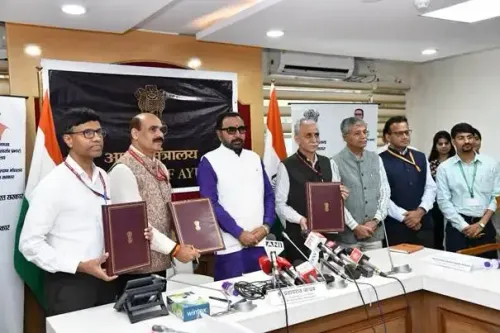
The Ministry of Ayush on 14 May signed a Memorandum of Understanding with the Digital India BHASHINI Division (DIBD) under the Ministry of Electronics and Information Technology (MeitY), aiming to deploy advanced AI-powered language technology to transcribe and translate traditional Ayush knowledge systems into multiple Indian languages. The partnership marks a significant step toward making Ayurveda, Unani, Siddha, Yoga, and allied systems digitally accessible to citizens across linguistic regions.
What the MoU Covers
Operating under the banner 'BHASHINI Rajyam – A BHASHINI Sahayogi Program', the agreement seeks to integrate the BHASHINI Platform — India's National Language Digital Public Infrastructure — across the digital services and portals of the Ministry of Ayush. The initiative targets all 22 scheduled languages recognised under the Eighth Schedule of the Constitution of India, ensuring wider accessibility for citizens regardless of their native tongue.
The MoU was formally signed by Dr. Subodh Kumar, Director, Ministry of Ayush, and Amitabh Nag, Chief Executive Officer of the Digital India BHASHINI Division.
What the Government Said
Vaidya Rajesh Kotecha, Secretary, Ministry of Ayush, underscored the civilisational significance of the collaboration. 'Ayush systems of medicine carry immense civilisational knowledge and cultural depth. Ensuring that this knowledge becomes accessible in every Indian language is essential for inclusive healthcare delivery and public outreach,' he said.
Kotecha added that the collaboration would 'strengthen multilingual capabilities across the Ayush ecosystem, develop robust domain-specific terminologies, and build future-ready AI systems that can support citizens seamlessly across linguistic boundaries.'
Role of Ayush Grid
The Ministry of Ayush is already operationalising its Ayush Grid initiative across healthcare delivery, capacity building, research, drug administration, and related sectors. Several portals, applications, and AI-enabled solutions developed under Ayush Grid are now proposed to be made available in all 22 scheduled languages. The BHASHINI integration will cover these Ayush Grid portals, applications, and AI tools to strengthen multilingual outreach nationally.
Building Domain-Specific AI for Healthcare
A focused component of the MoU involves developing domain-specific multilingual terminology systems tailored to traditional medicine disciplines — Ayurveda, Unani, Siddha, Yoga and Naturopathy, Sowa-Rigpa, and Homoeopathy. This includes strengthening Ayush language datasets and building contextual AI models for healthcare and wellness communication. Notably, creating accurate medical terminology across 22 languages is a technically demanding undertaking, and the success of the initiative will depend heavily on the quality of these domain-specific datasets.
What Comes Next
With the MoU now in place, both ministries are expected to begin integrating BHASHINI's language technologies into existing Ayush digital infrastructure. The broader ambition positions India's traditional knowledge systems as digitally inclusive public goods — accessible to a first-generation smartphone user in rural Odisha as readily as to a practitioner in an urban clinic. How quickly this integration moves from agreement to deployment will be the measure of the partnership's real impact.
Point of View
And India has a mixed record on digital health initiatives moving from announcement to adoption. BHASHINI itself is still maturing as a platform, and its integration with specialised medical vocabularies — Ayurvedic, Unani, Siddha — will test its capabilities in ways general-purpose translation does not. The initiative's value will ultimately be determined not by the number of languages covered, but by whether a rural citizen can actually use these tools to access reliable Ayush guidance in their mother tongue.
NationPress
1 Oct 2026
Frequently Asked Questions
What is the Ayush Ministry–BHASHINI MoU about?
The Ministry of Ayush has signed an MoU with the Digital India BHASHINI Division to use AI-powered language technology to translate and transcribe traditional Ayush knowledge systems into all 22 scheduled Indian languages. The partnership integrates BHASHINI's National Language Digital Public Infrastructure with Ayush Grid portals, apps, and AI tools.
What is the BHASHINI Rajyam program?
'BHASHINI Rajyam – A BHASHINI Sahayogi Program' is the name of the initiative under which the Ayush Ministry and BHASHINI Division will collaborate. It aims to make Ayush digital services multilingual and accessible to citizens across India's diverse linguistic regions.
Which traditional medicine systems are covered under this partnership?
The collaboration covers all six Ayush disciplines: Ayurveda, Unani, Siddha, Yoga and Naturopathy, Sowa-Rigpa, and Homoeopathy. Domain-specific AI models and terminology systems will be developed for each of these systems in multiple Indian languages.
Which languages will Ayush knowledge be available in?
The initiative targets all 22 languages listed under the Eighth Schedule of the Constitution of India, ensuring that Ayush knowledge and digital services are accessible to citizens regardless of their native language.
Who signed the MoU on behalf of both ministries?
The MoU was signed by Dr. Subodh Kumar, Director, Ministry of Ayush, and Amitabh Nag, Chief Executive Officer of the Digital India BHASHINI Division.