Giriraj Singh: Begusarai's Green Manure Model Goes National

Synopsis
On World Environment Day 2026, Union Textiles Minister Giriraj Singh spotlighted Begusarai's Jeevika-led 'Harit Khaad Model' after a delegation from Uttar Pradesh's Ambedkarnagar completed a three-day study of the initiative, which aims to cut chemical fertiliser use and boost sustainable agriculture.
Key Takeaways
Union Textiles Minister Giriraj Singh publicised Begusarai's green manure model on World Environment Day, June 5, 2026 .
A delegation from Ambedkarnagar, Uttar Pradesh conducted a three-day study tour of the model.
The initiative is driven by Jeevika self-help group women and local farmers of Begusarai, Bihar .
The model seeks to reduce dependence on chemical fertilisers while promoting environmental conservation and agricultural prosperity.
The initiative aligns with central schemes including the National Rural Livelihoods Mission and Paramparagat Krishi Vikas Yojana .
Cross-state interest signals potential replication of the model in Uttar Pradesh districts.
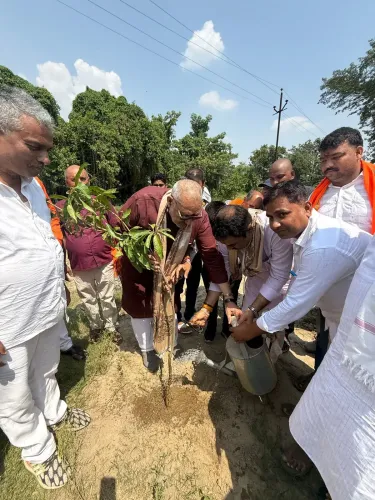
Union Textiles Minister Giriraj Singh on Friday, June 5, 2026 — World Environment Day — highlighted that a delegation from Ambedkarnagar, Uttar Pradesh completed a three-day study tour of Begusarai's grassroots 'green manure model', crediting Jeevika self-help group women and local farmers for pioneering a replicable approach to reducing chemical fertiliser dependence.
Context
In his post, Singh wrote: 'Hamara Begusarai ab desh ko 'harit kranti' aur sustainability ki nayi raah dikha raha hai' — 'Our Begusarai is now showing the country a new path of green revolution and sustainability.' He noted that the visiting UP delegation conducted a three-day study of what he called the 'Harit Khaad Model' (Green Manure Model), an initiative driven by Jeevika didiyan (Jeevika self-help group women) and local farmers of the district.
The post was timed to coincide with World Environment Day, an annual United Nations observance on June 5, and carried hashtags including #GreenGrowth and #NowForClimate, underscoring the environmental framing of the initiative.
Policy Backdrop
Jeevika, formally the Bihar Rural Livelihoods Promotion Society, operates under the umbrella of the National Rural Livelihoods Mission (2011) and has long been a vehicle for organising rural women into self-help groups that undertake livelihood and agricultural activities. The green manure model aligns with the Paramparagat Krishi Vikas Yojana (2015), a central scheme promoting organic and natural farming to wean farmers off synthetic fertilisers.
Reducing chemical fertiliser use has been a recurring policy priority, both for its fiscal implications — fertiliser subsidies run into tens of thousands of crore rupees annually — and for its environmental benefits, including soil health restoration and reduced groundwater contamination.
Stakeholders and Impact
The primary stakeholders are the Jeevika self-help group women of Begusarai and the district's farming community, who have developed and sustained the green manure practice at the grassroots level. By attracting an inter-state delegation from Ambedkarnagar in Uttar Pradesh, the model has demonstrated cross-state interest in replication.
For farmers, a successful shift away from chemical fertilisers can lower input costs and improve long-term soil fertility. For the Jeevika didiyan, the model represents an additional livelihood and a recognition of their role as agricultural innovators, not merely beneficiaries of government programmes.
What's Next
The Ambedkarnagar delegation's study visit raises the possibility of the green manure model being adopted or adapted in Uttar Pradesh districts, potentially with support from state rural livelihood missions. Any formal linkage to central natural-farming schemes — particularly during upcoming budget deliberations or environment-focused parliamentary sessions — could accelerate replication at scale.
As India intensifies its climate commitments, locally-proven, women-led agricultural innovations such as Begusarai's green manure model may find greater institutional support and policy visibility in the months ahead.
Point of View
Begusarai, as a source of exportable agricultural innovation — a narrative that serves both local pride and his national profile as a minister. The inter-state delegation visit, if it leads to formal replication, would mark a rare instance of a Bihar grassroots model influencing UP agricultural policy. More broadly, the post fits a wider BJP pattern of highlighting self-help group-led rural successes to demonstrate that welfare architecture built over the past decade is yielding tangible, replicable outcomes. The timing on World Environment Day also allows the party to claim ecological credentials at a moment of heightened global climate scrutiny.
NationPress
20 Oct 2026
Frequently Asked Questions
What is the Begusarai green manure model?
The Begusarai green manure model is a locally developed agricultural practice led by Jeevika self-help group women and farmers in Begusarai, Bihar, aimed at reducing chemical fertiliser use through organic green manure, thereby lowering input costs and protecting the environment.
Why did an Ambedkarnagar delegation visit Begusarai?
A delegation from Ambedkarnagar district in Uttar Pradesh visited Begusarai for a three-day study tour to understand and potentially replicate the district's green manure model, as highlighted by Union Textiles Minister Giriraj Singh on World Environment Day 2026.
What is Jeevika and what role does it play in Bihar farming?
Jeevika is the Bihar Rural Livelihoods Promotion Society, which organises rural women into self-help groups to support livelihoods and sustainable agriculture. In Begusarai, Jeevika women have been central to developing and promoting the green manure model.
How does the green manure model relate to central government schemes?
The model aligns with the National Rural Livelihoods Mission (2011) and the Paramparagat Krishi Vikas Yojana (2015), both of which support organic farming and self-help group-based rural livelihoods to reduce chemical fertiliser dependence across India.
What could happen next with Begusarai's green manure model?
Following the Ambedkarnagar delegation's study visit, the model could be adopted in Uttar Pradesh districts. Formal linkage to central natural-farming schemes during upcoming budget or parliamentary sessions could further accelerate its replication at a national scale.