Giriraj Singh hails Begusarai woman's footwear venture

Synopsis
Union Textiles Minister Giriraj Singh has praised Riya, a Begusarai woman who quit a multinational job to launch a footwear manufacturing unit, calling her a symbol of self-reliance and a living example of the Vocal for Local and Aatmanirbhar Bharat movements.
Key Takeaways
Union Textiles Minister Giriraj Singh publicly praised Riya , a young woman entrepreneur from Begusarai, Bihar , on 7 June 2026 .
Riya left a multinational company job to start a shoe-and-sandal manufacturing enterprise in her home district.
The Minister linked her story to the Aatmanirbhar Bharat Abhiyan and Vocal for Local campaigns.
The footwear and leather sector is a priority area under both Make in India (launched September 2014 ) and central MSME schemes including Mudra loans and Stand-Up India .
The post is part of a broader pattern of ministerial social-media outreach tying grassroots success stories to national self-reliance messaging.
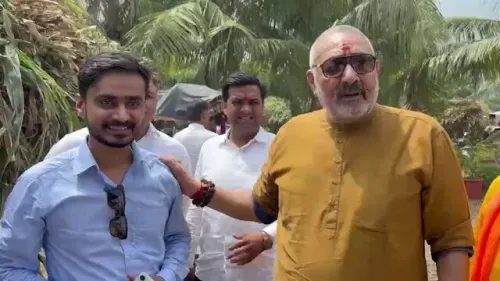
Union Textiles Minister Giriraj Singh on Sunday, 7 June 2026 praised Riya, a young woman entrepreneur from his parliamentary constituency of Begusarai, Bihar, for quitting a multinational job to launch a local footwear manufacturing unit — holding her up as a model of self-reliance and grassroots enterprise.
Context
In his post, the Minister wrote: 'Begusarai ki beti Riya ne yeh siddh kiya hai ki aatmanirbharta aur udyamita hi safalta ki nayi pehchaan hai' — 'Daughter of Begusarai, Riya, has proved that self-reliance and entrepreneurship are the new markers of success.' He noted that by leaving a multinational company and starting a shoe-and-sandal manufacturing enterprise in her own district, Riya had not only realised her own ambitions but had also reinforced local employment and the 'Vocal for Local' movement. The Minister concluded with warm wishes for her future.
The post is accompanied by a video and carries hashtags including #VocalForLocal, #AatmanirbharBharat, #WomenEmpowerment, and #Begusarai, signalling its dual role as constituency outreach and national-policy messaging.
Policy Backdrop
Aatmanirbhar Bharat Abhiyan was announced by Prime Minister Narendra Modi in May 2020 as a comprehensive push for domestic production, MSME revival, and reduced import dependence. 'Vocal for Local' emerged as one of its most visible consumer-facing planks, urging Indians to prefer domestically manufactured goods and to strengthen local value chains.
The Make in India programme, launched in September 2014, had earlier identified textiles, leather, and footwear as priority manufacturing sectors. Since then, central schemes such as Mudra loans and Stand-Up India have been directed at women-led micro and small enterprises, while production-linked incentives have targeted footwear clusters in states including Bihar. As Union Textiles Minister, Giriraj Singh oversees a portfolio that directly intersects with leather goods and footwear manufacturing.
Stakeholders and Impact
Women entrepreneurs, Bihar-based MSMEs, and district-level footwear manufacturing clusters are the immediate stakeholders in the story the Minister is amplifying. A footwear unit in a semi-urban district such as Begusarai can generate direct employment for stitching, finishing, and packaging workers — roles that are disproportionately filled by women and first-generation wage earners.
Ministerial visibility for individual success stories of this kind also serves a signalling function: it encourages other young professionals in smaller towns to consider entrepreneurship over salaried employment, particularly in sectors aligned with government incentive structures. The footwear and leather sector is among the labour-intensive industries the Centre has prioritised for job creation under its broader manufacturing push.
What's Next
Attention will turn to whether Begusarai and similar Bihar districts receive dedicated support under upcoming central or state-level footwear cluster development schemes. National textile and leather expos scheduled for 2025-26 could provide Riya's unit and similar grassroots enterprises a platform to access buyers, investors, and export linkages.
For the Minister, posts of this nature are part of a sustained pattern of constituency-level storytelling that ties individual achievement to the broader Aatmanirbhar Bharat narrative — a template likely to intensify as the government approaches key policy review milestones in the manufacturing sector.
Point of View
Spotlighting a woman-led manufacturing success story carries electoral and ideological weight simultaneously. The choice of footwear — a sector the Centre has actively promoted through production-linked incentives — is unlikely to be incidental, given the Minister's own portfolio. Sustained ministerial amplification of such stories can nudge district administrations and state governments to fast-track cluster support, making social-media posts of this kind a soft instrument of policy implementation.
NationPress
25 Sept 2026
Frequently Asked Questions
Who is Riya from Begusarai and what did she do?
Riya is a young woman entrepreneur from Begusarai, Bihar, who quit her job at a multinational company to start a footwear manufacturing unit in her home district, as highlighted by Union Textiles Minister Giriraj Singh on 7 June 2026.
What is the Vocal for Local movement in India?
'Vocal for Local' is a component of the Aatmanirbhar Bharat Abhiyan , launched in May 2020 , that encourages Indians to buy domestically manufactured goods and support local value chains and small enterprises.
Why did Giriraj Singh post about a Begusarai entrepreneur?
As the Lok Sabha MP from Begusarai and Union Textiles Minister , Giriraj Singh regularly highlights constituency success stories that align with national self-reliance and women-empowerment goals, using social media as a platform for both outreach and policy messaging.
What government schemes support women entrepreneurs in footwear manufacturing in Bihar?
Central schemes such as Mudra loans , Stand-Up India , and production-linked incentives under Make in India and Aatmanirbhar Bharat are available to women-led MSMEs in the footwear and leather sector, including in states like Bihar.
What is Aatmanirbhar Bharat Abhiyan?
Aatmanirbhar Bharat Abhiyan is a self-reliant India initiative announced by Prime Minister Narendra Modi in May 2020 , aimed at boosting domestic manufacturing, supporting MSMEs, and reducing India's dependence on imports across key sectors.