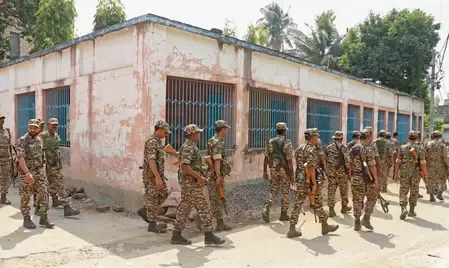
Election Commission Urges Rapid Identification of Sensitive Areas Ahead of Bengal Assembly Elections

Synopsis
As West Bengal gears up for crucial Assembly elections, the Election Commission has called on local police to swiftly identify sensitive areas. This is part of a strategic plan for deploying Central Armed Police Forces to ensure a smooth electoral process.
Key Takeaways
Election Commission of India prioritizes identifying sensitive areas for Assembly elections.
240 CAPF companies will be deployed on March 1 and an additional 240 on March 10.
Deployment strategy will involve coordination with central observers.
Focus on early area domination to ensure electoral security.
Detailed deployment plans are being developed in consultation with local authorities.
Kolkata, Feb 24 (NationPress) In light of the significant Assembly elections approaching in West Bengal later this year, the Election Commission of India (ECI) has urged the state's police force to expedite the identification of sensitive areas within the state, ideally by the second week of March.
This identification process is crucial as it will aid the ECI in strategizing the deployment of Central Armed Police Forces (CAPF) based on the sensitivity of the identified areas.
The ECI has already made arrangements to deploy CAPF in West Bengal even prior to the formal announcement of polling dates and the enforcement of the model code of conduct.
By March 10, a total of 480 CAPF companies will be stationed in the state, with 240 companies set to be deployed on March 1 and the remaining 240 on March 10.
During a preparatory meeting with senior police officials on Monday evening, the ECI emphasized that the initial 480 companies, scheduled for deployment between March 1 and March 10, can initially remain idle and should instead focus on establishing early area dominance.
The deployment of these 480 CAPF companies will be coordinated with central observers appointed by the ECI in West Bengal.
These observers have also been tasked with overseeing the deployment process of CAPF and providing daily updates to the ECI, as informed by sources from the Chief Electoral Officer's (CEO) office in West Bengal.
The Commission has previously instructed the West Bengal government to formulate a comprehensive deployment strategy in collaboration with the respective CAPFs and their chief force coordinators. The movement and deployment of CAPFs will be managed by the CRPF, as clarified by the Commission.
The first phase of 240 companies to be deployed on March 1 will consist of 110 companies from the Central Reserve Police Force (CRPF), 55 from the Border Security Force (BSF), 21 from the Central Industrial Security Force (CISF), 27 from the Indo-Tibetan Police Force (ITBP), and 27 from the Sashastra Seema Bal (SSB).
In the second phase, another 240 companies will be deployed on March 10, comprising 120 companies of CRPF, 65 of BSF, 16 of CISF, 20 of ITBP, and 19 of SSB.
The timeline for the de-induction of these 480 companies, which refers to the process of withdrawing troops, equipment, or personnel from a specific area, will be communicated in due course.
Point of View
The ECI aims to maintain peace and security during this pivotal political event.
NationPress
30 Sept 2026
Frequently Asked Questions
What is the purpose of identifying sensitive pockets in West Bengal?
Identifying sensitive pockets is crucial for planning the deployment of security forces to ensure a peaceful electoral process during the Assembly elections.
When will the Central Armed Police Forces be deployed in West Bengal?
The first phase of deployment will occur on March 1, with a total of 480 companies scheduled to be in place by March 10.
Who oversees the deployment of CAPF in West Bengal?
The deployment process will be supervised by central observers appointed by the Election Commission of India.
How many companies of CAPF will be deployed?
A total of 480 companies of CAPF will be deployed in West Bengal for the elections.
What does de-induction mean in this context?
De-induction refers to the process of withdrawing troops, equipment, or personnel from a specific area after their deployment.