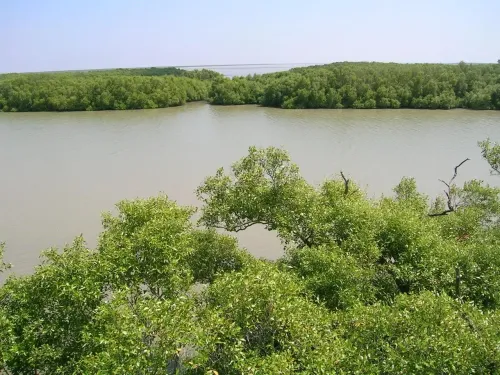
Sundarbans mangrove restoration: Bengal targets 1,600 hectares of encroached forestland
Synopsis
West Bengal's forest department has identified 1,600 hectares of Sundarbans mangrove forestland allegedly converted into illegal fish farms under the previous TMC regime — and has now begun demolitions. Satellite data reportedly shows a full island stripped of mangroves since 2016, pointing to what officials call a coordinated nexus of farm owners, politicians, and administrators.
Key Takeaways
The West Bengal forest department has identified 1,600 hectares of encroached mangrove forestland in the Sundarbans for restoration.
Encroachment allegedly occurred during the previous TMC government, with dams built to dry out land and convert it into aquaculture ponds.
Satellite imagery reportedly shows a formerly forested island stripped of mangroves since 2016 .
Forest Minister Manoj Kumar Oraon has ordered demolition of illegal farms and dams, followed by replanting of mangrove saplings.
District police have launched a parallel investigation into the alleged nexus between farm owners, local politicians, and administrators.
Environmentalists say Sundarbans mangroves are a critical coastal shield against cyclones and must be protected as a disaster-risk priority.
The West Bengal forest department has launched a formal process to restore over 1,600 hectares of mangrove forestland in the Sundarbans that was allegedly encroached upon and converted into brackish-water aquaculture farms during the tenure of the previous All India Trinamool Congress (TMC) government led by Mamata Banerjee. The restoration drive, initiated in late July 2025, follows a directive from Forest Minister Manoj Kumar Oraon to identify illegal fisheries, demolish encroachments, and replant mangrove saplings.
Scale of Encroachment Identified
A state forest department official involved in the process confirmed that the identification phase has been completed. According to the official, the 1,600 hectares of erstwhile forestland were systematically encroached upon — first through the construction of dams to block tidal water flow, which dried out the soil and destroyed the mangroves, and later by subdividing the land into small plots for fish-farming ponds.
'It was impossible to complete this process overnight, and hence a syndicated and well-coordinated approach involving fishing farm owners, local politicians and a section of the administration was evident,' the official said. Satellite imagery reportedly corroborates this timeline: mapping shows that before 2016, a particular island in the area was covered with thick mangrove forest, whereas the same island is now divided into plots occupied by illegal aquaculture operations.
Demolition and Replanting Under Way
With the identification phase concluded, the department has moved to the next stage: demolition of illegal farms and dams. Once that process is complete, planting of mangrove saplings across the 1,600 hectares is set to begin. The scale of the operation makes it one of the largest mangrove restoration efforts attempted in the Sundarbans in recent years.
Simultaneously, the district police administration has initiated a separate investigation to dismantle the alleged nexus between aquaculture farm owners, local politicians, and officials within the administration. Forest Minister Oraon has reportedly instructed authorities to take 'strong action against each person involved in the nexus as per legal provisions.'
Why Sundarbans Mangroves Matter
Environmentalists have welcomed the move, underscoring that the Sundarbans mangroves serve as a critical natural buffer for the entire coastal zone against cyclones and super-cyclones. The Sundarbans — a UNESCO World Heritage Site spanning the Bengal delta — is home to the world's largest contiguous mangrove ecosystem and provides livelihood and climate protection to millions of people in coastal West Bengal and Bangladesh. Experts argue that restoring degraded patches is not merely an environmental imperative but a disaster-risk-reduction priority.
Political Context
The crackdown comes after the Bharatiya Janata Party (BJP)-led state government under Chief Minister Suvendu Adhikari assumed office, which has since pursued action against what it characterises as illegal constructions and encroachments that accumulated under the previous administration. The forest department official noted that the organised nature of the encroachment — evident from satellite data and the scale of dam construction — points to what authorities describe as a clear nexus between private interests and political patronage.
With demolitions now under way and a police probe running in parallel, the coming weeks will determine how swiftly the Sundarbans restoration can move from identification to ground-level replanting.
Point of View
600 hectares, an entire island erased from satellite maps since 2016 — is not the story of a few opportunistic fish farmers. It is, if the forest department's account holds, a case study in how protected ecosystems are dismantled incrementally when political cover is available. The BJP government's crackdown is politically convenient, but the environmental urgency is real: the Sundarbans mangroves are India's first line of defence against Bay of Bengal cyclones, and their degradation carries consequences far beyond West Bengal. The test now is whether the demolition-and-replanting drive outlasts the political moment — mangrove restoration is a decade-long commitment, not a press-release event.
NationPress
13 Sept 2026
Frequently Asked Questions
What is the West Bengal government doing to restore Sundarbans mangroves?
The West Bengal forest department has identified 1,600 hectares of encroached mangrove forestland in the Sundarbans and begun demolishing illegal aquaculture farms and dams built on it. Once demolitions are complete, mangrove saplings will be replanted across the entire area.
How was the Sundarbans forestland allegedly encroached upon?
According to a state forest department official, encroachers first built dams to block tidal water flow, which dried out the soil and destroyed the mangroves. The land was then subdivided into small plots and converted into fish-farming ponds in what officials describe as a coordinated operation involving farm owners, local politicians, and administrators.
When did the Sundarbans mangrove encroachment reportedly begin?
Satellite mapping cited by the forest department indicates the encroachment was under way by 2016, when a particular island in the area still showed thick mangrove cover. The same island is now entirely divided into aquaculture plots, according to officials.
Who is being investigated in connection with the encroachment?
The district police administration has launched a separate investigation targeting the alleged nexus between aquaculture farm owners, local politicians, and a section of the administration. Forest Minister Manoj Kumar Oraon has instructed authorities to take legal action against all individuals found involved.
Why are Sundarbans mangroves considered ecologically critical?
The Sundarbans mangroves form a natural barrier protecting the coastal zone from cyclones and super-cyclones that regularly strike the Bay of Bengal coast. Environmentalists say their restoration is a disaster-risk-reduction priority for millions of people living in coastal West Bengal.