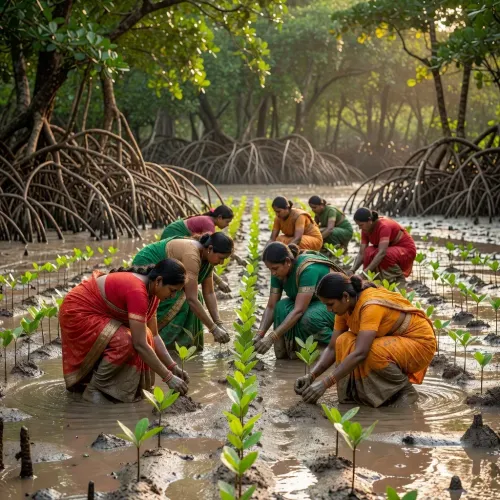
Jal Shakti Minister Paatil hails Sundarbans women rebuilding lives with mangroves

Synopsis
Union Jal Shakti Minister C. R. Paatil shared PM Narendra Modi's account of widows from Jharkhali in the Sundarbans who lost husbands to tiger attacks and are now planting mangrove forests — earning livelihoods while creating a natural coastal shield for their villages.
Key Takeaways
Women from Jharkhali, Sundarbans, West Bengal — many of them widowed by tiger attacks — are growing mangrove forests for income and coastal protection.
Union Jal Shakti Minister C.
Paatil shared the story on September 27, 2026 , amplifying a narrative originally told by PM Narendra Modi .
The Sundarbans is a UNESCO World Heritage Site and the world's largest mangrove delta, where human-tiger conflict regularly claims lives.
The MISHTI scheme , launched in Union Budget 2023-24 , promotes mangrove plantation and tangible incomes along India's coastline including West Bengal.
Mangroves planted by the Jharkhali women act as a natural buffer against cyclone storm surges and coastal erosion in the Bay of Bengal region.
Project Tiger (since 1973 ) has worked on human-wildlife conflict in the Sundarbans, with community livelihood generation remaining a key gap these women are helping to fill.
They lost their husbands to tiger attacks in one of the world's most unforgiving forests — and then turned to that same forest to survive. Union Jal Shakti Minister C. R. Paatil on Sunday, September 27, 2026, shared a deeply moving account, originally narrated by Prime Minister Narendra Modi, of widows from Jharkhali in West Bengal's Sundarbans who are planting mangrove forests and, in doing so, building a shield — for their villages and for themselves.
Paatil quoted PM Modi's words directly: 'प्रकृति के साथ हमारा रिश्ता सिर्फ उसे सहेजने तक ही सीमित नहीं है' ('Our relationship with nature is not limited only to preserving it. Sometimes, when we nurture nature, that same nature becomes the support of our lives.'). The women of Jharkhali, the post says, are a 'living, inspiring example' of exactly that relationship.
Tiger widows who chose the forest, not flight
The Sundarbans — a UNESCO World Heritage Site straddling West Bengal and Bangladesh — is the world's largest mangrove delta and home to the Royal Bengal Tiger. Human-wildlife conflict here is not an abstraction; it is a recurring tragedy for fishing and farming families who venture deep into the reserve. The women of Jharkhali know that grief personally.
Yet rather than abandoning the delta, they are replanting it. The mangroves they have nursed from seedlings are today described as a 'natural protective shield' (praakritik suraksha-kavach) for surrounding villages — buffering storm surges, anchoring coastlines against erosion, and absorbing the Bay of Bengal's cyclone-season fury. Their labour earns them an income, replacing the livelihoods their families lost.
MISHTI scheme and the national push behind it
The Jharkhali story does not exist in a policy vacuum. The MISHTI (Mangrove Initiative for Shoreline Habitats and Tangible Incomes) scheme, launched in the Union Budget 2023-24, was specifically designed to promote mangrove plantation and restoration along India's coastline — with West Bengal among the targeted states. The scheme frames mangroves precisely as the Jharkhali women are using them: simultaneously as ecological armour and as a source of community income.
Project Tiger, running since 1973, has long tried to reduce human-tiger conflict in the Sundarbans reserve, but alternative livelihood generation for affected families has remained a stubborn gap. Community-led plantation drives like the one at Jharkhali represent one answer — converting vulnerability into agency.
Nature-based solutions on India's climate frontier
For India's coastal climate strategy, the Sundarbans is a frontline. Cyclone frequency in the Bay of Bengal has intensified, and the delta's mangrove cover acts as a first responder — a living seawall that engineered infrastructure cannot fully replicate. Scientists and planners increasingly call this 'nature-based solutions' to climate adaptation. The Jharkhali women are delivering it on the ground, without the vocabulary, simply out of necessity.
Minister Paatil's amplification of this story — shared from the Jal Shakti ministry's perch, which oversees water security and related eco-restoration — underlines how the government wants to frame community conservation: not as charity, but as a self-sustaining economy built on the forest's own logic.
A community of women who had every reason to walk away from the Sundarbans chose instead to grow it back — and the forest, as PM Modi's narration puts it, grew back around them.
Point of View
Resilience, and ecological logic doing the heavy lifting. With the MISHTI scheme needing visible ground-level success stories in West Bengal ahead of state political cycles, narratives like this one carry both human and policy weight. The deeper question is whether the government translates these inspiring individual efforts into scaled, institutional support structures that outlast media cycles.
NationPress
27 Sept 2026
Frequently Asked Questions
Who are the Jharkhali women planting mangroves in the Sundarbans?
They are women from Jharkhali in West Bengal's Sundarbans region, many of whom lost their husbands to Royal Bengal Tiger attacks. They took up mangrove plantation to earn a livelihood and have also created a natural coastal shield for nearby villages.
What is the MISHTI scheme and how does it relate to the Sundarbans?
MISHTI stands for Mangrove Initiative for Shoreline Habitats and Tangible Incomes, launched in the Union Budget 2023-24. It promotes mangrove plantation and restoration along India's coastline, with West Bengal — including the Sundarbans — among its focus areas.
Why did C. R. Paatil share this Sundarbans mangrove story?
Union Jal Shakti Minister C. R. Paatil shared the post on September 27, 2026, amplifying a narrative originally told by PM Narendra Modi, highlighting the intersection of community conservation, coastal protection, and livelihood generation in the Sundarbans.
How do mangroves protect Sundarbans villages?
Mangroves act as a natural barrier — often called a 'living seawall' — that absorbs the force of cyclone storm surges, reduces coastal erosion, and stabilises the shoreline. In the Bay of Bengal, where cyclone frequency is high, this protection is critical for delta communities.
What is Project Tiger and what has it done about human-tiger conflict in the Sundarbans?
Project Tiger, launched in 1973, is India's flagship wildlife conservation programme. In the Sundarbans tiger reserve, it has included human-wildlife conflict mitigation efforts, though providing sustainable alternative livelihoods for conflict-affected families — like those in Jharkhali — has remained an ongoing challenge.