Shivraj highlights Sundarbans women turning grief into green cover
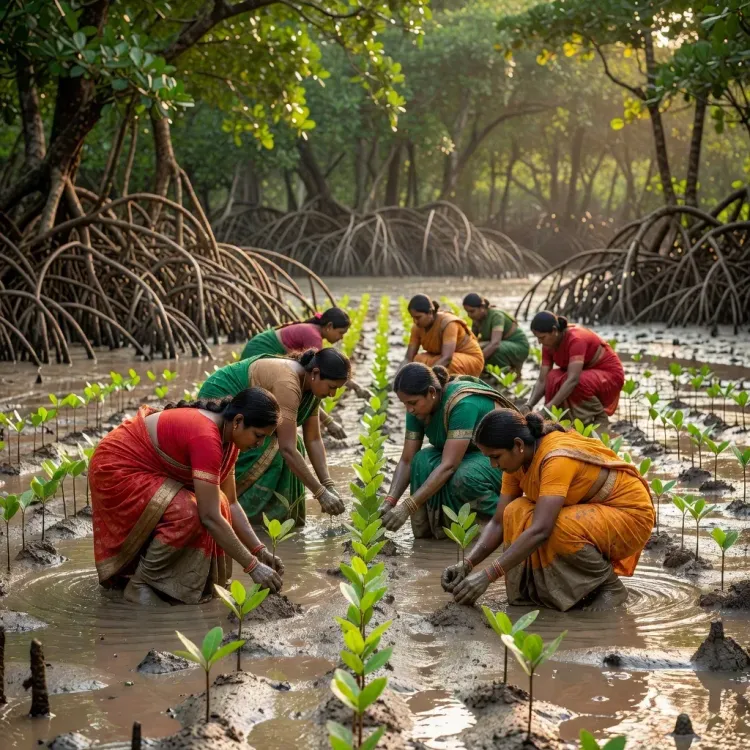
Synopsis
Union Agriculture Minister Shivraj Singh Chouhan shared how widows of tiger-attack victims in Jharkali, Sundarbans, are cultivating mangroves for income and coastal protection — a story spotlighted in PM Modi's Mann Ki Baat programme.
Key Takeaways
Women in Jharkali in the Sundarbans are cultivating mangrove forests, most of them widowed by tiger attacks in the region.
Union Agriculture Minister Shivraj Singh Chouhan shared the story on September 27, 2026 , citing PM Narendra Modi 's Mann Ki Baat radio programme.
The mangroves planted by these women serve as a natural coastal protection barrier for surrounding villages against cyclones and erosion.
The initiative provides paid livelihoods to women who lost their primary earner to human-wildlife conflict in the Sundarbans.
The story aligns with the MISHTI scheme launched in Union Budget 2023 , linking mangrove restoration to rural employment along India's coastlines.
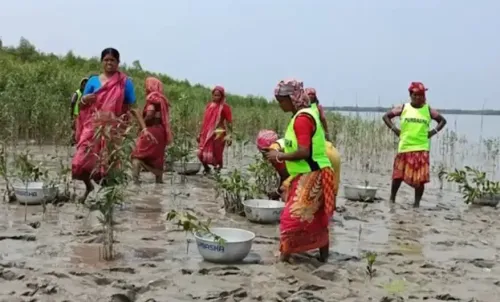
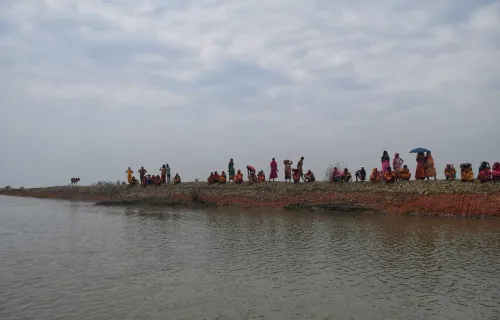
They lost their husbands to tiger attacks in the Sundarbans — and then turned back to the same forest for survival. Union Agriculture Minister Shivraj Singh Chouhan on Sunday, September 27, 2026, shared a striking story from Jharkali, where widowed women are growing mangrove forests, earning livelihoods, and building a natural shield for their villages — all at once.
Sharing the story in the context of Prime Minister Narendra Modi's monthly radio programme Mann Ki Baat, Chouhan wrote: 'The women of Jharkali are preparing mangrove forests. Most of them are women whose husbands lost their lives in tiger attacks. After losing their husbands, they found a means of livelihood from the Sundarbans itself. The mangroves planted by them are today becoming a natural protective shield for villages — and by planting them, these women are also earning income.'
Widows of the Sundarbans, guardians of its coast
The Sundarbans — the world's largest mangrove delta, straddling West Bengal and Bangladesh — is a UNESCO-recognised ecosystem and the home of the Royal Bengal Tiger. It is also a zone of chronic human-wildlife conflict, where fishermen and honey-collectors venturing into the forest have long faced fatal tiger attacks, leaving behind communities of widows with few economic options.
The Jharkali initiative threads together what policymakers have long struggled to stitch: conservation and welfare, grief and income, ecology and equity. By cultivating mangroves — plants that anchor coastlines against cyclone surges and erosion — these women are simultaneously healing a damaged ecosystem and creating a paying occupation for themselves.
MISHTI scheme: the policy backdrop these roots grow in
The story lands inside a broader national push. The Union Budget 2023 introduced the MISHTI (Mangrove Initiative for Shoreline Habitats and Tangible Incomes) scheme, specifically designed to promote mangrove plantation along India's coastline, linking ecological restoration to rural employment. The Sundarbans, as India's most ecologically significant mangrove zone, sits at the centre of that ambition.
India has increasingly treated mangrove restoration as a nature-based solution to coastal resilience — a low-cost, high-return buffer against the intensifying cyclone seasons that batter the Bay of Bengal coast. Tying that ecological mission to the livelihoods of the very communities most exposed to the forest's dangers makes the Jharkali model particularly compelling.
Mann Ki Baat as a grassroots megaphone
Mann Ki Baat, PM Modi's monthly radio address, has consistently used such ground-level stories — women-led conservation, self-help group enterprise, tribal innovation — to spotlight what the government frames as the convergence of welfare and environment goals. Chouhan's post amplifies that signal, bringing the Jharkali women's work to a national political audience in a single share.
The image it leaves is a hard one to forget: women who have every reason to fear the forest choosing instead to tend it, root by root, and in doing so, holding the shoreline together.
Point of View
The BJP is weaving conservation into its rural welfare narrative ahead of future budget cycles. The model also puts pressure on state governments and environment ministries to scale and document such community-led efforts with rigour. Whether the Jharkali initiative represents a replicable template or a one-off success story will depend on how quickly implementation data is made public.
NationPress
27 Sept 2026
Frequently Asked Questions
Who are the women growing mangroves in Jharkali, Sundarbans?
They are primarily widows of men who were killed in tiger attacks while working in the Sundarbans forest. These women turned to mangrove cultivation as a source of livelihood and have also created a natural coastal shield for their villages.
What is the MISHTI scheme and how does it relate to this?
The MISHTI (Mangrove Initiative for Shoreline Habitats and Tangible Incomes) scheme was announced in the Union Budget 2023 to promote mangrove plantation along India's coastline, combining ecological protection with rural employment — the same twin goal the Jharkali women's initiative demonstrates on the ground.
What is Mann Ki Baat and why was this story featured?
Mann Ki Baat is Prime Minister Narendra Modi 's monthly radio programme that highlights grassroots success stories from across India. The Jharkali mangrove initiative was cited as an example of women-led conservation and self-reliance.
Why are mangroves important for Sundarbans villages?
Mangroves act as a natural buffer against cyclones, storm surges, and coastal erosion — threats that are particularly severe in the low-lying Sundarbans delta on the Bay of Bengal. Dense mangrove cover significantly reduces the impact of extreme weather on villages.
What did Shivraj Singh Chouhan say about the Sundarbans women?
Chouhan shared that the women of Jharkali are growing mangrove forests, most of them having lost their husbands to tiger attacks. He noted that the mangroves are becoming a 'natural protective shield' for villages and are also generating income for the women who plant them.