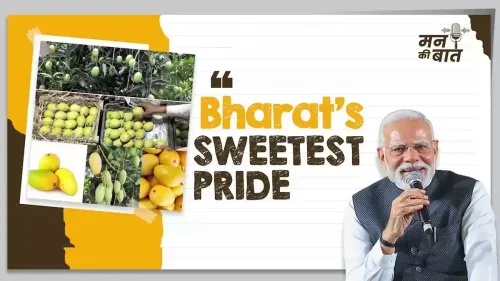
Shivraj Singh Chouhan Shares PM Modi's Mann Ki Baat on Mango Diversity
Synopsis
Union Agriculture Minister Shivraj Singh Chouhan amplified PM Modi's Mann Ki Baat remarks celebrating India's diverse regional mango varieties — from Alphonso and Kesar to Jardalu and Banganapalli — and their expanding journey to global markets.
Key Takeaways
Union Agriculture Minister Shivraj Singh Chouhan shared PM Narendra Modi 's Mann Ki Baat passage on mango diversity on 31 May 2026 .
The post names over a dozen regional varieties including Alphonso, Kesar, Dasheri, Langra, Jardalu, Chausa, Banganapalli, Totapuri, Himsagar , and Suvarnarekha .
Several named varieties — including Jardalu (GI tag: 2018) and Alphonso — hold formal Geographical Indication protection under the GI Act, 1999 .
APEDA has been driving mango export promotion through cold-chain infrastructure and phytosanitary compliance for markets in the EU, US, and Gulf.
The messaging connects cultural pride in regional produce with the government's stated objective of expanding India's horticulture footprint in global value chains.
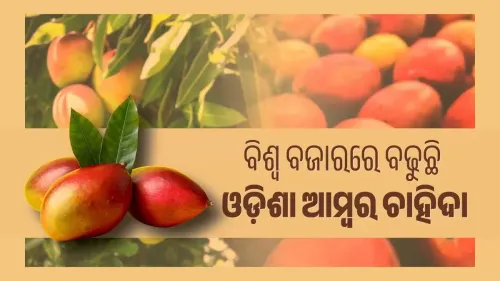
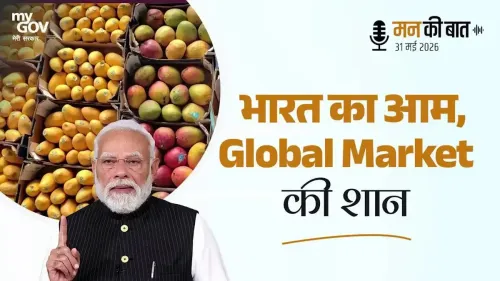
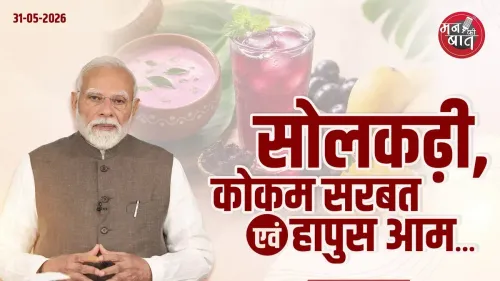
Union Agriculture Minister Shivraj Singh Chouhan on Sunday, 31 May 2026, shared a passage from Prime Minister Narendra Modi's Mann Ki Baat radio address celebrating India's extraordinary regional mango diversity and its growing journey from village farms to global markets.
Context
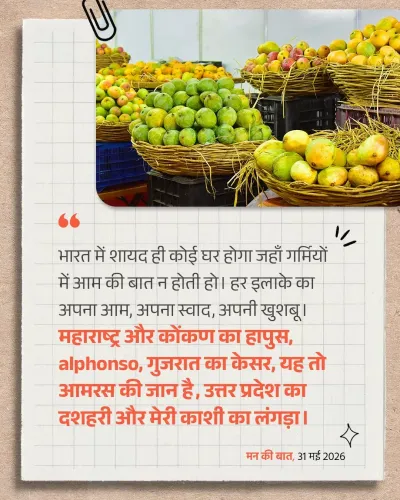
Chouhan's post quotes PM Modi's remarks from Mann Ki Baat, the monthly radio programme in which the Prime Minister addresses citizens on cultural and developmental themes. The quoted passage celebrates the breadth of India's mango heritage — noting that 'जगह बदलती है, आम का रूप-रंग और उसका स्वाद भी बदल जाता है' ('as the place changes, so does the mango's form, colour, and taste'). The minister shared the post with the hashtag #MannKiBaat, amplifying the Prime Minister's words to his own audience.
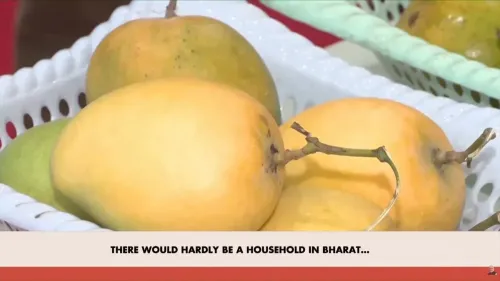
The passage names varieties across nearly every major mango-growing belt: Alphonso (Hapus) from Maharashtra's Konkan coast, Kesar from Gujarat, Dasheri and Langra from Uttar Pradesh, Jardalu from Bihar, Chausa, Malda, and from southern India — Banganapalli, Totapuri, Neelam, Malgova, Himsagar from Bengal, and Suvarnarekha from Odisha and Andhra Pradesh.
Policy Backdrop
Several of the varieties named carry formal Geographical Indication (GI) tags under the Geographical Indications Act, 1999. Bihar's Jardalu mango received its GI tag in 2018, while the Alphonso has long been protected to prevent misuse of its name in export markets. GI recognition is designed to safeguard regional identity, command premium pricing, and curb fraudulent labelling.
Export promotion for Indian mangoes has been pursued through the Agricultural and Processed Food Products Export Development Authority (APEDA), which has worked on cold-chain upgrades and phytosanitary compliance to open markets in the European Union, United States, Japan, and the Gulf. PM Modi's reference to the mango's journey reaching the 'global market' aligns with this long-running institutional effort to position Indian horticulture within international value chains.
Stakeholders and Impact
India is the world's largest producer of mangoes, and the crop supports millions of farmers, orchard workers, and traders across more than a dozen states. The cultural resonance of regional varieties — each tied to local memory and seasonal identity — gives public messaging around mangoes an unusually broad reach, cutting across linguistic and geographic divides.
Horticulture exporters and growers' cooperatives stand to benefit when senior government voices link cultural pride to market potential. For small and marginal farmers in belts such as Malihabad (UP), Murshidabad (Bengal), and Bhagalpur (Bihar), sustained policy attention and export infrastructure can translate directly into better farmgate prices.
What's Next
The broader Mann Ki Baat series continues to serve as a platform for connecting rural livelihoods with national narratives. Observers will watch for any follow-up policy announcements from the Agriculture Ministry — such as new export targets, GI enforcement drives, or horticulture infrastructure funding — that build on the momentum generated by this public messaging. APEDA's seasonal mango trade data for the 2026 export window will offer an early measure of whether the 'village to global market' aspiration is translating into numbers on the ground.
Point of View
The messaging seeks to build domestic pride that can be channelled into demand for GI-certified produce in international markets. The post also reinforces the federal character of India's agricultural identity at a time when centre-state coordination on horticulture export logistics remains a live policy challenge. Whether this public enthusiasm translates into measurable farmgate gains for small growers will depend on the infrastructure and procurement reforms that follow the rhetoric.
NationPress
14 Oct 2026
Frequently Asked Questions
What did PM Modi say about mangoes in Mann Ki Baat?
PM Modi celebrated India's regional mango diversity in a Mann Ki Baat address, naming varieties such as Alphonso from Maharashtra, Kesar from Gujarat, Dasheri and Langra from Uttar Pradesh, Jardalu from Bihar, and Banganapalli and Himsagar from southern and eastern India, and noted that the mango's journey is now reaching global markets.
Which Indian mango varieties have GI tags?
Several Indian mango varieties hold Geographical Indication tags under the GI Act, 1999, including Jardalu from Bihar (tagged in 2018), Alphonso (Hapus) from Maharashtra, Dasheri from Uttar Pradesh, and Banganapalli from Andhra Pradesh, among others.
Why did Shivraj Singh Chouhan post about mangoes?
Agriculture Minister Shivraj Singh Chouhan shared a passage from PM Modi's Mann Ki Baat radio address to amplify the Prime Minister's message celebrating India's mango heritage and its growing export potential.
How does India promote mango exports?
India promotes mango exports primarily through APEDA, which works on cold-chain infrastructure, phytosanitary compliance, and market access negotiations to ship Indian mangoes to the EU, US, Japan, and Gulf countries.
What is Mann Ki Baat?
Mann Ki Baat is a monthly radio programme launched by Prime Minister Narendra Modi in October 2014 in which he addresses citizens on cultural, social, and developmental themes, including agriculture and rural livelihoods.