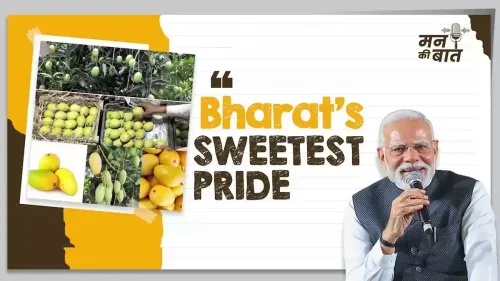
Goyal highlights India's mango diversity, eyes global markets
Synopsis
Union Commerce Minister Piyush Goyal invoked India's regional mango varieties — from Alphonso to Jardalu — on Mann Ki Baat, connecting agricultural diversity to the country's push for expanded global fruit exports and GI-tagged produce promotion.
Key Takeaways
Commerce Minister Piyush Goyal posted on 31 May 2026 listing over a dozen regional Indian mango varieties from states including Maharashtra, Gujarat, Uttar Pradesh, Bihar, West Bengal, Odisha, and Andhra Pradesh .
The post was tagged #MannKiBaat , Prime Minister Modi's monthly All India Radio programme launched in October 2014 .
Several named varieties — including Bihar's Jardalu — carry Geographical Indication (GI) tags that support premium export positioning.
Goyal explicitly linked India's mango diversity to global market reach, stating the mango's journey is now going 'from village to global market.' APEDA is the nodal agency for Indian mango exports, with active market access in Europe, the Middle East, Japan, South Korea , and the United States .
The post signals a push to diversify India's mango export basket beyond the internationally dominant Alphonso variety.
Union Commerce and Industry Minister Piyush Goyal on Sunday, 31 May 2026, invoked India's rich regional mango heritage — from Maharashtra's Alphonso to Bihar's Jardalu — drawing a direct line between the country's agricultural diversity and its growing ambitions in global fruit markets. The post, tagged #MannKiBaat, reflects the broader public conversation around India's farm produce and export potential.
Context
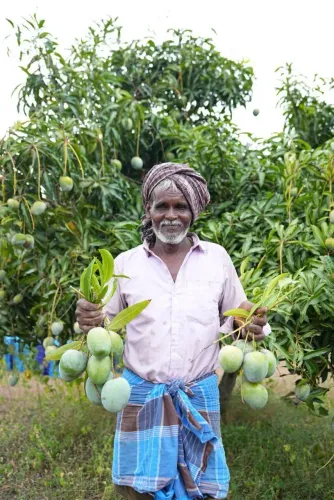
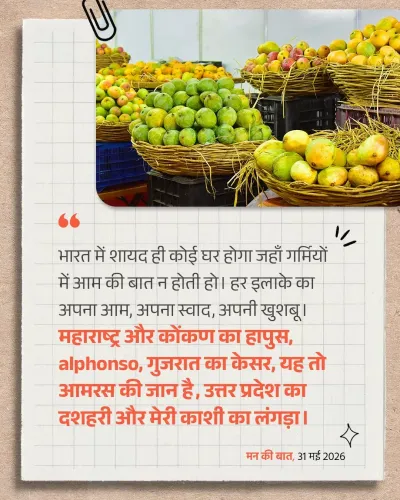
In his post, Minister Goyal named more than a dozen regional mango varieties: 'महाराष्ट्र और कोंकण का हापुस' (Hapus/Alphonso of Maharashtra and Konkan), Gujarat's Kesar, Uttar Pradesh's Dasheri, 'मेरी काशी का लंगड़ा' (Langra of 'my Kashi'), Bihar's Jardalu, and south Indian varieties including Banganapalli, Totapuri, Neelam, and Malgova, as well as Bengal's Himsagar and Odisha and Andhra Pradesh's Suvarnrekha. The sweep is deliberate — covering nearly every major mango-growing belt in the country.
He summarised the essence simply: 'जगह बदलती है, आम का रूप-रंग और उसका स्वाद भी बदल जाता है' — 'As the place changes, so does the form, colour, and taste of the mango.' The closing line — that this journey of the mango is now reaching from the village to the global market — is the political and economic anchor of the post.
Policy Backdrop
Prime Minister Narendra Modi launched the Mann Ki Baat radio programme in October 2014 on All India Radio as a platform to discuss public issues, citizen achievements, and matters of national interest. The hashtag on Goyal's post signals the episode's themes were being amplified by Cabinet colleagues.
Several of the varieties Goyal named carry Geographical Indication (GI) tags under the Geographical Indications of Goods (Registration and Protection) Act, 1999. Bihar's Jardalu mango, for instance, holds a GI tag that has been used to build its export identity. GI certification is a key instrument the Commerce Ministry deploys to add premium value to regional produce in international markets.
India is among the world's largest mango producers, and the Agricultural and Processed Food Products Export Development Authority (APEDA) has been a principal vehicle for pushing fresh mango exports to markets in Europe, the Middle East, Japan, South Korea, and the United States.
Stakeholders and Impact
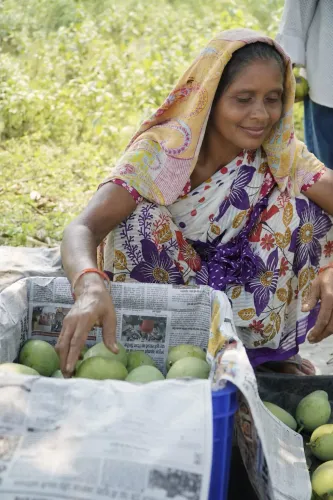
For mango growers across the Konkan coast, the Gangetic plains, and the Deccan plateau, visibility in national political communication translates into policy attention — better cold-chain infrastructure, phytosanitary clearances, and market-linkage programmes. Agri-exporters who handle the logistics of getting perishable fruit to distant markets are equally invested in the government's commitment to expand access.
The mention of varieties like Banganapalli (Andhra Pradesh) and Himsagar (West Bengal) alongside the more internationally recognised Alphonso signals an intent to diversify India's mango export basket beyond a single premium variety. This broadens the economic benefit to a wider geography of farmers.
What's Next
Watchers of agricultural trade policy will track APEDA's mango export data for the 2026 season to assess whether the political emphasis on regional varieties is translating into measurable shipment volumes. Fresh GI applications for additional regional mango varieties and any new bilateral market-access agreements for Indian mangoes will be the concrete policy markers to follow. The Commerce Ministry's ability to convert cultural pride in regional produce into durable export infrastructure will determine whether the mango's journey from village to global market becomes a sustained economic story.
Point of View
South, east, and west — the minister signals geographic inclusivity in agricultural policy, a useful optic ahead of any state election cycle. The Mann Ki Baat hashtag places this squarely within the Prime Minister's broader public-outreach architecture, amplifying a soft-power message about India's agrarian richness. The real test, however, lies in whether the Commerce Ministry's export facilitation machinery — cold-chain logistics, phytosanitary compliance, and bilateral market access — keeps pace with the political rhetoric.
NationPress
22 Sept 2026
Frequently Asked Questions
Which mango varieties did Piyush Goyal mention in his Mann Ki Baat post?
Goyal named Alphonso (Hapus) from Maharashtra and Konkan, Kesar from Gujarat, Dasheri and Langra from Uttar Pradesh, Jardalu from Bihar, Banganapalli, Totapuri, Neelam, and Malgova from south India, Himsagar from West Bengal, and Suvarnrekha from Odisha and Andhra Pradesh.
What is Mann Ki Baat and why is it relevant here?
Mann Ki Baat is a monthly radio programme launched by Prime Minister Narendra Modi in October 2014 on All India Radio to discuss public issues. Goyal's post was tagged #MannKiBaat, indicating the mango diversity theme was part of that episode's conversation.
Which Indian mango varieties have GI tags?
Several varieties mentioned by Goyal carry Geographical Indication tags under the GI Act of 1999, including Bihar's Jardalu, Maharashtra's Alphonso (Hapus), and Uttar Pradesh's Dasheri and Langra, which helps them command premium prices in export markets.
How does India export mangoes internationally?
India's mango exports are facilitated primarily by APEDA (Agricultural and Processed Food Products Export Development Authority), which manages phytosanitary protocols, cold-chain logistics, and market-access negotiations with countries in Europe, the Middle East, Japan, South Korea, and the United States.
What is the significance of promoting regional mango varieties for Indian farmers?
Promoting GI-tagged and regionally distinct varieties helps mango growers across multiple states access premium international markets, diversifies India's export basket beyond the Alphonso, and can drive investment in cold-chain and post-harvest infrastructure that benefits a broader base of agricultural communities.