Dr. Jitendra Singh shares PM Modi's Mann Ki Baat on India's mango diversity
Synopsis
Union Minister Dr. Jitendra Singh amplified PM Modi's Mann Ki Baat remarks celebrating India's regional mango diversity — from Alphonso and Kesar to Jardalu and Himsagar — and their expanding journey to global markets, underlining the government's GI-led export ambition.
Key Takeaways
Jitendra Singh shared a Mann Ki Baat excerpt by PM Narendra Modi on 31 May 2026 celebrating India's mango diversity.
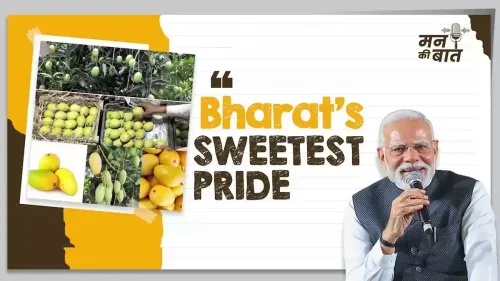
PM Modi named over a dozen regional varieties including Alphonso, Kesar, Dasheri, Langra, Jardalu, Banganapalli, Himsagar , and Suvarnarekha .
The post connects India's mango cultural heritage to its growing presence in global export markets .
India's Agricultural Export Policy 2018 lists mangoes as a priority commodity for value-added international shipments.
Several named varieties — including Alphonso, Dasheri, and Banganapalli — already hold Geographical Indication (GI) tags protecting their regional identity.
Mann Ki Baat has since October 2014 periodically used regional produce stories to link cultural pride with economic opportunity.
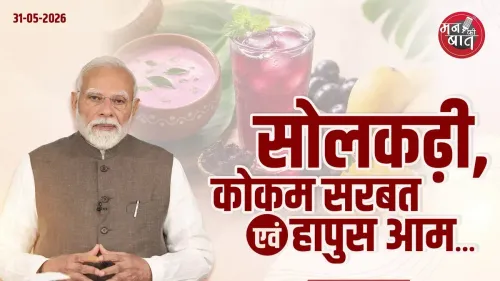
Union Science and Technology Minister Dr. Jitendra Singh on Sunday, 31 May 2026 shared an excerpt from Prime Minister Narendra Modi's Mann Ki Baat address on X, highlighting India's extraordinary regional mango diversity and the fruit's growing journey from village farms to global markets.
Context
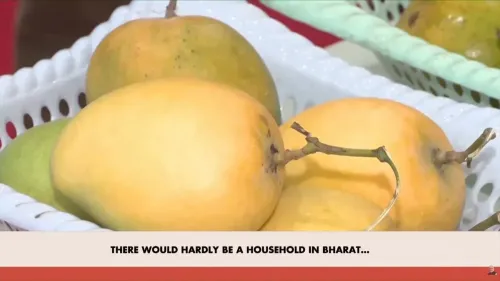
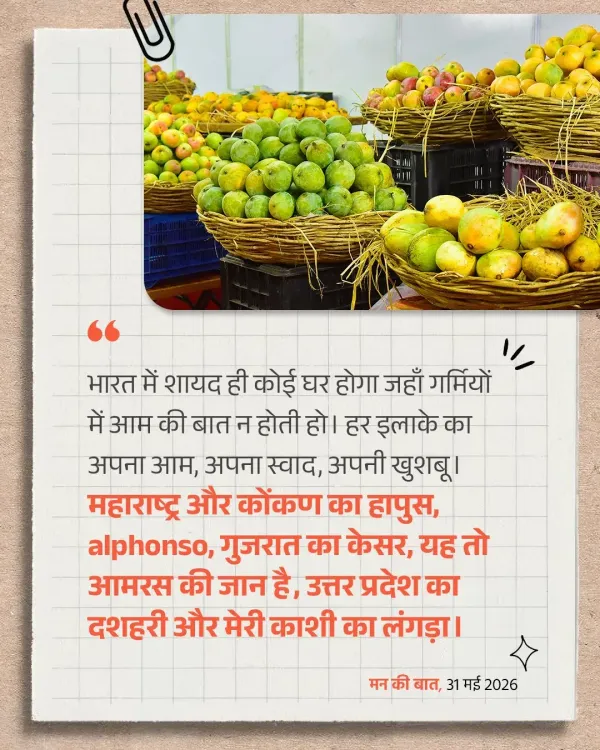
The post quotes PM Modi as saying: 'Bharat mein shayad hi koi ghar hoga jahan garmiyon mein aam ki baat na hoti ho' — 'There is hardly a home in India where mangoes are not discussed in summer.' The excerpt weaves together the names of celebrated regional varieties: Alphonso (Hapus) from Maharashtra and Konkan, Kesar from Gujarat, Dasheri and Langra from Uttar Pradesh, Jardalu from Bihar, Chausa, Malda, and from the south, Banganapalli, Totapuri, Neelam, Malgova, Himsagar from Bengal, and Suvarnarekha from Odisha and Andhra Pradesh.
PM Modi is quoted as observing: 'As the place changes, so does the form, colour, and taste of the mango.' He then connects this cultural richness to commerce, noting that 'this journey of the mango is now reaching from the village to the global market.'
Policy Backdrop
India's Agricultural Export Policy 2018 identified mangoes among priority commodities for value-added global shipments, recognising the fruit's premium potential abroad. Successive administrations have pursued Geographical Indication (GI) tags for individual mango varieties — including Alphonso, Dasheri, Langra, Jardalu, Banganapalli, and Himsagar — to protect their provenance and command higher prices in international markets.
Mann Ki Baat, the Prime Minister's monthly radio programme launched in October 2014, has periodically showcased Indian agricultural heritage and GI-tagged produce as a bridge between cultural pride and economic aspiration. The recurring emphasis on regional foods underscores a broader government communication strategy that links local identity with national export ambition.
Stakeholders and Impact
India is among the world's largest producers of mangoes, and the varieties named in PM Modi's address represent the livelihoods of millions of farmers across Maharashtra, Gujarat, Uttar Pradesh, Bihar, West Bengal, Odisha, Andhra Pradesh, and Tamil Nadu. GI protection and export promotion directly affect growers, packhouses, cold-chain operators, and agri-export companies.
The public amplification of this message by a Union Cabinet minister signals continued political will to position Indian mangoes — already exported to markets in the United States, Europe, the Gulf, and Southeast Asia — as premium, origin-certified produce. Consumer sentiment, both domestic and diaspora-driven, plays a significant role in sustaining demand for named varieties like Alphonso and Kesar.
What's Next
Attention will now turn to the Commerce Ministry's annual agricultural export data for 2025-26, which is expected to reflect the impact of sustained GI promotion and export facilitation measures. Any new GI applications for additional mango varieties in the coming parliamentary session would further institutionalise the government's premiumisation strategy. The mango season's overlap with the Mann Ki Baat broadcast cycle suggests further cultural-agricultural messaging is likely in the weeks ahead.
Point of View
The near-universal Indian affinity for mangoes — to build public support for an export-oriented agricultural agenda. By naming specific regional varieties, PM Modi's Mann Ki Baat excerpt simultaneously flatters local identities across multiple states, a politically astute move that transcends the usual policy announcement. The amplification by a senior Union Minister extends the message's reach beyond the radio programme's core audience into the social-media news cycle. This pattern of soft-power agricultural messaging, backed by GI tagging and export facilitation, has become a durable feature of the government's rural outreach playbook.
NationPress
17 Oct 2026
Frequently Asked Questions
Which mango varieties did PM Modi mention in Mann Ki Baat?
PM Modi named Alphonso (Hapus) from Maharashtra and Konkan, Kesar from Gujarat, Dasheri and Langra from Uttar Pradesh, Jardalu from Bihar, Chausa, Malda, Banganapalli, Totapuri, Neelam, Malgova from South India, Himsagar from Bengal, and Suvarnarekha from Odisha and Andhra Pradesh.
What is Mann Ki Baat and when did it start?
Mann Ki Baat is Prime Minister Narendra Modi's monthly radio programme that began in October 2014. It covers citizen-centric topics including agriculture, culture, and social issues.
Why did Dr. Jitendra Singh share this post about mangoes?
Dr. Jitendra Singh, Union Minister for Science and Technology, shared the excerpt from PM Modi's Mann Ki Baat to amplify the Prime Minister's message on India's regional mango diversity and its growing global export potential.
Do Indian mango varieties have GI tags?
Yes, several Indian mango varieties including Alphonso, Dasheri, Langra, Jardalu, Banganapalli, and Himsagar hold Geographical Indication tags that protect their regional identity and help command premium prices in export markets.
What is India's policy on mango exports?
India's Agricultural Export Policy 2018 identified mangoes as a priority commodity for value-added global shipments. GI tagging and export facilitation measures have been used to promote named varieties in markets including the United States, Europe, and the Gulf.