Mohan Bhagwat: True progress is not imitating the West
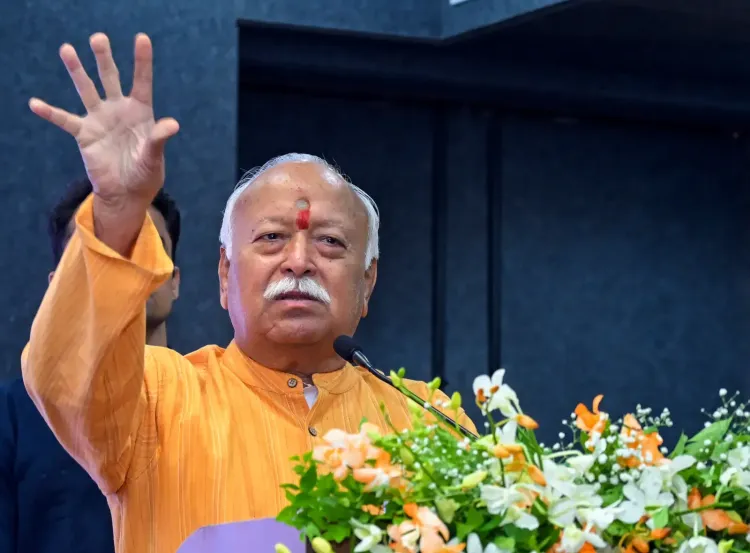
Synopsis
RSS chief Mohan Bhagwat used a circus metaphor — elephants playing football, tigers dining with goats — to argue Viksit Bharat 2047 cannot mean becoming America, China or Russia. True development, he said in Chhatrapati Sambhajinagar, is staying king of one's own jungle, not performing someone else's tricks.
Key Takeaways
RSS Sarsanghchalak Mohan Bhagwat spoke in Chhatrapati Sambhajinagar on 25 November .
He said Viksit Bharat 2047 must be a developed India, not a developed America, China or Russia.
He cited unity despite languages, customs and 33 crore deities, held by “We, the People”.
Using a circus analogy, he said an elephant's growth is not acting human, nor a tiger's dining with a goat.
On Padma awardees, he said ordinary people may be seen as Mahapurush after 25 years .
He said the common mindset is that Chhatrapati Shivaji Maharaj should be born in the neighbour's house, not ours.
Rashtriya Swayamsevak Sangh (RSS) Sarsanghchalak Mohan Bhagwat on Wednesday said true national progress means remaining rooted in India's own character rather than imitating the West, arguing that a Viksit Bharat by 2047 must be a developed India — not a developed America, China or Russia. Speaking in Chhatrapati Sambhajinagar on 25 November, he tied that argument to unity in diversity, the meaning of development, and how society treats its historical icons.
Unity in diversity and ‘We, the People’
Bhagwat emphasised that despite immense variations in languages, dialects, food habits, customs, and 33 crore deities, the collective identity of “We, the People” keeps the nation united. He presented that shared “we” as the binding force of a civilisationally diverse country, rather than sameness of tongue, diet or ritual.
He also offered insights on India's enduring spirit of unity in diversity and on how society later elevates some among it as great personalities. Notably, diversity was treated as a given, not as a problem to be ironed out. This comes amid a long-running national conversation on language, custom and regional identity — a conversation the RSS chief addressed by locating unity in common belonging.
Circus analogy and the 2047 development goal
Addressing the vision of a Viksit Bharat by 2047, Bhagwat used a circus analogy to define what he described as authentic progress. He observed that in a circus, elephants play football, monkeys ride bicycles, and tigers eat alongside goats.
“People pay money to watch this spectacle, but that is not their development,” Bhagwat stated. “An elephant's growth does not lie in acting like a human, nor does a tiger's growth lie in becoming non-violent and dining with a goat. While non-violence is a noble principle, a tiger's true development is in living as the king of the jungle,” he noted.
Connecting this to India's future, he stressed that the goal for 2047 is not to become a developed America, China or Russia, but a developed India — staying true to its own roots while working together with a sense of collective ownership. The year marks a century of Independence, and Viksit Bharat is the horizon the Centre has projected for national development. Bhagwat's intervention recast that horizon in civilisational rather than imitative terms: growth, in this telling, is becoming more fully oneself, not performing another country's tricks for an audience.
Padma Awards and ordinary people as future Mahapurush
Reflecting on individuals honoured with the Padma Awards, Bhagwat noted that while society may not immediately label them as Mahapurush (great personalities), they might be revered as such 25 years down the line. He pointed out that these awardees started as ordinary people just like everyone else, proving that common individuals can achieve extraordinary feats.
“Society functions and progresses because such people exist among us,” he remarked. The observation recasts national honours as delayed recognition of work already being done in plain sight, rather than as a closed club of born greats.
Historical icons and the Shivaji remark
Bhagwat also critiqued the tendency of people to worship historical heroes from afar rather than emulating their difficult paths. He remarked that while people celebrate the birth and death anniversaries of great leaders, the common mindset is “Chhatrapati Shivaji Maharaj should be born, but in the neighbour's house, not ours.”
Disagreeing with the popular English adage that “Ideals are like stars; we never reach them, but we can plot our chart according to them,” Bhagwat cited the Hindi proverb “Nar karni kare to nar ka Narayan ban jaye” (Through noble deeds, a human can rise to the divine). He concluded that people often revere icons as gods and worship them simply to avoid walking the challenging, crisis-filled paths those leaders actually took.
The test of that argument, going forward, is whether public culture treats Shivaji and other icons as templates for hard choices — or only as names for anniversaries and statues.
Point of View
Infrastructure and global rankings — metrics that look a lot like the West he says India must not copy. The Shivaji line, that the great king should be born in the neighbour's house, is the sharper cut: it calls out performative reverence that never accepts the cost of leadership. If 2047 is to mean something other than a richer imitation, the roots, the institutions and the trade-offs have to be named, not only the animals that belong in which cage.
NationPress
25 Nov 2026
Frequently Asked Questions
What did Mohan Bhagwat say about imitating the West?
RSS Sarsanghchalak Mohan Bhagwat said true progress means staying true to India's roots rather than imitating the West. He argued that Viksit Bharat by 2047 should be a developed India, not a developed America, China or Russia.
What was Mohan Bhagwat's circus analogy about development?
Bhagwat said that in a circus, elephants play football, monkeys ride bicycles and tigers eat alongside goats, but that spectacle is not their development. He added that a tiger's true development is living as the king of the jungle, not becoming non-violent and dining with a goat.
What did Bhagwat say about Viksit Bharat 2047?
He stressed that the 2047 goal is not to become a developed America, China or Russia, but a developed India that stays true to its own roots. He linked that aim to working together with a sense of collective ownership.
What was Bhagwat's remark on Chhatrapati Shivaji Maharaj?
Bhagwat said the common mindset is that Chhatrapati Shivaji Maharaj should be born, but in the neighbour's house, not ours. He argued people celebrate birth and death anniversaries of great leaders while avoiding the difficult paths those leaders actually took.
What did Mohan Bhagwat say about Padma Award winners?
Bhagwat noted that Padma awardees may not be immediately labelled Mahapurush, but might be revered as such 25 years later. He said they started as ordinary people, and that society progresses because such people exist among us.