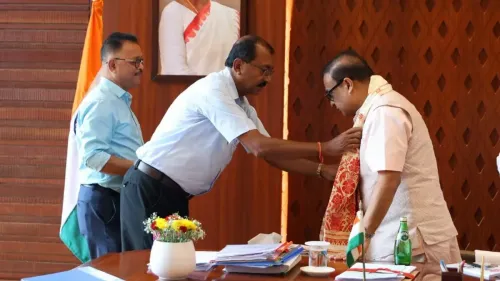
Assam CM: Action if law demands on Deputy Speaker Teron

Synopsis
Assam Chief Minister Himanta Biswa Sarma has said action against Deputy Speaker Habbey Teron will follow the law and Karbi Anglong's traditional courts after a married woman alleged a relationship, a child and abandonment at a Diphu press conference. The claims remain unsubstantiated.
Key Takeaways
Assam Chief Minister Himanta Biswa Sarma on Wednesday said action against Deputy Speaker Habbey Teron would follow the law and competent authorities.
A married woman allegedly accused Teron of a relationship, fathering a child and abandoning her at a press conference in Diphu , Karbi Anglong .
Sarma said Karbi Anglong has its own rules, regulations and traditional courts, and that action would follow whatever the law and the courts say.
The allegations remain unsubstantiated and no conclusion has been established.
Teron holds a constitutional position as Deputy Speaker of the Assam Legislative Assembly .
Assam Chief Minister Himanta Biswa Sarma on Wednesday said appropriate action would be taken against Legislative Assembly Deputy Speaker Habbey Teron over allegations levelled against him, in accordance with the law and the findings of the competent authorities. Speaking in Guwahati on 25 November after questions from reporters, Sarma also pointed to the customary laws, established traditions and traditional judicial mechanisms of Karbi Anglong, which deal with certain local disputes.
What the Chief Minister said
Sarma framed the next step as institutional, not political. He said Karbi Anglong has its own rules and regulations and traditional courts, and that the government would follow whatever those forums conclude.
“Karbi Anglong has its own rules and regulations, and there are traditional courts. Whatever the law and the courts say, action will be taken accordingly,” the Chief Minister said.
He did not announce any immediate administrative step against Teron, who occupies a constitutional office in the Assam Legislative Assembly. The response indicates that Dispur will await the relevant legal and institutional processes before deciding on any course of action.
The allegations made in Diphu
The controversy surrounding Teron surfaced after a married woman allegedly accused the Deputy Speaker of having a relationship with her, fathering a child and subsequently abandoning her. The woman reportedly made the allegations during a press conference in Diphu, the headquarters of Karbi Anglong district, bringing the matter into the political spotlight.
Her claims have triggered questions over the conduct of the senior legislator and drawn attention across political and administrative circles in the state. The allegations against Teron remain unsubstantiated, and no conclusion has been established regarding the claims made by the woman.
Customary law in Karbi Anglong
The Chief Minister specifically referred to the customary judicial framework prevalent in Karbi Anglong, where traditional institutions continue to play a role in addressing certain community-level disputes. That emphasis matters because the dispute has been placed, at least in part, before forums that sit alongside the ordinary courts rather than being treated solely as a matter for the state government to settle by executive order.
This comes amid considerable public attention on an elected representative holding a constitutional position in the Assam Legislative Assembly. Notably, Sarma tied any action to what the law and the courts say, rather than to a political timeline. For residents of Karbi Anglong, the episode will also be watched as a test of whether customary institutions and the state's formal machinery move together, or whether process becomes delay.
The Deputy Speaker's office is not a private party post. How a sitting presiding officer of the Assembly is treated while serious personal allegations are examined is a separate institutional question — one Sarma did not answer on Wednesday beyond the commitment to follow the law.
Who is affected and why it matters
Those directly named are Teron and the woman who spoke in Diphu. The wider effect is on public confidence in how Assam handles conduct complaints against high office-holders, especially in a hill district where customary rules still govern some disputes. Political and administrative circles in the state are already tracking the case because it involves a constitutional functionary, not a back-bench legislator.
Rushing to a verdict before facts are tested would cut against the legal caution Sarma publicly adopted. Equally, leaving the matter only to an unspecified wait for ‘competent authorities’ will invite the charge that a powerful office is being insulated by procedure. Both risks now sit with the government, the Assembly and the traditional courts the Chief Minister invoked.
What happens next
Further developments are expected as the matter progresses through the relevant legal and customary mechanisms. Competent authorities — including, as Sarma underlined, traditional courts in Karbi Anglong — will have to examine the woman's claims before any action is taken.
Until those findings emerge, the allegations remain unsubstantiated. The Chief Minister's line on Wednesday was that action will follow if the law demands it. How quickly those forums move, and whether the Assembly itself takes a view of the Deputy Speaker's position, will decide whether this stays a local dispute or becomes a prolonged political test in Assam.
Point of View
Especially when the accused occupies a constitutional chair. That caution is legally sound — the Diphu claims are untested — but it also leaves a gap between public office and public conduct. Karbi Anglong's customary courts cannot become a convenient delay if the allegation is one of abandonment and paternity involving a sitting Deputy Speaker. The real test is whether those forums, and the Assembly, move on facts rather than on the calendar of convenience.
NationPress
25 Nov 2026
Frequently Asked Questions
What did Assam CM Himanta Biswa Sarma say about Deputy Speaker Habbey Teron?
Sarma said appropriate action would be taken against Habbey Teron in accordance with the law and the findings of the competent authorities. He added that Karbi Anglong has its own rules, regulations and traditional courts, and that action would follow whatever the law and the courts say.
What are the allegations against Assam Deputy Speaker Habbey Teron?
A married woman allegedly accused Teron of having a relationship with her, fathering a child and subsequently abandoning her. She reportedly made the claims at a press conference in Diphu, the headquarters of Karbi Anglong district.
Have the allegations against Habbey Teron been proved?
No. The allegations remain unsubstantiated and no conclusion has been established regarding the woman's claims. The Chief Minister said the government would await legal and customary processes before any action.
Why did Himanta Biswa Sarma mention traditional courts in Karbi Anglong?
Sarma said Karbi Anglong has its own customary laws, established traditions and traditional judicial mechanisms that deal with certain local disputes. He indicated that those forums, along with the ordinary law, would guide any action against the Deputy Speaker.
Where were the allegations against Habbey Teron made?
The woman reportedly made the allegations during a press conference in Diphu, the headquarters of Karbi Anglong district in Assam. Chief Minister Himanta Biswa Sarma later responded to questions on the controversy in Guwahati on 25 November.