Viksit Bharat 2047 is a moving goal, not a waiting game: PM Modi
Synopsis
Modi's Deepwali Milan address at BJP headquarters reframed the Viksit Bharat 2047 vision from a distant deadline into an active, milestone-driven journey — drawing a pointed parallel with India's independence movement and stacking up a list of achievements, from the Moon's south pole to the world's largest real-time payment system, to argue the goal is already within reach.
Key Takeaways
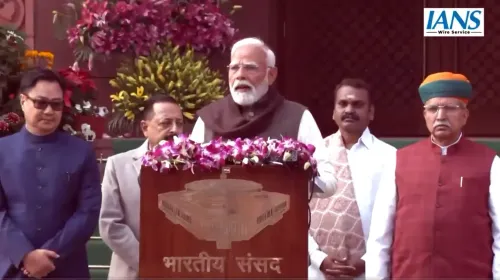
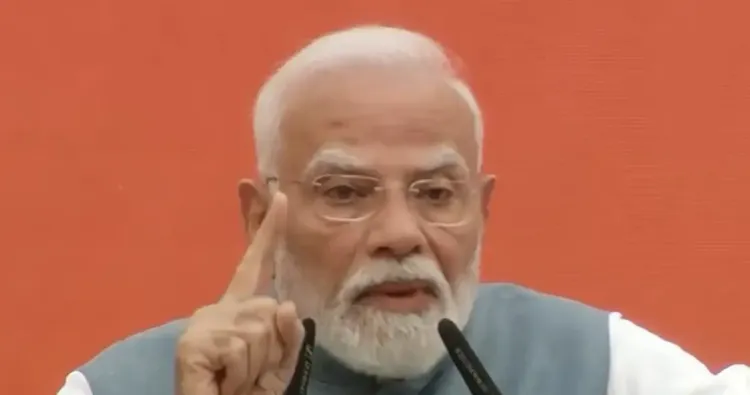
PM Narendra Modi spoke at the Deepwali Milan Samaroh at BJP headquarters, New Delhi on 12 November 2026 .
He declared that Viksit Bharat 2047 should be treated as a continuously pursued goal, not a deadline to wait for.
Modi cited India becoming the world's second-largest mobile manufacturer , the third-largest startup ecosystem , and UPI as the largest real-time payment system globally .
He invoked India's Chandrayaan Moon landing near the south pole and the Chenab River railway arch bridge as milestones once thought unimaginable.
Modi contrasted past governments' repeated poverty-eradication promises with what he called visible, present-day poverty reduction.
He urged the media to amplify India's success stories globally, referencing Mann Ki Baat as a model platform.
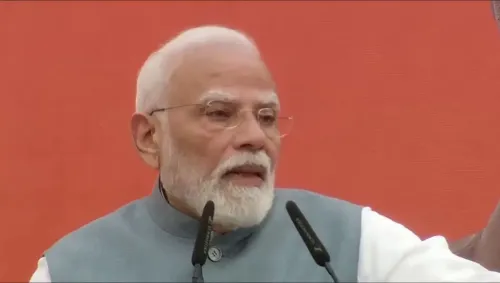
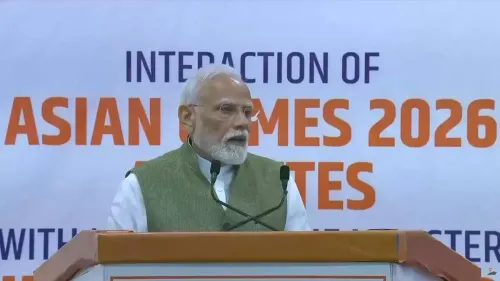
Prime Minister Narendra Modi on Thursday, 12 November 2026, declared that the vision of a Viksit Bharat — a developed India — is well within reach, pointing to a decade of achievements spanning space exploration, digital payments, infrastructure, and startup growth. Speaking at the Deepwali Milan Samaroh at the BJP headquarters in New Delhi, Modi urged the country not to treat 2047 as a distant finish line, but as the endpoint of a journey that must advance continuously from today.
Key Remarks at BJP's Deepwali Gathering
The event was hosted by BJP National President Nitin Nabin and attended by senior party leaders including Union Home Minister Amit Shah, Defence Minister Rajnath Singh, and Union Minister J.P. Nadda. Modi used the festive occasion to both celebrate India's progress and issue a call to action — asking the media, in particular, to amplify the country's success stories to a global audience.
'Given the achievements with which India is moving forward today, the goal of a Viksit Bharat is entirely within reach,' the Prime Minister said at the gathering.
Milestones Modi Cited
Modi highlighted a range of accomplishments achieved over the past 12 years that he said would have seemed implausible not long ago. These include India's successful lunar landing near the Moon's south pole — a historic first globally — the country's rise to become the world's second-largest mobile manufacturer, and the development of the world's third-largest startup ecosystem.
He also pointed to the Unified Payments Interface (UPI), which he described as now the largest real-time payment system globally, and the construction of the world's highest railway arch bridge over the Chenab River as emblems of infrastructural ambition. 'Who would have thought that the world's highest railway arch bridge would be built over the Chenab River?' he said, contrasting the current scale of projects with an era when building a four-lane road was considered a significant feat.
On Poverty and Governance
The Prime Minister also addressed the trajectory of poverty alleviation in India, drawing a sharp contrast between past rhetoric and present outcomes. He said that while earlier governments repeatedly made poverty eradication a campaign promise — often announced from the Red Fort — the country was now witnessing tangible reductions in poverty levels as people overcame it themselves.
'There was a time when every leader spoke about eradicating poverty from the Red Fort. It was almost like a constant mantra for them. But today, the poor are actually overcoming poverty themselves, and we are witnessing poverty being reduced,' he said.
This framing is consistent with Modi government messaging around schemes such as PM Jan Dhan Yojana, PM Awas Yojana, and direct benefit transfers, which the administration has cited as structural drivers of poverty reduction. Critics, however, have noted that official poverty data methodologies and their independence remain subjects of ongoing debate among economists.
The 2047 Framework: Progress, Not Patience
Perhaps the most substantive message of Modi's address was a reframing of the Viksit Bharat 2047 vision — the government's overarching goal of making India a developed nation by the centenary of its Independence. Rather than treating the year as a deadline to work toward, Modi invoked India's freedom struggle as a parallel, arguing that large national goals are achieved through a series of smaller, confidence-building milestones.
'The 2047 deadline does not mean that we have to wait until then. Think about India's freedom movement. The goal of complete independence was not something that could be achieved in a day or two. But gradually, smaller goals were set and achieved, which built people's confidence that independence would certainly be attained,' he said.
This signals a broader administrative philosophy: that the Viksit Bharat agenda should be operationalised in near-term targets rather than deferred to a single horizon year.
Media's Role in Telling the India Story
Closing his address, Modi made a direct appeal to the media, calling communication 'the greatest strength of the connected world of the 21st century.' He referenced his monthly radio programme Mann Ki Baat as a vehicle for citizen achievement stories and urged journalists to invest in coverage that takes India's progress narrative to international audiences.
'We have a young population, talent, technology, affordable data and, most importantly, a wonderful story to tell the world: the India Story,' he said. The Prime Minister also extended festive greetings for Diwali, Navratri, and Chhath Puja to those present.
With general elections a few years away and the Viksit Bharat 2047 framework increasingly central to the BJP's political identity, Modi's framing of achievement as ongoing — rather than promised — will likely shape party communication strategies in the near term.
Point of View
But the harder question mainstream coverage tends to skip is whether these milestones have translated into broad-based income growth and job quality for the bottom quartile. Invoking the independence struggle as an analogy is powerful rhetoric, but the freedom movement had a binary, verifiable endpoint — 'developed nation' status does not. Without a transparent dashboard of Viksit Bharat targets — poverty headcount, manufacturing share of GDP, human development indices — the vision risks becoming a permanent horizon that always recedes.
NationPress
12 Nov 2026
Frequently Asked Questions
What is the Viksit Bharat 2047 goal PM Modi spoke about?
Viksit Bharat 2047 is the Indian government's overarching vision of making India a fully developed nation by 2047, the centenary of Independence. At the Deepwali Milan Samaroh on 12 November 2026, Modi reframed it not as a distant deadline but as a continuously pursued goal built on near-term milestones.
Where did PM Modi make these remarks?
Modi spoke at the Deepwali Milan Samaroh hosted at the BJP headquarters in New Delhi on 12 November 2026. The event was hosted by BJP National President Nitin Nabin and attended by senior leaders including Home Minister Amit Shah, Defence Minister Rajnath Singh, and J.P. Nadda.
What achievements did PM Modi highlight in his speech?
Modi cited India's lunar landing near the Moon's south pole, its rise to the world's second-largest mobile manufacturer, the world's third-largest startup ecosystem, UPI becoming the largest real-time payment system globally, and the construction of the world's highest railway arch bridge over the Chenab River.
How did Modi connect the 2047 goal to India's freedom movement?
Modi drew a parallel between the 2047 Viksit Bharat vision and India's independence struggle, arguing that large national goals are reached through successive smaller milestones that build collective confidence — not by waiting for a single end-date. He said the same confidence-building approach should drive progress toward a developed India.
What did PM Modi say about poverty reduction?
Modi contrasted earlier governments' repeated electoral promises to eradicate poverty — often made from the Red Fort — with what he described as visible, present-day reductions in poverty levels, saying the poor are now overcoming poverty themselves rather than depending on promises.