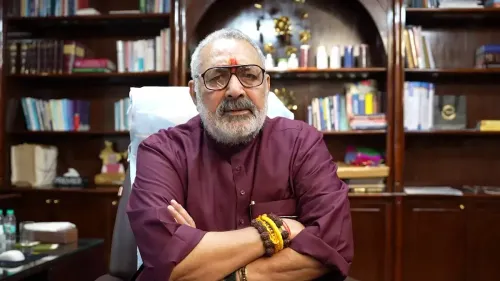
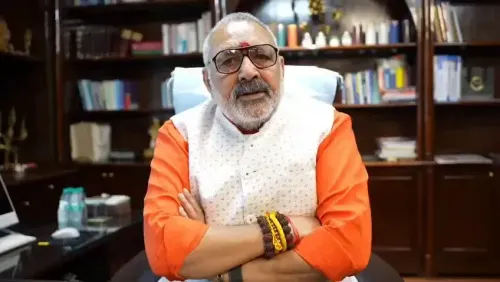
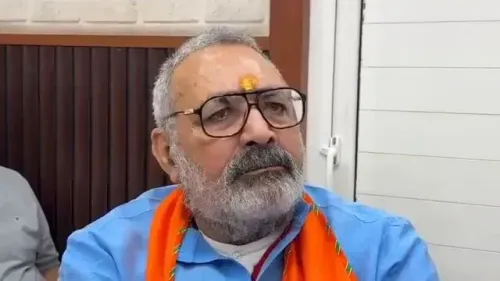
Giriraj Singh targets opposition over 'tukde-tukde gang' politics

Synopsis
Union Textiles Minister Giriraj Singh fired a sharp political attack on 12 November 2026, accusing an unnamed opposition party of ignoring violence against women while defending sedition accused, branding the entire party a 'tukde-tukde gang'.
Key Takeaways
Union Textiles Minister Giriraj Singh posted a combative attack on 12 November 2026 targeting an unnamed opposition party.
He accused the party of 'closing eyes' to atrocities against women while showing 'boundless love' for those accused of sedition.
Singh used the phrase 'tukde-tukde gang' — a BJP rhetorical label originating from the 2016 JNU protests — to describe the party.
No specific party, individual, or incident was named in the post, keeping the attack broad and politically circulating.
The twin framing of national security and women's safety reflects a sustained BJP strategy to challenge opposition credibility on two high-salience fronts simultaneously.
Opposition parties are likely to respond, raising the temperature of political discourse further.
A sharp political broadside from Union Textiles Minister Giriraj Singh landed on Thursday, 12 November 2026 — accusing an unnamed opposition party of turning a blind eye to atrocities against women while showering sympathy on those facing sedition charges.
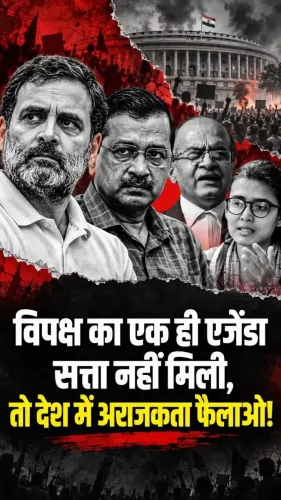
Posting in Hindi, Singh wrote: 'Betiyon ke utpeedan par aankhen moondkar deshdroah ke aaropiyon par aseem prem lutaane ki inki rajneeti bhala kisse chhupi hai!' — 'Their politics of closing eyes to the oppression of daughters while lavishing boundless love on those accused of sedition is hardly hidden from anyone!' He added that the public can see clearly, and that an entire party has now become a brigade of the so-called 'tukde-tukde gang'.
What 'tukde-tukde gang' means — and why it still draws blood
The phrase 'tukde-tukde gang' — loosely meaning 'break-India gang' — first entered the political lexicon after the 2016 JNU campus protests, when students were accused of raising anti-national slogans and several faced sedition charges. BJP leaders adopted the phrase to describe critics they characterised as sympathetic to those accused of sedition, and it has remained a potent rhetorical weapon in the party's arsenal ever since.
Singh's post pairs that national-security frame with women's safety — a combination BJP leaders have used repeatedly to question rival parties' moral and nationalist credentials simultaneously. The twin charge is deliberate: it casts the target as both anti-national and indifferent to gender-based crime, two issues that cut deep with broad voter constituencies.
A pattern of partisan pressure, with no names named
Notably, Singh's post names neither the specific party, nor any individual, nor any particular incident of either sedition or women's oppression. The statement draws its charge from implication and accumulated political memory rather than a specific, verifiable event — a tactic that keeps the message circulating across social media without anchoring it to a falsifiable claim.
This approach fits a sustained BJP strategy visible across periods of heightened electoral competition: frame opposition parties as simultaneously weak on national security and indifferent to crimes against women, forcing rivals onto the defensive on both fronts at once. Opposition parties have consistently rejected the 'tukde-tukde' label as a smear designed to silence legitimate dissent.
With responses from targeted parties and further statements from other BJP leaders likely to follow, this salvo signals the temperature of political discourse is running high — and that the battle over who truly stands for India's daughters and India's integrity is far from settled.
Point of View
Suggesting competitive political pressure is building. The opposition's counter-response — and whether it engages the substance or rejects the label — will shape the next cycle of this recurring battle over who owns the narratives of national security and women's dignity.
NationPress
12 Nov 2026
Frequently Asked Questions
What did Giriraj Singh say about the tukde-tukde gang?
On 12 November 2026 , Singh accused an unnamed opposition party of ignoring violence against women while defending those charged with sedition, and said the entire party has become a brigade of the so-called 'tukde-tukde gang'.
What does tukde-tukde gang mean?
The phrase 'tukde-tukde gang' translates roughly as 'break-India gang.' It entered political usage after the 2016 JNU protests and has since been used by BJP leaders to describe those they accuse of sympathising with anti-national elements or sedition accused.
Which party did Giriraj Singh target in his post?
Singh did not name any specific party, individual, or incident in his post, leaving the target defined by political implication rather than explicit identification.
Why does BJP combine women's safety with the sedition issue?
BJP leaders have used this twin framing to simultaneously challenge opposition credibility on national security and gender-based crime — two issues with broad voter resonance — forcing rivals onto the defensive on both fronts at once.
Who is Giriraj Singh?
Giriraj Singh is India's Union Minister of Textiles , a senior BJP leader, and Lok Sabha MP from Begusarai, Bihar , known for outspoken positions on political and social issues.