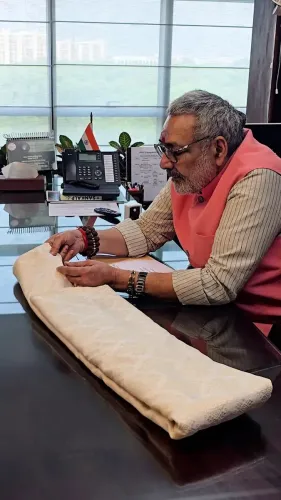
Giriraj Singh: Jan Vishwas Act 2026 boosts silk sector ease of doing business
Synopsis
Union Textiles Minister Giriraj Singh has highlighted the Jan Vishwas Act 2026 as a key ease-of-doing-business reform for India's silk sector, replacing imprisonment for minor regulatory violations with warnings and administrative penalties to create a simpler, more business-friendly environment.
Key Takeaways
The Jan Vishwas Act 2026 extends decriminalisation of minor regulatory violations to India's silk industry.
Imprisonment for small compliance lapses will be replaced by warnings and administrative penalties .
The reform follows the Jan Vishwas (Amendment of Provisions) Act, 2023 , which had already amended 42 central laws on the same principle.
Union Textiles Minister Giriraj Singh described the change as making the system 'simpler, more transparent, and business-friendly.' Primary beneficiaries include silk-sector MSMEs, small weavers, sericulture farmers, and textile exporters .
Specific rules for the silk sector under the 2026 Act are yet to be notified.
Imprisonment for a paperwork lapse. That was once a real risk for a small silk weaver or sericulture entrepreneur who tripped over a minor regulatory technicality — until Union Textiles Minister Giriraj Singh flagged on Thursday, 12 November 2026 that the Jan Vishwas Act 2026 is changing that reality for India's silk industry.
Posting on X in Hindi, the Minister described the legislation as an important reform strengthening Ease of Doing Business in the resham udyog (silk industry). His post stated: 'Replacing imprisonment for minor regulatory violations with warnings and administrative penalties helps ensure a simpler, more transparent, and business-friendly system for the industry.'
Decriminalisation that follows a proven blueprint
The Jan Vishwas Act 2026 builds directly on the Jan Vishwas (Amendment of Provisions) Act, 2023, which amended 42 central laws to substitute imprisonment for minor offences with monetary penalties or warnings. That earlier legislation was itself part of a wider, multi-year government push to strip criminal liability from technical and procedural lapses across sectors — a move aimed squarely at reducing compliance costs for businesses and improving India's investment climate.
Extending that logic to the silk sector is significant. India is one of the world's largest producers and consumers of silk, and the industry is dominated by MSMEs, small weavers, and sericulture farmers — most of them in states like Karnataka, West Bengal, Andhra Pradesh, and Assam. For these operators, the threat of criminal prosecution for a technical compliance miss was a disproportionate deterrent. Administrative penalties carry a sting without the existential fear of a jail term.
What changes on the ground for silk industry players
Under the new framework, minor regulatory violations that previously carried the risk of criminal proceedings will now attract a warning or a financial penalty instead. This directly lowers the legal risk faced by small silk manufacturers, processors, and exporters who navigate multiple licensing and compliance requirements. A less adversarial regulatory relationship, in theory, also frees up enforcement resources to focus on genuinely serious infractions.
Textile exporters stand to benefit as well. India's silk exports are price-sensitive and compete with Chinese and Vietnamese products. Any reduction in domestic compliance friction — and the litigation costs that accompany it — marginally improves the competitiveness of Indian silk on global markets.
The specific rules for the silk sector under the 2026 Act are yet to be notified and watched closely by industry bodies. How broadly 'minor violations' are defined will determine how much practical relief reaches the loom floor. That detail will be the real measure of this reform's reach.
Point of View
Amplifying this reform publicly signals the Textiles Ministry's intent to position the sector as MSME-friendly ahead of potential export policy revisions. The real test will be in the rule-making — how broadly 'minor violations' are defined will determine whether the relief is substantive or symbolic. If implemented robustly, it could modestly shift India's competitiveness narrative against dominant silk producers in East and Southeast Asia.
NationPress
12 Nov 2026
Frequently Asked Questions
What is the Jan Vishwas Act 2026?
The Jan Vishwas Act 2026 is a central legislation that extends decriminalisation of minor regulatory violations to strengthen ease of doing business, replacing imprisonment for small compliance lapses with warnings and administrative penalties across sectors including the silk industry.
How does the Jan Vishwas Act 2026 affect the silk industry?
Silk industry players — including small weavers, sericulture farmers, and exporters — will no longer face the risk of imprisonment for minor regulatory or procedural violations; they will instead receive warnings or monetary penalties, reducing compliance fear and legal costs.
What was the Jan Vishwas Act 2023?
The Jan Vishwas (Amendment of Provisions) Act, 2023 amended 42 central laws to replace criminal imprisonment for minor offences with penalties or warnings. The 2026 Act builds on this framework and extends it further.
Who benefits most from decriminalising silk industry regulations?
MSMEs, small-scale silk weavers, sericulture farmers, and textile exporters benefit most, as they are most exposed to minor technical compliance risks and least equipped to handle criminal proceedings.
What is Giriraj Singh's role in textiles policy?
Giriraj Singh is the Union Minister of Textiles and a senior BJP leader representing Begusarai, Bihar in the Lok Sabha. He oversees policy for India's entire textiles sector, including silk, cotton, and technical textiles.