Bhupender Yadav Invites Citizens to Send Feedback Openly
Synopsis
Union Environment Minister Bhupender Yadav has posted an open appeal on X, urging citizens to write to him without hesitation about what governance improvements are still needed, branding the current government a 'dost sarkar' — a friendly, accessible administration.
Key Takeaways
Union Environment Minister Bhupender Yadav posted an open public-feedback appeal on 19 November 2026 .
He described the government as a 'dost sarkar' (friendly government), contrasting it with an unnamed 'old government.' Citizens were invited to write to him openly and without hesitation about improvements still needed.
The post carries no specific programme, deadline, or ministry focus — the appeal is broadly open-ended.
Direct social-media feedback outreach has been a recurring BJP communication strategy since 2014 .
Any follow-up policy action by the Ministry of Environment, Forest and Climate Change will be the credibility test for this appeal.
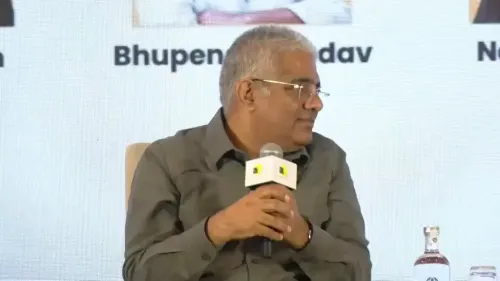
A minister asking the public to write to him — without hesitation, without holding back — is either a genuine call for accountability or a well-worn political gesture. Union Environment Minister Bhupender Yadav put that question squarely on the table on Thursday, 19 November 2026, when he posted a direct appeal to citizens on X, telling them this government considers itself a friend and means to act like one.
Yadav's post, written in Hindi, reads: 'Yeh purani sarkar nahin hai, yeh dost sarkar hai. Yeh dosti nibhana jaanti hai aur aap mere sachche dost hain. Isliye bina sankoch, bina jhijhak, mujhe khulkar likhkar bheijie ki abhi bhi kya sudhar zaroori hai.' In plain English: 'This is not the old government, this is a friendly government. It knows how to honour friendship and you are my true friends. So without any hesitation, write to me openly about what improvements are still needed.'
The 'Dost Sarkar' pitch and what it signals
The framing is deliberate. By invoking the word dost (friend) repeatedly, Yadav is drawing a sharp contrast — implicitly positioning the current dispensation against an older, more distant style of governance. The BJP-led central government has leaned on direct social-media outreach since 2014 as a signature tool: ministers soliciting feedback, sharing progress, and creating the impression of a two-way channel between elected officials and voters.
The appeal carries an open-ended brief. Yadav does not specify a ministry programme, a region, or a deadline — the invitation is wide, asking citizens to flag 'whatever improvements are still needed.' That breadth can be a strength (low barrier to participation) or a weakness (harder to convert into actionable policy response).
Environment ministry: the feedback context
As Minister of Environment, Forest and Climate Change, Yadav oversees a portfolio that touches millions of lives — from forest-rights communities and industrial clearance timelines to air-quality norms and climate commitments. Public feedback in this space tends to cluster around on-ground grievances: delays in green clearances, encroachment on forest land, inadequate local consultation. Any follow-up announcements from the ministry on feedback received — or resulting policy adjustments — will be the real test of whether this post is a conversation starter or a performance.
The appeal carries modest urgency but clear political intent: it is a minister planting a flag of accessibility ahead of whatever comes next on his agenda. The inbox, he is saying, is open. What fills it — and what changes as a result — is the story worth watching.
Point of View
Not lectures. As a senior minister overseeing a portfolio with high public stakes (green clearances, forest rights, air quality), the open feedback call also serves as a soft reset, signalling responsiveness ahead of potential policy announcements. The absence of any specific programme or mechanism for collecting feedback, however, leaves the gesture open to criticism as performative rather than procedural. Its real weight will be measured only if the ministry demonstrably acts on what it receives.
NationPress
19 Nov 2026
Frequently Asked Questions
What did Bhupender Yadav post on X on 19 November 2026?
He posted an open appeal in Hindi inviting citizens to write to him freely about what governance or policy improvements are still needed, calling the government a 'dost sarkar' — a friendly government that knows how to honour its bonds with the public.
What does 'dost sarkar' mean?
'Dost sarkar' is Hindi for 'friendly government.' Yadav used the phrase to contrast the current administration with what he called the 'old government,' framing the BJP-led government as accessible and responsive.
How can citizens send feedback to Bhupender Yadav?
Yadav's post invites citizens to write to him directly, though no specific email address, portal, or formal channel was mentioned in the post. The appeal was made via his official X account @byadavbjp.
Is this kind of public feedback outreach common in Indian politics?
Yes. The BJP-led central government has used direct social-media outreach to solicit public feedback since 2014, with ministers regularly posting appeals for citizen input on governance and service delivery.
What areas does the Ministry of Environment, Forest and Climate Change handle?
The ministry oversees environmental clearances for infrastructure and industry, forest rights and land use, air and water quality regulation, wildlife protection, and India's international climate commitments.