Pralhad Joshi Addresses IIT Delhi-Abu Dhabi's First Convocation

Synopsis
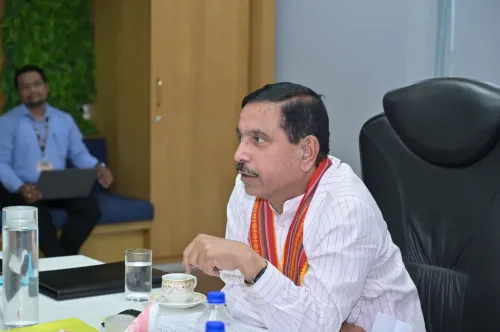
Union Minister Pralhad Joshi addressed the inaugural convocation of IIT Delhi-Abu Dhabi on 19 November 2026, calling the campus a symbol of PM Modi's NEP 2020 vision for global Indian education. He congratulated graduates and invoked 'Vasudhaiva Kutumbakam' as a guiding principle.
Key Takeaways
IIT Delhi-Abu Dhabi held its first-ever convocation on 19 November 2026 in Abu Dhabi.
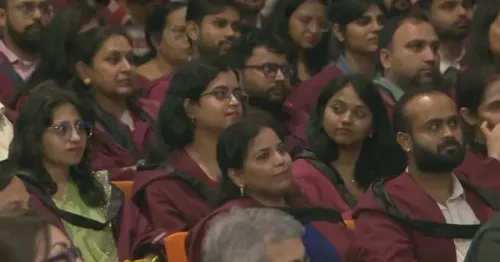
Union Minister Pralhad Joshi addressed the ceremony, congratulating the Class of 2026 .
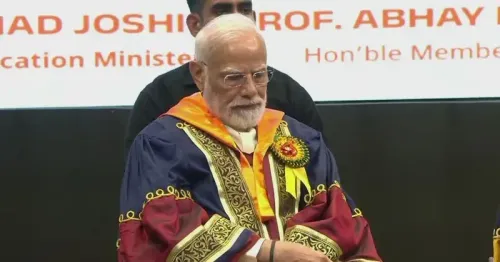
Harish Salve , Chairman of the Board of Governors of IIT Delhi, was present at the event.
The campus is backed by Abu Dhabi Department of Education and Knowledge (ADEK) and Tamkeen , with both acknowledged by the Minister.
Joshi linked the campus directly to National Education Policy 2020 and PM Modi's vision of internationalising Indian higher education.
Graduates were urged to become global citizens guided by the Indian principle of Vasudhaiva Kutumbakam — 'the world is one family'.
History was made in Abu Dhabi on Thursday, 19 November 2026, as IIT Delhi-Abu Dhabi held its very first convocation — a milestone that marks India's most prestigious technical institution planting a permanent academic flag on foreign soil. Union Minister Pralhad Joshi addressed the ceremony, congratulating the Class of 2026 and urging them to carry forward IIT Delhi's legacy of innovation and excellence onto the world stage.
Speaking at the ceremony alongside Harish Salve, Chairman of the Board of Governors of IIT Delhi, India's Ambassador to the UAE, and Smt. Reema Al Mokarrab, Joshi framed the occasion not merely as an academic milestone but as a living symbol of Prime Minister Narendra Modi's vision for internationalising Indian education under the National Education Policy 2020. 'IIT Delhi-Abu Dhabi is a symbol of taking India's educational institutions to the global level,' the Minister said, invoking NEP 2020 as the policy backbone enabling such cross-border campuses.
India's Technical Excellence Goes Global Under NEP 2020
IIT Delhi-Abu Dhabi is one of the most visible outcomes of the National Education Policy 2020, which explicitly called for the internationalisation of India's premier higher-education institutions. The Abu Dhabi campus was established with active support from the Abu Dhabi Department of Education and Knowledge (ADEK) and Tamkeen, the UAE body that promotes skills and workforce development. Joshi extended formal thanks to both organisations, acknowledging that this bilateral education partnership would not have taken shape without their institutional backing.
The Gulf region has been a strategic focus of India's educational outreach, and the IIT Delhi-Abu Dhabi campus sits at the intersection of two priorities: strengthening the India-UAE relationship — one of South Asia's most consequential bilateral partnerships — and demonstrating that Indian academic excellence is fully exportable. The first graduating cohort crossing the stage makes that aspiration concrete and irreversible.
A Charge to the Class of 2026: 'Vasudhaiva Kutumbakam'
Joshi closed his address with a distinctly philosophical charge to the graduates, rooted in a 2,000-year-old Sanskrit principle. He urged the new engineers and technologists to use their knowledge 'for the betterment of humanity' and to march forward as global citizens guided by the values of Vasudhaiva Kutumbakam — 'the world is one family' — India's civilisational ideal that the Modi government has repeatedly placed at the centre of its foreign-policy and educational messaging.
The graduates stepping off that Abu Dhabi stage carry an IIT Delhi degree earned on foreign soil — a credential that did not exist five years ago. If the rollout of further international IIT and IIM campuses follows, this convocation may well be remembered as the moment India's higher-education revolution stopped being a promise and became a passport.
Point of View
Joshi signals that overseas IIT campuses are a political priority, not just a bureaucratic exercise. The India-UAE axis is central here: strong people-to-people ties and a large Indian diaspora make the Gulf an ideal launchpad for academic internationalisation. If this model succeeds, pressure will mount to replicate it in other regions, turning what is today a flagship pilot into a systematic export of India's higher-education excellence.
NationPress
19 Nov 2026
Frequently Asked Questions
What is IIT Delhi-Abu Dhabi and when did it start?
IIT Delhi-Abu Dhabi is an international campus of the Indian Institute of Technology Delhi, established in Abu Dhabi under India's National Education Policy 2020 to extend Indian technical education globally. It held its first convocation in November 2026.
Who attended the first IIT Delhi-Abu Dhabi convocation?
Union Minister Pralhad Joshi addressed the convocation. Senior advocate and IIT Delhi Board of Governors Chairman Harish Salve, India's Ambassador to the UAE, and Smt. Reema Al Mokarrab were also present among other dignitaries.
What role does NEP 2020 play in IIT's overseas expansion?
The National Education Policy 2020 explicitly promotes the internationalisation of India's premier higher-education institutions, providing the policy framework under which IIT Delhi established its Abu Dhabi campus.
Which UAE organisations supported the IIT Delhi-Abu Dhabi campus?
The Abu Dhabi Department of Education and Knowledge (ADEK) and Tamkeen, a UAE body promoting skills development, were key institutional partners in establishing the IIT Delhi-Abu Dhabi campus.
What is 'Vasudhaiva Kutumbakam' and why did Joshi mention it?
'Vasudhaiva Kutumbakam' is a Sanskrit phrase meaning 'the world is one family.' Joshi invoked it to encourage IIT graduates to become responsible global citizens who use their knowledge for the benefit of all humanity.