Smriti Irani at SGT University: India Must Lead AI, Quantum Era

Synopsis
BJP leader Smriti Irani inaugurated Synergy Tech Fest 2026 at SGT University, Gurugram, calling on students to drive indigenous breakthroughs in AI, quantum computing, semiconductors, robotics, and space technology — framing the next generation as architects, not just participants, of India's tech future.
Key Takeaways
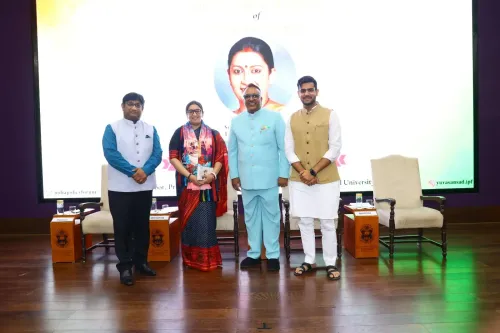
Smriti Irani addressed the inauguration of Synergy Tech Fest 2026 – Student Edition at SGT University, Gurugram on 19 November 2026 .
She highlighted India's expanding capabilities in artificial intelligence, quantum computing, semiconductors, robotics, and space technology .
Irani emphasised building indigenous capabilities , connecting to the broader Atmanirbhar Bharat policy framework.
She called on students to question established assumptions and connect knowledge across disciplines rather than specialise narrowly.
Her address tracks a policy arc from Make in India (2014) through the National AI Strategy (2018) to the India Semiconductor Mission (2021) .
The convergence of technology, science and entrepreneurship was framed as India's core competitive edge for the next wave of global innovation.
India's next technological leap will not be borrowed — it must be built. BJP leader Smriti Irani delivered that message with force on Thursday, 19 November 2026, addressing the inauguration of Synergy Tech Fest 2026 – Student Edition at SGT University, Gurugram, urging young innovators to stop watching the global tech revolution from the sidelines and start steering it.
The Gurugram stage and what Irani told students
Speaking to a hall of engineering and technology students in one of India's most dynamic tech corridors, Irani mapped the five frontiers she sees defining the next decade: artificial intelligence, quantum computing, semiconductors, robotics, and space technology. The ask was not modest — she called on students to 'question established assumptions, connect knowledge across disciplines and transform curiosity into innovation.'
The core argument was pointed: participation in a technological revolution is not enough. India must aspire to shape its direction. That framing places a generational responsibility squarely on the students in the room.
Indigenous capability — the thread running through India's tech policy
Irani's emphasis on 'building indigenous capabilities' did not emerge in a vacuum. It tracks a decade-long policy arc. The Make in India initiative, launched in 2014, first signalled the government's intent to shift India from a technology consumer to a producer. NITI Aayog's National Strategy for Artificial Intelligence, released in 2018, laid out a roadmap for AI-led growth. Then, in 2021, the India Semiconductor Mission took the most concrete step yet — committing state resources to building domestic chip design and manufacturing capacity from the ground up.
Gurugram itself is a fitting backdrop for this conversation: the city anchors a dense cluster of IT firms, start-ups, and research labs in the National Capital Region, giving students here a front-row seat to exactly the ecosystem Irani was describing.
Convergence as the new competitive edge
What distinguished Irani's address from standard tech-optimism boilerplate was the stress on convergence — the intersection of technology, science, and entrepreneurship as the real engine of breakthrough. That is a sharper point than it sounds. India's historic strength in software services was largely siloed; the next wave — quantum-AI hybrids, semiconductor-embedded robotics, space-linked data infrastructure — demands researchers who move fluidly across disciplines.
Her call to 'connect knowledge across disciplines' is, in effect, a critique of narrow specialisation and a pitch for the kind of systems-thinking that produces founders, not just engineers.
What students — and policymakers — will be watching next
The road from inspiration to institution runs through execution. Approved semiconductor fabs, quantum technology parks, and student innovation challenges backed by ministry funding are the tangible checkpoints that will determine whether speeches like this one translate into the ecosystem Irani envisioned. The students who filed out of SGT University on 19 November 2026 will be the ones who find out.
India has drawn the map. Now it needs the builders.
Point of View
Quantum, semiconductors — she anchors a broad ideological message in concrete policy deliverables, making the government's tech investments legible to young voters. The choice of Gurugram, India's most visible private-sector tech hub, reinforces the message that indigenous capability and market dynamism are complementary, not competing, goals. Whether the speech translates into measurable student-innovation pipelines will be the real test of the convergence thesis she espoused.
NationPress
19 Nov 2026
Frequently Asked Questions
What did Smriti Irani say at SGT University Gurugram in 2026?
Smriti Irani inaugurated Synergy Tech Fest 2026 at SGT University on 19 November 2026, calling on students to build indigenous capabilities in AI, quantum computing, semiconductors, robotics, and space technology, and urging them to shape — not merely participate in — the global technological revolution.
What is SGT University in Gurugram?
SGT University is a private university located in Gurugram, Haryana, offering engineering and technology programmes and hosting student-focused tech and innovation events.
What is India's policy on semiconductor and AI development?
India established the Make in India initiative in 2014, released a National Strategy for Artificial Intelligence through NITI Aayog in 2018, and launched the India Semiconductor Mission in 2021 to build domestic chip design and manufacturing capabilities.
What is Atmanirbhar Bharat and how does it relate to technology?
Atmanirbhar Bharat, meaning self-reliant India, is a government policy framework that seeks domestic self-sufficiency across sectors including frontier technologies such as AI, quantum computing, and semiconductors, reducing dependence on foreign supply chains.
Why is Gurugram significant for India's technology sector?
Gurugram is a major city in the National Capital Region and hosts a dense cluster of IT firms, start-ups, and research organisations, making it one of India's most active hubs for emerging technology and entrepreneurship.