Smriti Irani at StratosIndiaForum: India Shaping Global Order
Synopsis
BJP leader Smriti Irani addressed the StratosIndiaForum in Mumbai, co-hosted by Bain and Company and Cambridge Judge Business School, arguing that India's blend of democratic values, technological innovation and strategic autonomy positions it to help shape — not merely navigate — a contested global order.
Key Takeaways
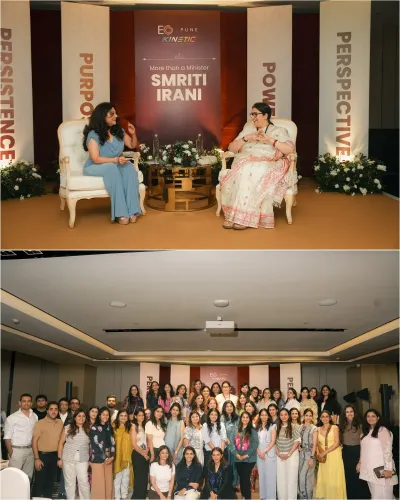
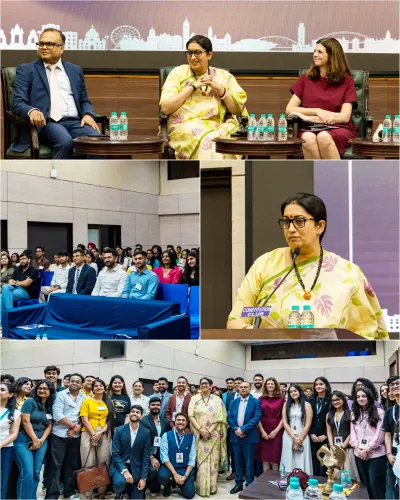
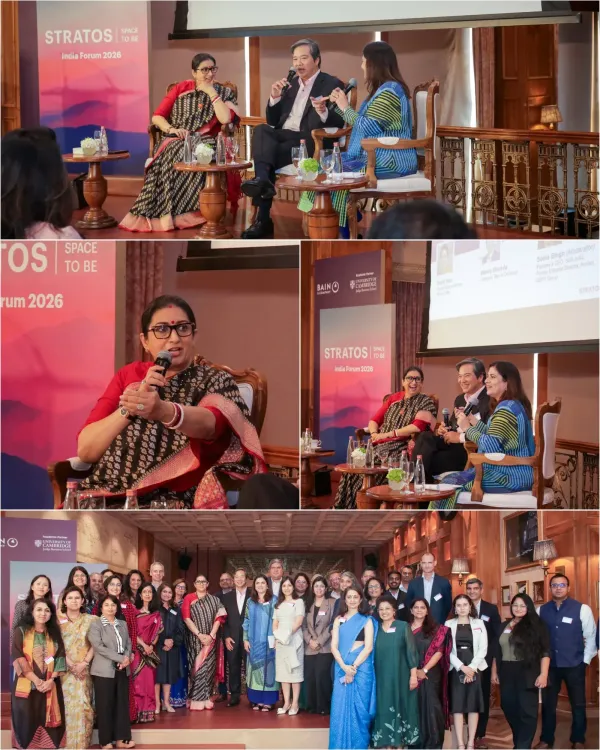
BJP leader Smriti Irani spoke at the StratosIndiaForum in Mumbai on 25 July 2026 on the theme 'Geopolitics: Sovereignty in a Contested World.' The forum was co-hosted by Bain and Company and Cambridge Judge Business School , targeting senior policymakers, investors and executives.
Irani argued India uniquely combines democratic values , technological innovation , strategic autonomy and responsible global leadership .
Her remarks align with India's policy lineage: the 2023 G20 presidency , the 2020 Atmanirbhar Bharat initiative, and the 2018 National AI Strategy .
Irani called for building a global order that is 'more resilient, more trusted, more prosperous and more inclusive.' India's upcoming positions at multilateral AI and technology governance forums will be the next indicator of how these ambitions translate into policy.
BJP leader and former Union Minister Smriti Irani addressed the StratosIndiaForum in Mumbai on Friday, 25 July 2026, speaking on the theme 'Geopolitics: Sovereignty in a Contested World' at an event hosted by Bain and Company in partnership with Cambridge Judge Business School. Irani argued that the central challenge of the era is no longer merely responding to change but actively shaping it, positioning India as a nation uniquely equipped to do so.
Context
Irani's remarks came at a Mumbai forum that brought together policymakers and business leaders to examine how deepening geopolitical fault lines, the rapid advance of artificial intelligence, and shifting centres of capital are redrawing the map of global power. Speaking at the intersection of technology and statecraft, she framed the moment as one demanding institutional courage to challenge long-held assumptions. 'In an era of profound disruption, resilience will belong to those who can adapt without compromising the values that define them,' she said.
The forum, co-hosted by global management consulting firm Bain and Company and Cambridge Judge Business School, the business school of the University of Cambridge, focused on sovereignty, AI governance, and the evolving architecture of international economic relationships — themes that have moved to the centre of India's foreign-policy conversation in recent years.
Policy Backdrop
Irani's address drew on a policy lineage stretching back several years. India's 2023 G20 presidency placed multi-alignment and inclusive global governance at the heart of its international agenda, while the Atmanirbhar Bharat initiative, launched in 2020, articulated a pursuit of strategic autonomy alongside international economic integration. India's 2018 National Strategy for Artificial Intelligence had already flagged responsible technology adoption as a pillar of national development.
Together, these policy anchors underpin the argument Irani advanced at the forum: that India can combine democratic values with technological innovation, strategic autonomy with trusted global partnerships, and economic ambition with responsible leadership. This formulation reflects India's sustained effort to present itself as a bridge between competing global blocs rather than a client of any single power centre.
Stakeholders and Impact
The audience at a Bain-Cambridge forum typically comprises senior executives, investors, and policymakers — precisely the constituencies whose capital allocation and regulatory decisions shape the technology and trade corridors India is seeking to attract. Irani's framing of India as 'not merely adapting to a changing world, but helping shape it' is aimed squarely at this audience, signalling political will behind the country's ambitions in AI, manufacturing, and global governance.
For the technology industry, the remarks reinforce the signal that India intends to be an active rule-setter in emerging AI governance frameworks rather than a rule-taker. For multilateral institutions, they restate India's preference for a global order that is, in Irani's words, 'more resilient, more trusted, more prosperous and more inclusive' — language consistent with India's positions at forums from the United Nations to the QUAD and BRICS.
What's Next
India's positions at upcoming multilateral technology and AI governance meetings will be the next test of whether the aspirations Irani articulated translate into concrete negotiating stances. Potential updates to national AI regulations and new bilateral technology agreements are among the policy instruments being watched by analysts tracking India's role in shaping the emerging digital order.
As geopolitical competition over technology standards and supply chains intensifies, the framing on display at the StratosIndiaForum suggests that senior BJP voices intend to keep India's claim to rule-shaper status — rather than rule-taker — at the centre of the country's international narrative.
Point of View
Sovereignty, strategic autonomy — mirrors the exact fault lines along which India is currently negotiating bilateral technology agreements and multilateral AI governance frameworks. By invoking values-based adaptation alongside economic ambition, Irani is threading a needle between Western liberal-order rhetoric and the Global South's demand for a more equitable international architecture. The address is less a policy announcement than a positioning statement, but in the current geopolitical environment, such framing exercises carry real diplomatic weight.
NationPress
23 Oct 2026
Frequently Asked Questions
What did Smriti Irani say at the StratosIndiaForum?
Smriti Irani said the defining challenge of the era is to shape change rather than merely respond to it, and argued that India is uniquely positioned to help build a global order that is more resilient, trusted, prosperous and inclusive by combining democratic values with technological innovation and strategic autonomy with global partnerships.
What is the StratosIndiaForum?
The StratosIndiaForum is a Mumbai-based forum focused on geopolitics, sovereignty, artificial intelligence and global economic shifts, co-hosted by management consulting firm Bain and Company in partnership with Cambridge Judge Business School.
What is India's foreign policy stance on strategic autonomy?
India has maintained a multi-alignment approach, engaging simultaneously with Western institutions, QUAD partners and BRICS nations. This posture, articulated through the 2020 Atmanirbhar Bharat initiative and reinforced during the 2023 G20 presidency, seeks strategic autonomy alongside selective technology and trade partnerships.
How does India plan to shape AI governance globally?
India's 2018 National Strategy for Artificial Intelligence flagged responsible technology adoption as a pillar of national development. Senior political figures, including Smriti Irani, have signalled that India intends to be an active rule-setter in emerging AI governance frameworks rather than simply adopting standards set by others.
Why is India described as uniquely positioned in geopolitics right now?
Analysts point to India's large democratic mandate, its growing technological capacity, its role as a bridge between the Global North and Global South, and its consistent multi-alignment foreign policy as factors that give it unusual leverage at a moment when AI, supply chains and capital flows are being restructured globally.