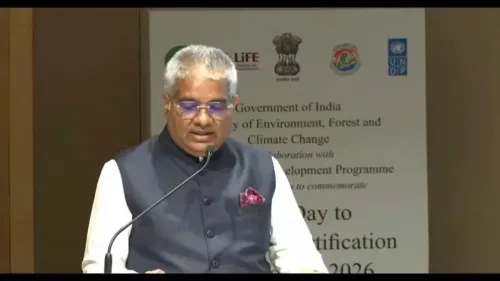
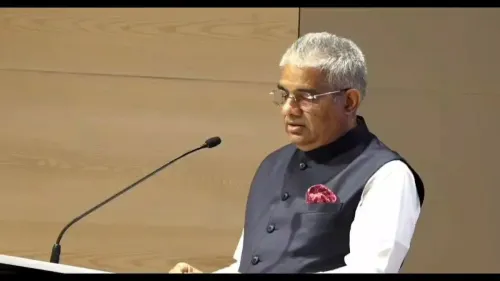
Bhupender Yadav: 'Nation First' is India's guiding mantra

Synopsis
Union Environment Minister Bhupender Yadav on 22 June 2026 posted that the world recognises 'Nation First' as India's supreme governing mantra, reiterating a core BJP ideological position that underpins India's domestic policy and international negotiating stance.
Key Takeaways
Bhupender Yadav , Union Minister of Environment, Forest and Climate Change, posted on 22 June 2026 that 'Nation First' is India's greatest guiding mantra.
The minister stated that every country in the world clearly understands this to be India's defining principle.
The assertion aligns with the BJP government's established ideological framework, including the Atmanirbhar Bharat initiative launched in May 2020 .
India's Paris Agreement submissions and COP positions have consistently foregrounded national development priorities over uniform global mandates.
No specific new policy or event was cited as the trigger for the post; it reflects a standing party-wide governance philosophy.
Upcoming COP meetings and bilateral climate talks will be key forums to watch for this principle being applied as a negotiating red line.
Union Environment Minister Bhupender Yadav on Monday, 22 June 2026 reaffirmed that the principle of 'Nation First' remains the defining philosophy of contemporary Indian governance, posting his assertion on X to a wide national audience.
Writing in Hindi, the minister stated: 'दुनिया का हर देश इस बात को भलीभांति समझता हैं कि आज के भारत के लिए नेशन फर्स्ट ही सबसे बड़ा मंत्र हैं।' — ('Every country in the world clearly understands that for today's India, Nation First is the greatest guiding mantra.') The statement carries no reference to a specific event or policy trigger but is framed as a settled, universally acknowledged truth about India's current posture.
Context
Bhupender Yadav has served as Union Minister of Environment, Forest and Climate Change since July 2021 and is a senior BJP leader from Rajasthan. His portfolio places him at the intersection of domestic development priorities and international climate commitments — precisely the arena where the 'Nation First' framing carries the most operational weight. The post, though brief, reflects a well-established ideological line that the ruling party has consistently articulated since coming to power in 2014.
Policy Backdrop
The 'Nation First' doctrine has concrete policy antecedents. Prime Minister Narendra Modi's Atmanirbhar Bharat initiative, announced in May 2020, explicitly positioned national economic sovereignty as the central organising principle of India's post-pandemic recovery strategy. On the global stage, India's submissions to the Paris Agreement in 2015 and its subsequent positions at COP negotiations have consistently stressed differentiated national responsibilities — the argument that developing nations must retain the right to prioritise growth even as they pursue climate goals.
Successive governments under the BJP have advanced a governance narrative that places national interest above uniform multilateral mandates, whether in trade, security, or environmental regulation. Yadav's post reiterates this established ideological position without announcing any new policy measure.
Stakeholders and Impact
The statement resonates across two distinct audiences. Domestically, it reinforces a political message to Indian citizens that the government's decisions — on subsidies, industrial policy, or emissions timelines — are calibrated first by national need. For the diplomatic community, it signals continuity in India's negotiating posture: that New Delhi will engage multilateral forums on its own terms.
This framing has practical implications for upcoming climate and trade talks. Countries and blocs seeking India's alignment on binding global commitments will read such statements as a reminder that India treats national development imperatives as non-negotiable red lines in any negotiation.
What's Next
Observers will watch India's interventions at forthcoming COP sessions and bilateral climate or trade dialogues for explicit invocations of this 'Nation First' principle as a justification for specific positions. As the minister responsible for both forest conservation and India's international climate obligations, Yadav's rhetorical framing today may foreshadow the negotiating posture India adopts in those high-stakes settings. The consistency of this messaging across BJP leadership suggests it will remain a durable feature of India's domestic and foreign-policy communication.
Point of View
The minister frames national-interest arguments as globally legitimised rather than parochial. This rhetorical move is particularly significant coming from the environment minister, whose portfolio is most exposed to international pressure on climate commitments. The timing ahead of upcoming multilateral engagements suggests the statement may serve as a calibrated signal to both domestic audiences and diplomatic interlocutors.
NationPress
23 Jun 2026
Frequently Asked Questions
What did Bhupender Yadav say about Nation First?
Bhupender Yadav stated on 22 June 2026 that every country in the world clearly understands that 'Nation First' is the greatest guiding mantra for today's India.
What is the Nation First policy in India?
'Nation First' is the BJP government's governing philosophy that prioritises India's national interests — in economic, security, and environmental policy — over uniform multilateral mandates. It underpins initiatives like Atmanirbhar Bharat and India's differentiated stance in climate negotiations.
Who is Bhupender Yadav?
Bhupender Yadav is India's Union Minister of Environment, Forest and Climate Change since July 2021 and a senior BJP leader from Rajasthan. He represents India in major international climate forums including COP summits.
How does India's Nation First approach affect climate negotiations?
India uses a national-interest framework to argue for differentiated responsibilities in climate talks, insisting that developing nations must retain policy space for economic growth. This shapes India's positions at COP meetings and in bilateral environmental agreements.
What is Atmanirbhar Bharat and how does it relate to Nation First?
Atmanirbhar Bharat, launched in May 2020, is Prime Minister Narendra Modi's self-reliance initiative that places national economic sovereignty at the centre of policy. It is widely regarded as the most concrete policy expression of the 'Nation First' philosophy.